Essentials
Currency, language, transit & safety — tap to expand.
Currency — Asia spans 40+ currencies — no single tender. Major ones: Japanese Yen (¥), Chinese Yuan (¥/CNY), Indian Rupee (₹), Thai Baht (฿), Indonesian Rupiah (Rp), Singapore Dollar (S$), South Korean Won (₩). Rates fluctuate — check XE before you fly. [ASSUMPTION] Rough anchors: 1 USD ≈ 150 JPY, 7 CNY, 83 INR, 35 THB, 15,800 IDR.
Cash vs card — Wildly varies. Japan and South Korea still lean cash for small vendors but card-friendly in cities. China is mobile-pay first (WeChat Pay, Alipay) — foreign cards now linkable but bring cash backup. Southeast Asia (Thailand, Vietnam, Indonesia, Cambodia) is cash-heavy outside hotels and malls. Singapore, Hong Kong, Taiwan: cards everywhere. ATMs widespread in cities; rural areas can be dry. Tipping is NOT customary in Japan, Korea, China — can offend. 10% standard in Indian restaurants, Thailand and Vietnam appreciate rounding up. Always carry small bills for taxis, temples, street food.
Budget — Huge spread by country. Budget: $25–50/day SE Asia (Vietnam, Cambodia, Indonesia), $80–120/day Japan/Korea/Singapore. Mid-range: $80–150 SE Asia, $200–350 NE Asia. Luxury: $300+ SE Asia, $600+ Japan/Singapore/Hong Kong.
Language — No single lingua franca. Mandarin (China, Taiwan, Singapore), Japanese, Korean, Hindi/English (India), Thai, Vietnamese, Bahasa (Indonesia/Malaysia), Tagalog (Philippines). English is co-official in India, Singapore, Philippines.
Language barrier — Singapore, Philippines, India, Hong Kong, Malaysia: high English fluency, easy travel. Japan, South Korea, Taiwan: signage and transit are bilingual in cities, but conversation outside tourist zones is limited — Google Translate camera mode is essential. China, Vietnam, Thailand, Indonesia, Cambodia, Laos: minimal English outside hotels and tourist hubs. Download offline language packs before arrival.
Getting around — Asia has the best public transit on the planet — and some of the worst traffic. In Japan, Korea, Taiwan, Singapore, Hong Kong: trains beat taxis every time. In Bangkok, Jakarta, Manila, Ho Chi Minh City: ride-hailing apps (Grab, Gojek) are non-negotiable — metered taxis often scam or refuse. India: prebook trains weeks ahead on IRCTC; use Uber/Ola in cities. Rural Southeast Asia still runs on scooters, tuk-tuks, and negotiation.
Safety — Asia is broadly safer than Western travellers expect — violent crime is rare in most major destinations. Real risks: motorbike accidents (leading cause of tourist death in Vietnam, Thailand, Bali — wear a helmet, check your travel insurance covers scooters and that you have the correct licence), dengue and malaria in tropical zones (repellent with DEET, not just citronella), air quality in Delhi/Beijing/Jakarta/Hanoi (check AQI, pack N95s in winter), tap water unsafe in most of South and Southeast Asia (bottled or filtered only — including for brushing teeth). Scams: gem shops and 'closed temple' tuk-tuk detours in Bangkok, tea ceremony scams in Shanghai/Beijing, taxi meter dodges in Hanoi and Saigon, fake monks asking for donations. Solo female travel is generally fine in Japan, Korea, Taiwan, Singapore, Vietnam; exercise more caution in parts of India and after dark in any unfamiliar area. LGBTQ+ travellers: legal landscape varies sharply — Taiwan and Thailand are welcoming, Malaysia/Indonesia/Brunei are not. Earthquake and typhoon zones (Japan, Philippines, Taiwan, Indonesia) — know your hotel's evacuation route.
Highlights
Asia isn't one trip — it's forty-something countries stitched together by monsoons, mega-cities, and food cultures that reward curiosity. You can go from neon-soaked Tokyo to silent Himalayan villages in the same week, but the real shift is mental: distances feel longer, bureaucracy varies wildly, and 'standard' Western assumptions about queues, tipping, and personal space don't transfer.
Regional identity matters more than 'Asia'
Treating East Asia (Japan, Korea, Taiwan), Southeast Asia (Thailand, Vietnam, Indonesia, Philippines), South Asia (India, Sri Lanka, Nepal), and Central Asia as one region is the fastest way to plan badly. Visa rules, payment systems, dress codes, and even power plugs differ. Pick a sub-region per trip — two countries in three weeks beats six in three weeks.
ICONIC
Visa reality in 2024–2025
Many Asian countries now offer e-visas or visa-on-arrival for most Western passports: Vietnam (e-visa, 90 days), India (e-visa via indianvisaonline.gov.in), Sri Lanka (ETA), Cambodia (e-visa), Indonesia (VOA at major airports). Japan, South Korea, Taiwan, Thailand, Malaysia, Singapore, and the Philippines are visa-free for most EU/UK/US/CA/AU passports for 30–90 days. China reintroduced 15-day visa-free transit for many nationalities in 2024 [ASSUMPTION: verify current list]. Always check 6-month passport validity and onward-ticket requirements.
BOOK AHEAD
SIM cards and connectivity
Airalo and Holafly eSIMs cover most of Asia and work the moment you land — best for short trips or multi-country routes. For longer stays, buy local: AIS or TrueMove in Thailand, Viettel in Vietnam, Jio or Airtel in India (passport + selfie required), Smart or Globe in the Philippines, Telkomsel in Indonesia. Japan and South Korea favour pocket WiFi or eSIMs (Ubigi, Sakura Mobile) since prepaid local SIMs are clunky for tourists.
PLUGIN TIP · TRANSIT-FRIENDLY
Payment apps are fragmented
Cash is still king in much of Southeast and South Asia, but super-apps dominate locally: GrabPay (SEA), GoPay/OVO (Indonesia), PromptPay (Thailand), MoMo (Vietnam), Paytm/UPI (India — foreign cards now work via select apps), Alipay/WeChat Pay Tour (China, both now accept foreign cards). Japan and Korea are surprisingly cash-friendly outside cities; Suica and T-money transit cards double as convenience-store payment. Bring a no-FX-fee debit card (Wise, Revolut) and one backup credit card.
PLUGIN TIP
Etiquette that actually matters
Shoes off indoors across most of East and Southeast Asia — temples, homes, some restaurants and guesthouses. Don't touch anyone's head (Thailand, Laos, Cambodia) or point feet at people or Buddha images. Use both hands when giving/receiving in Korea, Japan, and much of SEA. Tipping is not expected in Japan, Korea, China, or Taiwan and can offend; it's appreciated but not mandatory in Thailand, Vietnam, Indonesia. Dress modestly at religious sites — shoulders and knees covered, no exceptions at most mosques and temples.
ICONIC
Offline maps and translation
Download Google Maps offline regions before flying, but also install Maps.me for hiking and rural areas where Google data is thin. Google Translate's camera mode is essential for menus in Japan, Korea, China, Thailand — download the language pack offline. In China specifically, Google services are blocked: install a VPN (Astrill, ExpressVPN) before arrival and use Baidu Maps or Amap as backup.
PLUGIN TIP · HIDDEN GEM
The night-train and budget-flight unlock
Two systems that experienced Asia travellers exploit: overnight trains (Vietnam's Reunification line, Thailand's Bangkok–Chiang Mai sleeper, India's AC2 class, Japan's Sunrise Izumo) save a hotel night and cover distance while you sleep. And budget carriers — AirAsia, Scoot, VietJet, Cebu Pacific, IndiGo — sell one-way tickets between countries for €30–80 if booked 3–6 weeks out. Skyscanner's 'everywhere' search from a regional hub like Bangkok or Kuala Lumpur is the cheat code for open-ended routing.
BUDGET · TRANSIT-FRIENDLY · HIDDEN GEM
When to Go
November and early December is the sweet spot across most of Asia — dry, cooler, clear light, and pre-holiday pricing. For Japan specifically, late October to mid-November delivers autumn colour without sakura-level crowds. February (post-Lunar New Year) is a strong runner-up for Southeast Asia walking and food.
Cherry Blossom Season
Japan and Korea's sakura/beotkkot bloom moves north from late March through mid-April, lasting roughly a week in any given city. It's the single biggest tourism event in East Asia and shapes flight and hotel pricing for months either side.
Book accommodation 6–9 months ahead in Kyoto, Tokyo, and Seoul; expect crowds at every famous viewpoint.
Songkran & Regional New Year
Mid-April brings water-fight new year festivals across Thailand (Songkran), Laos (Pi Mai), Myanmar (Thingyan), and Cambodia (Chaul Chnam Thmey). Cities effectively shut down for 3–5 days of street celebrations.
Protect cameras and phones; transport and businesses pause, so plan stationary stays during the festival days.
Southwest Monsoon
The defining weather system for South Asia and mainland Southeast Asia, bringing afternoon downpours, lush landscapes, and dramatic skies. Intensity varies wildly by location — Kerala drenches, while Bali stays sunny.
Cheaper prices and fewer tourists, but build buffer days for flight delays, landslides, and closed trekking routes.
Typhoon Season
Tropical cyclones spin up in the western Pacific and track toward the Philippines, Taiwan, southern Japan, eastern China, and Vietnam. September is statistically the worst month for major storms.
Buy travel insurance with weather coverage and avoid tight connections through Manila, Taipei, or Hong Kong.
Autumn Colour Season (Koyo)
Japan's autumn foliage rivals sakura for beauty and is arguably better for photography — longer-lasting colour, crisp blue skies, and cooler walking weather. Peaks late October in Hokkaido, mid-November in Kyoto.
Second-busiest tourism window in Japan; book Kyoto and Nikko ryokans early but flights are cheaper than spring.
Lunar New Year
The largest annual human migration on Earth, with hundreds of millions traveling home across China, Vietnam, Taiwan, Singapore, Malaysia, and Korea. Falls on a different date each year between late January and mid-February.
Expect closures, sold-out trains, and inflated prices; book domestic transport 60+ days ahead or avoid the week entirely.
Where to Stay
Asia delivers the widest price-to-quality spread on Earth — a $30 guesthouse in Hanoi can outshine a $150 mid-range hotel in Tokyo, while luxury here often costs half what it does in Europe for double the service. The catch: shoulder-season pricing varies wildly by sub-region (monsoon vs. dry, Chinese New Year, Songkran), and the best independent properties book out 3–6 months ahead. Photographers should prioritise rooftop access and east-facing rooms for sunrise — both surprisingly rare in dense Asian cities.
Aman Tokyo
Otemachi, Tokyo
Hotel
ICONIC · PHOTO · BOOK AHEAD
The Siam Hotel
Dusit, Bangkok
Boutique Hotel
ICONIC · PHOTO · WORKSHOP SPOT
Hotel Niwa Tokyo
Kanda, Tokyo
Boutique Hotel
CENTRAL · TRANSIT-FRIENDLY
Tribe Bali Kuta Beach
Kuta, Bali
Hotel
VALUE · FAMILY
Lub d Bangkok Siam
Siam Square, Bangkok
Hostel
BUDGET · TRANSIT-FRIENDLY · SOCIAL
Mad Monkey Hostels (regional chain)
multiple — Siem Reap, Phnom Penh, Phu Quoc, Pai
Hostel
BUDGET · SOCIAL · CROWD WARNING
Hoshinoya Kyoto
Arashiyama, Kyoto
Resort
UNIQUE · SPLURGE · PHOTO · SEASONAL
Bamboo Treehouse Stays, Mae Hong Son Loop
Northern Thailand (Pai, Mae Hong Son)
Guesthouse
HIDDEN GEM · SUNRISE · PHOTO · SEASONAL
Top Attractions
№ 1 · Essential
Angkor Wat
★ ICONIC · SUNRISE · PHOTO · CROWD WARNING · GOLDEN HOUR
The largest religious monument on Earth lives up to the hype, but the sunrise crowd has become a circus. Worth every step — just plan around the mob.
Tip: Skip the famous reflecting pond at sunrise and head to Ta Prohm or Preah Khan first while everyone else is jostling for that one shot. Return to Angkor Wat itself around 9am when tour buses leave.
Best: Pre-dawn arrival (5am) for sunrise, or late afternoon 3–5pm for warm side-light on the western facade
Fees: $37 USD for 1-day pass, $62 for 3-day
Fushimi Inari Shrine, Kyoto
Ten thousand vermilion torii gates winding up a mountain — genuinely magical and completely free. The lower paths are a selfie-stick scrum; the upper trail is where it gets good.
ICONICTiger's Nest Monastery (Paro Taktsang), Bhutan
Cliffside monastery clinging to a 3,000-foot rock face — the photo everyone wants of Bhutan. The hike is real (4–6 hours round trip, altitude is the killer, not distance).
ICONICGardens by the Bay, Singapore
Yes it's touristy and yes it's worth it. The Supertree Grove light show is free and genuinely impressive; the conservatories are pricey but worth one visit for the Cloud Forest waterfall.
ICONICDay Trips
Nikko from Tokyo, Japan
Travel: 140 km / 2 hr by Tobu Limited Express
Bagan day trip from Mandalay, Myanmar
Travel: 180 km / 4 hr by car, or 30 min flight
Cameron Highlands from Kuala Lumpur, Malaysia
Travel: 200 km / 3.5–4 hr by car or bus
Lantau Island from Hong Kong
Travel: 30 km / 1 hr by MTR + cable car
Hoi An from Da Nang, Vietnam
Travel: 30 km / 45 min by taxi or Grab
Mount Bromo from Surabaya or Malang, Indonesia
Travel: 90 km from Malang / 3 hr by jeep (pre-dawn start)
Pingyao from Xi'an or Taiyuan, China
Travel: From Taiyuan: 90 km / 30 min by high-speed rail
Scenic Routes
Hakone Romancecar Route
Driving
Route: Shinjuku, Tokyo to Hakone-Yumoto
ICONIC · PHOTO · TRANSIT-FRIENDLY · BOOK AHEAD
Ha Giang Loop
Driving
Route: Ha Giang City loop, northern Vietnam
HIDDEN GEM · PHOTO · GOLDEN HOUR · SEASONAL
Tiger's Nest Monastery Trail
Hiking
Route: Ramthangkha trailhead to Paro Taktsang, Bhutan
ICONIC · PHOTO · HARD HIKE · PERMIT NEEDED
Kyoto Philosopher's Path
Walking
Route: Ginkaku-ji to Nanzen-ji, Kyoto
EASY WALK · PHOTO · SEASONAL · FREE · CROWD WARNING
Karakoram Highway
Driving
Route: Islamabad, Pakistan to Kashgar, China
ICONIC · PHOTO · PERMIT NEEDED · SEASONAL
Dragon's Backbone Rice Terraces Walk
Hiking
Route: Ping'an to Tiantouzhai, Longsheng, China
PHOTO · SUNRISE · SEASONAL · EASY WALK
Street Art
Asia's street art scene is vast and uneven, but several cities have built world-class outdoor galleries over the past 15 years. Penang (Malaysia) kicked off the modern Southeast Asian boom with Ernest Zacharevic's 2012 murals, while Hong Kong, Seoul, Taipei, and Yogyakarta have developed distinct local voices. Tokyo and Singapore are more restrained (and more sanctioned) but reward patient walkers.
George Town, Penang
The benchmark for Southeast Asian street art. Zacharevic's 'Children on a Bicycle' and 'Boy on a Motorbike' integrate real objects with painted figures. The local Sculpture at Work wrought-iron caricatures add historical context block by block.
Start Lebuh Armenian, loop via Lebuh Ah Quee, Lebuh Cannon, Lebuh Chulia
ICONIC · PHOTO · GOLDEN HOUR · EASY WALK · CROWD WARNING
Sheung Wan and Central, Hong Kong
Dense, layered, and constantly rotating. Graham Street and the stairs around PoHo have the highest concentration. Pieces get painted over fast, so anything you see online may already be gone. [ASSUMPTION] HKWalls festival pieces from recent years still dominate the inventory.
Graham Street at Hollywood Road; Tank Lane; Square Street; Bridges Street
PHOTO · TRANSIT-FRIENDLY · GOLDEN HOUR
Ihwa Mural Village, Seoul
A hillside neighborhood painted under a 2006 government revitalization project. Honest take: it's pleasant but overrated as a photo destination, and residents are visibly tired of tourists. Some famous murals like the flower stairs and angel wings were removed by locals. Go for the views and the walk, not the art alone.
Ihwa-dong, Jongno-gu; start at Hyehwa Station Exit 2, climb toward Naksan Park
EASY WALK · TRANSIT-FRIENDLY · CROWD WARNING
Jogjakarta (Yogyakarta), Java
Indonesia's most authentic and least commercialized major street art scene. Politically charged, technically strong, and tied to the city's art school culture. Taring Padi collective's woodcut-influenced work and the Jogja Mural Forum produce some of the best work in Asia.
Jalan Mangkubumi underpass; along the Code River; Tirtodipuran area; XT Square
HIDDEN GEM · PHOTO · GOLDEN HOUR
Ximending and Bopiliao, Taipei
Ximending's back alleys host a rotating young scene with strong manga and skate influences. Bopiliao Historic Block pairs preserved Qing-era shophouses with sanctioned murals, giving you texture and color in one frame.
Ximen MRT Exit 6; alleys behind Wuchang Street; Bopiliao at Guangzhou Street
PHOTO · BLUE HOUR · NIGHT SHOOT · TRANSIT-FRIENDLY
Culture & History
Asia is the world's largest and most populous continent, home to the oldest continuous civilizations, four of the world's major religions, and writing systems that predate the alphabet. Its cultural identity isn't singular — it's a vast mosaic shaped by river-valley civilizations, trade routes like the Silk Road, monsoon agriculture, colonial encounters, and rapid 20th-century modernization. What resonates is the coexistence of the ancient and hyper-modern, often on the same street.
Eat & Drink
Asia's food scene is impossibly broad — from Tokyo's hyper-precise sushi counters to Bangkok's chaotic street woks, from Cantonese dim sum trolleys to Sichuan numbing heat. What unites it is a respect for technique and a culture of eating out: in most Asian cities, the best meals aren't in restaurants at all but in hawker centres, night markets, and family-run shops where one dish has been refined over three generations. Budget travellers eat exceptionally well here. A USD 3 bowl of pho or laksa can outclass a USD 80 tasting menu back home. Photographers should note: steam, neon, and condensation on glass are your best friends. Shoot wide for market chaos, tight for plating, and always ask before pointing a lens at a vendor — a smile and a purchase goes a long way.
Sushi Saito ★★★★★
edomae-style omakase sushi
Akasaka, Tokyo, Japan
Restaurant
Tim Ho Wan ★★★★★
baked BBQ pork buns, har gow, dim sum classics
Sham Shui Po, Hong Kong
Restaurant
Anjappar Chettinad ★★★★
South Indian Chettinad vegetarian thalis and dosa
T. Nagar, Chennai, India
Restaurant · vegetarian_restaurant
Jay Fai ★★★★
crab omelette and drunken noodles cooked over charcoal
327 Maha Chai Rd, Phra Nakhon, Bangkok, Thailand
Restaurant
Loving Hut ★★★
pan-Asian vegan comfort food, mock meats, noodle bowls
Multiple locations across Taipei, Saigon, Singapore
Restaurant · vegan_restaurant
% Arabica
single-origin pour-overs with Higashiyama views
Arashiyama, Kyoto, Japan
Coffee · cafe
The Workshop
Vietnamese specialty coffee, egg coffee, coconut cold brew
27 Ngo Duc Ke, District 1, Ho Chi Minh City, Vietnam
Coffee · cafe
Fabrique Aromatique
Bali-grown beans, slow bar brewing
Seminyak, Bali, Indonesia
Coffee · cafe
Simple Kaffa
award-winning Taiwanese roasts from a World Barista Champion
Xinyi District, Taipei, Taiwan
Coffee · cafe
Tiong Bahru Bakery
kouign-amann, croissants, sourdough by chef Gontran Cherrier
Tiong Bahru, Singapore
Bakery · bakery
Paris Baguette
Korean-French pastries, cream buns, savoury breakfast sandwiches
Myeongdong, Seoul, South Korea
Bakery · bakery · breakfast_restaurant
Lin Heung Tea House
traditional Chinese lotus paste buns and wife cakes
Sheung Wan, Hong Kong
Bakery · bakery
Saravana Bhavan
South Indian vegetarian — dosa, idli, sambar
Multiple locations across India and Southeast Asia
Vegetarian · vegetarian_restaurant
Bodhi Vegetarian
Buddhist-style mock-meat dim sum and Cantonese classics
Wan Chai, Hong Kong
Vegetarian · vegan_restaurant
May Veggie Home
Thai vegan curries, larb, and tom kha
Sukhumvit Soi 16, Bangkok, Thailand
Vegetarian · vegetarian_restaurant · vegan_restaurant
Shopping
Asia is the world's most rewarding continent for shoppers willing to dig — from chaotic megamarkets in Bangkok to obsessive craft workshops in Kyoto and tailor districts in Hong Kong. If you like hunting, haggling, and finding things you genuinely can't get at home, this is the place.
Chatuchak Weekend Market
Mixed
Independent Thai fashion designers, handmade ceramics, vintage denim, plants, and small-batch homewares. Skip the mass-produced elephant pants near the entrances.
Market · ICONIC · PHOTO · BUDGET · CROWD WARNING
Panjiayuan Antique Market
Antiques
Mao-era ephemera, calligraphy brushes, jade (buyer beware), old books, Cultural Revolution posters, and genuine vs. 'genuine' ceramics. Treat most 'antiques' as reproductions and price accordingly.
Market · HIDDEN GEM · PHOTO · SUNRISE
Nishiki Market
Mixed
Non-food: hand-forged knives at Aritsugu, hand-dyed tenugui cloths, ceramics, and lacquerware. The knife shop alone justifies the visit.
Market · ICONIC · CROWD WARNING · TRANSIT-FRIENDLY
Dilli Haat
Craft
State-rotated craft stalls: Kashmiri pashmina, Rajasthani block prints, Channapatna wooden toys, Bengali kantha textiles. Artisans rotate every 15 days so inventory genuinely changes.
Market · LOCAL · BUDGET
Sheung Wan & Hollywood Road
Hong Kong's antiques and design spine — Chinese furniture dealers, Mid-Century shops, contemporary galleries, and indie homewares mixed with old apothecaries on Queen's Road West.
Cat Street for curios and Mao-kitsch, Hollywood Road for serious antiques, and Tai Ping Shan Street for small-batch Hong Kong design and ceramics.
District · LOCAL · VINTAGE · PHOTO
Ginza & Nihonbashi
Tokyo's old-money retail core — flagship department stores (Mitsukoshi, Matsuya), Japanese stationery temples, and craft houses that have been operating for centuries.
Itoya for stationery (six floors, no exaggeration), Mitsukoshi's basement for wrapped gifts, Ozu Washi for handmade paper, and Hakuhinkan for Japan-only toys.
District · LUXURY · ICONIC · TRANSIT-FRIENDLY
Insadong
Seoul's traditional crafts quarter — calligraphy, hanji paper, celadon, and tea ware, though increasingly diluted by generic souvenir stalls and chain cafes.
Ssamziegil complex for younger Korean designers, Tongin Market side streets for ceramics, and the small galleries off the main drag where serious craftspeople still sell. [ASSUMPTION] Avoid the main pedestrian street on weekends — overpriced and crowded.
District · LOCAL · CROWD WARNING
Photo Spots
Seasonal light across Asia splits into three regimes. Tropical Southeast Asia (Cambodia, Myanmar, southern India) runs on a dry/wet cycle — Nov–Feb gives clear skies, cool temperatures, and the haziest most photogenic golden hours (the dry-season particulate makes light tangible). Mar–May is brutally hot with white skies; avoid. Jun–Oct monsoon brings dramatic clouds but unpredictable shoots. East Asia (Japan, Taiwan, Korea) has four real seasons — cherry blossom light in early April is soft and pink-tinted, summer is humid and high-contrast, autumn (Nov in Kyoto, Oct in Korea) gives the cleanest air and warmest low-angle light of the year, and winter offers crisp blue hours but short shooting windows (sunset by 4:30pm). The Himalayas (Bhutan, Nepal, Ladakh) demand Mar–May or Sep–Nov for clear mountain views; monsoon erases the peaks entirely. Gear-wise, a two-body or one-body-two-lens setup wins across this region: a 16–35mm or 24mm prime for temple interiors and stilt-village wides, plus a 70–200mm for the compression shots that define Asian landscape photography (pagodas stacking in Bagan, terraced rice in Yunnan, layered Himalayan ridgelines). Skip the heavy macro. A travel tripod under 1.5kg is mandatory for blue-hour temple work but useless in Japan where most observation decks and many shrines ban them — pair it with a fast f/1.4 prime for handheld night work. Bring a polarizer for white temple walls and jungle foliage, but pull it off for any reflection shot. For editing: Asian skin tones and vermilion temple paint both shift orange under daylight WB — pull the orange luminance down 10–15 in HSL and warm the shadows slightly rather than the highlights. RAW is non-negotiable; the dynamic range between shadowed temple interiors and tropical sky will eat any JPEG alive.
Angkor Wat Reflecting Pools
The five towers mirrored in the north reflecting pool with pre-dawn purple-pink sky behind them. Position on the left pool — the right one is more crowded and the lotus pads are sparser. The silhouette emerges before the sun actually clears the towers.
Tokyo — Shibuya Sky Observation Deck
Helipad-style open-air rooftop with unobstructed 360° views — the money shot is the Shibuya Scramble grid lit up at night with Tokyo Tower glowing in the distance. Best corner is the southwest edge for the tower alignment.
Tiger's Nest Monastery (Paro Taktsang)
The monastery clinging to a 900m cliff face. Best frame is from the second viewpoint (the bridge/waterfall area) where you get the full cliff and prayer flags in foreground. Morning side-light hits the white walls dramatically.
Bagan Hot Air Balloon Fields
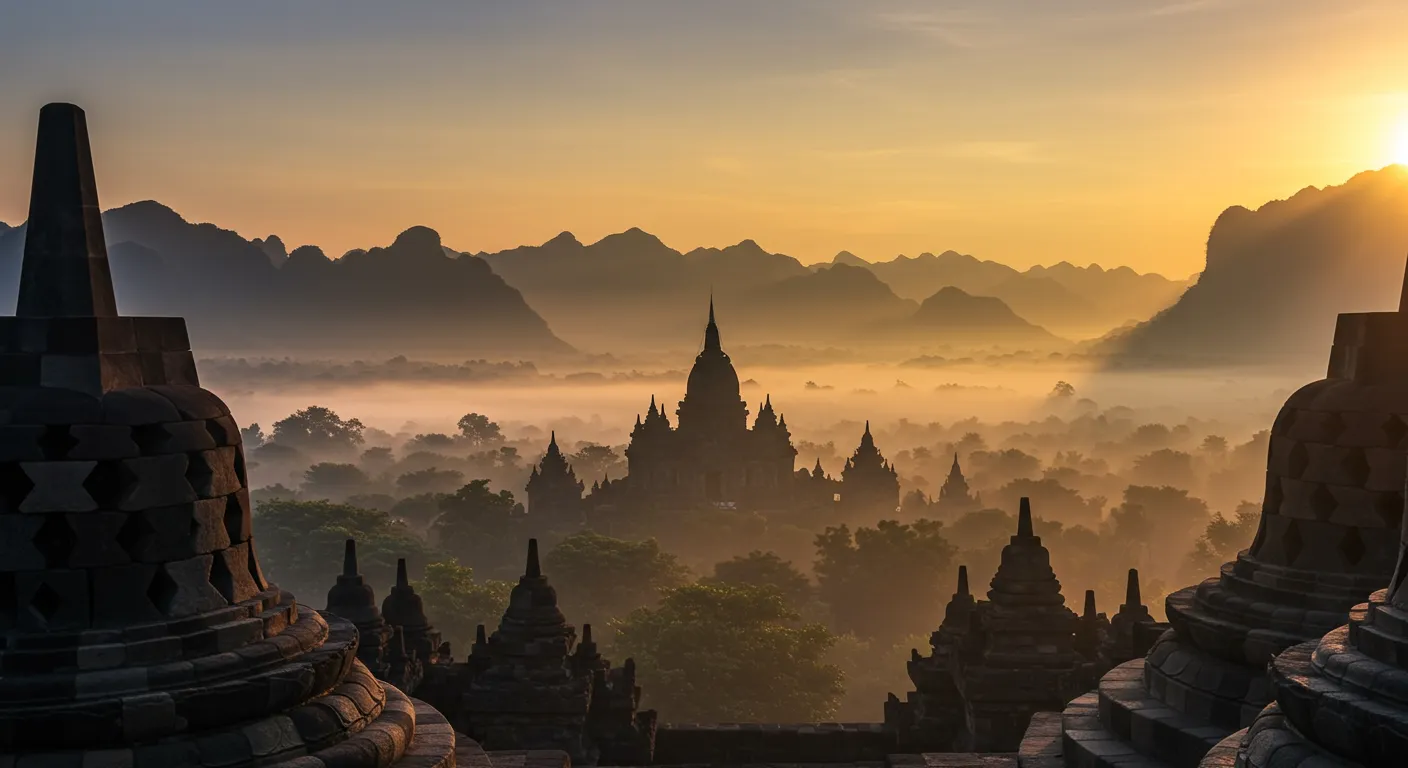
Stupas emerging from morning mist with balloons rising behind them. Shwesandaw and other 'sunrise pagodas' are now closed for climbing — use the earthen viewing mounds near Bulethi or shoot from a private balcony hotel. [ASSUMPTION] Conditions in Myanmar remain unstable — confirm access and safety before planning.
Jiufen Old Street — A-Mei Teahouse
Red lanterns reflecting on wet stone steps with the teahouse facade glowing. The Spirited Away aesthetic. The classic frame is from the staircase across the alley looking up — go higher than most tourists do.
Hampi Boulder Fields — Matanga Hill
Vijayanagara temple ruins scattered through surreal granite boulder landscape. Matanga Hill summit gives the highest 360° view — Virupaksha Temple gopuram on one side, Achyutaraya Temple ruins on the other, all in golden light.
Kampong Phluk Stilt Village, Tonlé Sap
20-meter-tall stilt houses with fishing boats below, reflected in glassy water. Far less touristed than the floating villages. The flooded forest section by canoe gives intimate light-through-trees shots that nobody is making.
Kyoto — Fushimi Inari Upper Trails
Everyone shoots the lower torii gates with crowds. The trick: hike 30 min up past Yotsutsuji intersection where 95% of visitors turn back. Empty vermilion tunnels, dappled morning light, sometimes a single monk or visitor for scale.
Suggested Itinerary
Nightlife
Asia's nightlife is wildly uneven across the continent — from Tokyo's hyper-specific 6-seat jazz cellars and Seoul's 4am soju marathons to Singapore's polished rooftops and Bangkok's chaotic rooftop-to-alley sprawl. Things start late almost everywhere (10pm onwards), and the best venues skew local; the tourist-bar circuits in places like Khao San Road or Lan Kwai Fong are loud, easy, and almost always a downgrade from what locals are actually doing.
Bar Benfiddich
An apothecary-style cocktail den where Hiroyasu Kayama crushes fresh herbs with a pestle and pours absinthe from unlabelled bottles; feels like drinking in a 1920s alchemist's study.
9th floor of an anonymous office building — no sign, easy to miss. No reservations, queue forms early. Cocktails around 2,000–3,000 yen. Closed Sundays. Smart casual fine.
Smalls
A tight, smoky jazz room with Beijing's serious players working through standards and originals; conversation drops when the soloist takes off.
Cover usually 60–100 RMB depending on act. Sets start around 9:30pm. Book a table for weekend headliners. No dress code.
Atlas Bar
Art Deco cathedral of gin with a three-storey gin tower behind the bar; dress-up date-night energy, not a place to roll in from the hostel.
Smart elegant dress code — no shorts, no flip-flops, collared shirts after 5pm. Reservations essential for weekend evenings. Martinis around S$28. [ASSUMPTION] Afternoon tea service can be a cheaper way in.
Tep Bar
Thai craft spirits and live mor lam folk performances in a restored shophouse; locals and clued-in travellers in roughly equal mix.
Live music Thursday to Saturday from around 9pm. Try the ya dong (Thai herbal moonshine) flight. Walk-ins fine early; gets packed after 10pm. Casual dress.
Zest Bar
Underground house and techno basement that fills with Seoul's actual dance crowd around 2am and runs until the trains restart.
Cover 20,000–30,000 KRW including a drink, higher for international DJs. Friday/Saturday only worth it. No sneakers issue, but no sandals. ID checked.
The Pawn
Colonial-era pawnshop converted into a multi-level pub with a breezy verandah overlooking the tram lines; expat-heavy but unpretentious.
Verandah seats are the prize — arrive before 7pm or book. Pints around HK$90. Kitchen runs late, food is decent. Smart casual.
Penicillin
Sustainability-obsessed cocktail lab where every garnish is upcycled and the drinks taste better than that sounds; quietly one of Asia's most influential bars.
Reservations strongly recommended, especially after the Asia's 50 Best ranking attention. Cocktails HK$140–180. Tucked on Hollywood Road. Smart casual.
Piknik Rooftop
Plastic chairs, fairy lights, cheap Gorkha beer and a 360-degree view over Thamel's tangle of rooftops; honest and unpretentious.
Beers around 350 NPR. No reservations, no dress code. Closes earlier than you'd think — most Thamel venues shut by midnight due to noise rules. Cash easier than card.
Potato Head Beach Club
Sunset-into-night beach club with infinity pool, international DJs, and a crowd that swings from families at 5pm to dancefloor chaos by midnight.
No cover but minimum spend on daybeds (around 1.5–2 million IDR). Book daybeds days ahead in high season. Cocktails 200,000+ IDR. Resort smart — no shirtless after 6pm.
Ronin
Hidden 16-seat omakase cocktail bar above a yakitori joint; you go for the bartender's attention as much as the drinks.
Reservation only via Instagram DM, usually weeks out. Two seatings most nights. Around 1,500 PHP per cocktail. Poblacion is also the city's best bar-hopping district if you can't get in.
Build your own Itinerary from this guide
Pick the places you care about — attractions, photo spots, map markers — and we'll lay out a day-by-day starting point. Yours to edit; guide updates never touch it.
Premium section
Special Interest
This part of the guide is included with a NextTripLabs account. Sign in to read it here — full guide unlocks and itineraries are available in the NextTripLabs app.
Premium section
Hidden Gems and Off the Beaten Path
This part of the guide is included with a NextTripLabs account. Sign in to read it here — full guide unlocks and itineraries are available in the NextTripLabs app.
Premium section
Sustainability Guide
This part of the guide is included with a NextTripLabs account. Sign in to read it here — full guide unlocks and itineraries are available in the NextTripLabs app.