Essentials
Currency, language, transit & safety — tap to expand.
Currency — Botswana Pula (BWP), symbol P. Roughly P13–14 = 1 USD, P14–15 = 1 EUR [ASSUMPTION: rates fluctuate, verify before travel]
Cash vs card — Cards widely accepted in Gaborone, Maun, Kasane and at lodges/hotels. Carry cash for rural areas, fuel stations, and small vendors. ATMs reliable in towns but scarce near safari camps — withdraw before heading into the Delta or Kalahari. Tipping expected: 10% in restaurants, guide tips roughly P150–300/day per guest, plus camp staff tips.
Budget — Botswana is not a budget destination. Self-drive/camping budget: ~P700–1000/day (USD 50–75). Mid-range lodges: ~P2700–5500/day (USD 200–400). Luxury fly-in safari: P40000+/day (USD 1000–3000+). The premium pricing is deliberate government policy — low-volume, high-cost tourism.
Language — English is the official language, used in government, business and signage. Setswana is the national language and most widely spoken in daily life across nearly all communities.
Language barrier — Very low for English speakers. English is taught in schools and used commercially; guides, lodge staff and most urban Batswana speak it fluently. Rural and elderly speakers may prefer Setswana.
Getting around — There's no train network worth using and distances are huge. Realistically you either fly between safari hubs, self-drive a 4x4, or let your lodge handle transfers. Charter flights are the backbone of Delta travel. Self-driving is rewarding but demands a proper 4x4, fuel planning, and confidence on sand.
Safety — Botswana is one of Africa's safest and most stable countries; violent crime against tourists is rare. The real risks are wildlife and environment, not people. Never walk in unfenced camps at night — elephants, hippos and lions move through. Hippos and elephants cause more deaths than predators; keep distance on mokoro and boat trips. Malaria is present in the north (Delta, Chobe) especially Nov–Apr; take prophylaxis. Distances between fuel and water are vast — self-drivers must over-prepare. Dehydration and sun exposure in the Kalahari are serious. Petty theft exists in Gaborone; use normal urban caution there.
Highlights
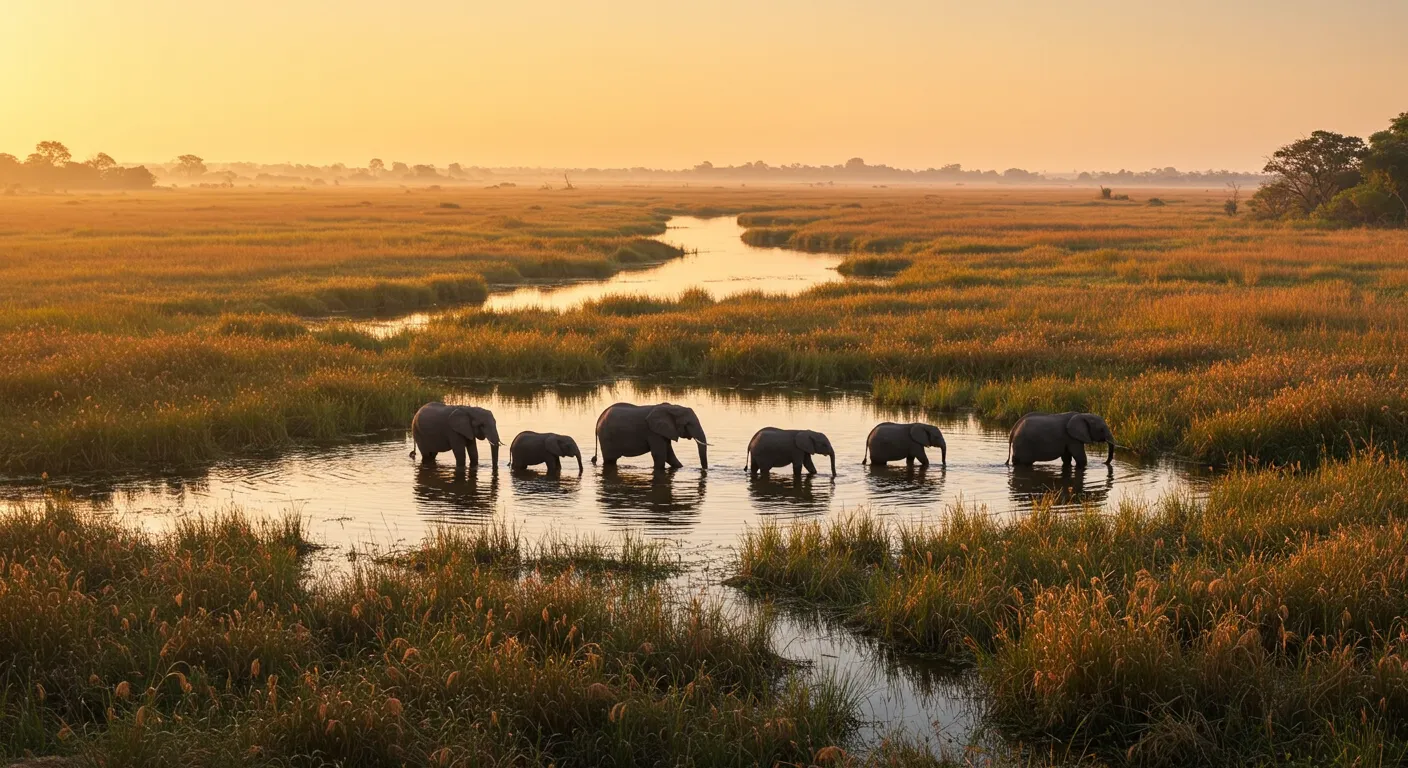
Botswana sells space, not crowds — it is one of the last places on earth where you can drive for hours through the Kalahari or pole a mokoro through the Okavango Delta channels without seeing another vehicle. The country built its tourism on a deliberate high-value, low-volume model, which means it feels uncluttered and wild in a way that neighbouring countries with mass safari traffic do not. Come for the elephants of Chobe and the floodwaters of the Delta; stay for the silence.
The high-cost, low-impact safari reality
Botswana deliberately prices the Okavango Delta and Moremi at the premium end — fly-in camps run hundreds to thousands of USD per night. The workaround experienced travellers use: self-drive the public areas (Khwai community concession, Central Kalahari, Nxai Pan, Makgadikgadi) where camping fees are far lower, and save one or two nights for a Delta camp. Book Khwai community campsites direct rather than through agents.
BUDGET · BOOK AHEAD
Setswana courtesy is non-negotiable
Greetings come before everything — walking up and immediately asking a question is considered rude. Learn 'Dumela rra' (hello sir) and 'Dumela mma' (hello ma'am), and 'Ke a leboga' (thank you). Botswana is a calm, conservative society; raised voices and impatience mark you as a difficult tourist. Pula, the currency name, literally means 'rain' and is also a national toast — rain is wealth here.
Entry is genuinely easy for most
Most Western passport holders (US, UK, EU, Australia, Canada) get visa-free entry for up to 90 days. There is a tourism levy of USD 30 (the 'Pula' levy) payable online before arrival via the official portal — sort this in advance to avoid friction at Maun or the Kazungula border. [ASSUMPTION] Levy enforcement at land borders can be inconsistent, so keep your payment confirmation accessible offline.
TRANSIT-FRIENDLY
Connectivity drops off fast outside towns
Buy an Orange or Mascom SIM in Maun, Kasane, or Gaborone — bring your passport for registration. Coverage is solid in towns and along the A1/A3 highways but vanishes in the Delta, CKGR, and Makgadikgadi. Download maps.me or Google Maps offline for your full route, and treat any camp WiFi as a bonus, not a given. Tracks4Africa is the gold-standard navigation app for self-drivers.
PLUGIN TIP
Self-drive demands real preparation
Deep sand and salt-pan tracks require a high-clearance 4x4 — rent from Maun specialists (Bushlore, Travel Adventures Botswana) that fit dual batteries, rooftop tents, recovery gear, and long-range fuel tanks. Fuel up at every town because stations are 200+ km apart, carry 30+ litres of water, and book national park entry and campsites through DWNP or the relevant concession manager well ahead — sites are capped and sell out.
BOOK AHEAD · PERMIT NEEDED
Time your visit to the floods, not the calendar
The Okavango paradox: the Delta floods June to August — peak game viewing and mokoro season — even though it's the dry season elsewhere, because the water arrives from Angolan rains months earlier. The Makgadikgadi pans are best in the green season (December–March) for flamingos and zebra migration. Don't assume one window suits everything; pick your region by what you want to see.
SEASONAL · GOLDEN HOUR
Chobe's river game drives at golden hour
Chobe National Park near Kasane holds one of Africa's densest elephant populations. Skip the midday vehicle drives and take an afternoon boat cruise on the Chobe River instead — elephants come to drink and cross, the low side-light is perfect for backlit dust and water spray, and you shoot from a stable platform near eye level. Far better light and angles than a bouncing 4x4.
PHOTO · GOLDEN HOUR · ICONIC
When to Go
For photography and reliable game viewing, target July through September — clear light, animals packed around water, and crisp cool mornings. May offers an underrated quiet window with green backdrops and low rates. If your priority is dramatic skies and birds over big-game ease, the green season around December rewards the trade-off.
Green Season
The summer rains transform Botswana into a lush, bird-rich landscape with dramatic skies and newborn wildlife. Camps are quieter and far cheaper, but water disperses the big game across the bush. Some areas flood and a few camps close.
Best for birdwatching, budget travel, and storm photography, but harder big-game spotting and road access.
Transition Season
Rains end while the landscape stays green and temperatures turn comfortable. Wildlife visibility steadily improves and rates remain moderate before the peak surge. An underrated value window.
Excellent value with green scenery, cooling nights, and rising game viewing.
Dry Season
Cold dawns and clear skies define peak safari time, with animals concentrating at shrinking water sources for reliable sightings. The Okavango flood often peaks here, ideal for mokoro excursions. Crowds and prices are at their highest.
Best for big-game safaris and photography, but book far ahead and pack warm layers.
Hot Build-Up
Pre-rain heat intensifies and remaining water draws extraordinary wildlife concentrations. Dust and brown landscapes add drama for tolerant photographers. October midday heat is severe.
Arguably the best raw game viewing of the year, if you can handle extreme heat.
Okavango Flood
Distant Angolan rains arrive months later as floodwaters spread across the Okavango Delta, peaking around June–July. The flooded channels enable mokoro trips and draw concentrated wildlife. [ASSUMPTION] Exact peak timing varies year to year.
Best window for mokoro water-based safaris and Delta photography.
Where to Stay
Botswana runs a deliberate high-value, low-volume tourism model, so the Okavango Delta and Chobe deliver some of Africa's priciest safari beds — often $1,000–$2,500+ per person per night all-inclusive. The smart play is mixing a splurge fly-in camp with self-drive campsites or town guesthouses in Maun and Kasane, where prices crash to a fraction of the camp rate. Booking gotcha: top Delta camps sell out 10–14 months ahead for peak dry season (Jul–Oct), and most camp rates are quoted per person sharing, not per room.
Mombo Camp (Wilderness)
Moremi Game Reserve, Okavango Delta
Resort
ICONIC · PHOTO · GOLDEN HOUR · BOOK AHEAD · WORKSHOP SPOT
Chobe Game Lodge
Chobe National Park, near Kasane
Resort
ICONIC · PHOTO · GOLDEN HOUR · SEASONAL · BOOK AHEAD
Cresta Riley's Hotel
Maun
Hotel
TRANSIT-FRIENDLY · VALUE · EASY WALK
Thebe River Safaris
Kasane
Guesthouse
VALUE · TRANSIT-FRIENDLY · FAMILY
The Old Bridge Backpackers
Maun (Thamalakane River)
Hostel
BUDGET · SOCIAL · TRANSIT-FRIENDLY
Senyati Safari Camp
Lesoma Valley, near Kasane
Guesthouse
BUDGET · HIDDEN GEM · PHOTO · GOLDEN HOUR · WORKSHOP SPOT
Jack's Camp (Natural Selection)
Makgadikgadi Pans
Resort
UNIQUE · NIGHT SHOOT · PHOTO · SPLURGE · BOOK AHEAD
Planet Baobab
Gweta, near Makgadikgadi Pans
Resort
UNIQUE · VALUE · SEASONAL · TRANSIT-FRIENDLY
Top Attractions
№ 1 · Essential
Okavango Delta
★ ICONIC · PHOTO · GOLDEN HOUR · BOOK AHEAD · SEASONAL
A vast inland delta where the Okavango River fans out into the Kalahari, creating a maze of channels, lagoons, and islands teeming with wildlife. This is the crown jewel of Botswana and lives up to every bit of hype. Best experienced by mokoro (dugout canoe) for low, eye-level wildlife encounters.
Tip: Fly into a remote camp on a light aircraft transfer — the aerial view of the channels is half the experience and prime for the window seat. Sit on the left going in if you can.
Best: May to August, peak flood season when water levels are high and game congregates; mornings for the clearest light and most active wildlife.
Fees: Park fees roughly 120 BWP/day for non-residents; camp/safari packages run far higher [ASSUMPTION on exact 2024 rate]
Chobe National Park
Famous for the densest elephant population in Africa — herds in the hundreds gathering along the Chobe River at dusk. The riverfront game drives and boat cruises are genuinely spectacular, not overrated. Easily combined with a Victoria Falls day trip across the border.
ICONICMakgadikgadi Pans
One of the largest salt flats on Earth, a surreal white expanse stretching to the horizon. In the dry season it's an otherworldly emptiness; in the wet season it floods and draws flamingos and zebra migrations. A polarizing landscape — magic for some, monotonous for others.
PHOTOCentral Kalahari Game Reserve
The second-largest protected area in the world, a remote desert wilderness with black-maned lions, oryx, and big skies. It's harder to reach and emptier than the Delta, which is exactly the point — true solitude. Not for first-timers without a capable 4x4 and self-sufficiency.
PHOTODay Trips
Chobe National Park (from Kasane)
Travel: Park gate ~10 km / 15 min from Kasane; access town reached by air to Kasane Airport
Victoria Falls (Zimbabwe/Zambia side, from Kasane)
Travel: ~80 km / 1.5 hr by road from Kasane, plus border crossing
Okavango Delta mokoro day excursion (from Maun)
Travel: Varies; ~1 hr transfer + boat/light aircraft from Maun to a delta poling station
Makgadikgadi Pans (from Maun or Gweta)
Travel: ~150–200 km / 2–3 hr by road from Maun toward Gweta
Tsodilo Hills (from Shakawe/Maun region)
Travel: Remote; long drive — several hours from Maun, closer from Shakawe
Nxai Pan National Park (Baines' Baobabs)
Travel: ~135 km / ~2 hr toward Gweta then 4x4 in, from Maun
Gaborone city and Kgale Hill (from Gaborone)
Travel: In-city; Kgale Hill ~5 km / 15 min from central Gaborone
Scenic Routes
Chobe Riverfront Drive
Driving
Route: Kasane to Serondela
ICONIC · PHOTO · GOLDEN HOUR · SEASONAL · BOOK AHEAD
Okavango Delta Mokoro Channels
Walking
Route: Maun-area poling station to delta island camps
ICONIC · PHOTO · BOOK AHEAD · SEASONAL · EASY WALK
Makgadikgadi Pans Crossing
Driving
Route: Gweta to Kubu Island
HIDDEN GEM · PHOTO · SUNSET · NIGHT SHOOT · SEASONAL
Tsodilo Hills Rock Art Walk
Hiking
Route: Tsodilo site office to Female and Male Hills trails
HIDDEN GEM · PHOTO · HARD HIKE · PERMIT NEEDED
Moremi Game Reserve Loop
Driving
Route: South Gate to North Gate via Khwai
ICONIC · PHOTO · GOLDEN HOUR · SEASONAL · BOOK AHEAD
Kasane Town Riverside Stroll
Walking
Route: Kasane center to Sedudu Gate area
FREE · EASY WALK · BUDGET · TRANSIT-FRIENDLY
Street Art
Botswana doesn't have a dense, internationally-known street art scene the way Cape Town or Johannesburg do, but Gaborone has a small, growing mural culture driven by local youth collectives, NGO-funded community projects, and occasional festival commissions. Expect bursts of color in the capital rather than a continuous gallery-on-the-street experience. Much of the work clusters around cultural centers, schools, and a handful of commercial districts, with themes tied to wildlife, heritage, HIV/health awareness, and national identity. [ASSUMPTION] Outside Gaborone and Maun, public mural art is sparse and largely tied to specific events or sponsored campaigns.
Main Mall
Gaborone's central pedestrian spine, where occasional commissioned murals, painted shopfronts, and event-driven art appear. Good place to gauge the current scene and find vendor color for street photography.
Main Mall pedestrian area, central Gaborone, near the Three Dikgosi area
PHOTO · TRANSIT-FRIENDLY · EASY WALK
Old Naledi
One of Gaborone's oldest informal settlements and the most likely place to find community-driven murals, NGO health-awareness walls, and youth art projects. Strong sense of place; subjects often local life and social messaging.
Old Naledi, southern Gaborone
PHOTO · HIDDEN GEM · GOLDEN HOUR
Cultural Precinct near National Museum
Area around the Botswana National Museum and Art Gallery occasionally hosts public art, sculpture, and festival murals. Best paired with indoor galleries for a fuller arts day.
Independence Avenue, near the National Museum, Gaborone
PHOTO · RAINY DAY · EASY WALK
Maun Town Center
Gateway to the Okavango Delta, Maun sees tourism-driven painted signage, safari operator murals, and the occasional community wall. Less a dedicated art scene than functional, characterful color worth a few frames between safari logistics.
Central Maun, around the main road and Riverside areas
PHOTO · GOLDEN HOUR · SEASONAL
Culture & History
Botswana stands out in Africa as a stable democracy that has carefully preserved its cultural identity while modernising on its own terms, built on the values of botho (humanity toward others) and consensus decision-making. Shaped by the Tswana chieftaincies, the harsh beauty of the Kalahari, and the deep heritage of the San peoples, its culture blends ancient survival knowledge with a quiet, communal pride. The country's identity is one of resilience, dignity, and a profound relationship with land and cattle.
Eat & Drink
Botswana's food scene is shaped by the Kalahari, cattle country, and a no-fuss approach to hearty eating. Beef is king here, raised on open rangeland and grilled simply, while seswaa (slow-pounded, salted meat) and bogobe (sorghum or maize porridge) anchor most traditional plates. The capital Gaborone and tourism hubs like Maun and Kasane carry the bulk of the restaurant offerings, with safari-lodge dining a category of its own.
Sanitas Tea Garden ★★★★★
garden-fresh lunches, salads, grilled meats
Gaborone, Kgale (Tlokweng Road area)
Restaurant
Hilary's ★★★★★
homemade quiches, soups, fresh bread
Maun, near Riverside
Restaurant
The Courtyard Restaurant ★★★★
vegetarian plates, salads, light dinners
Gaborone, Main Mall
Restaurant · vegetarian_restaurant
Old Bridge Backpackers Restaurant ★★★★
river-view burgers, bream, cold beer
Maun, Matlapaneng (Thamalakane River)
Restaurant
Equatorial Cafe ★★★
vegan bowls, plant-based wraps
Gaborone, Riverwalk area
Restaurant · vegan_restaurant
Cafe Dijo
proper espresso, cakes, light lunches
Gaborone, Kgale View
Coffee · cafe
Bon Ton
cappuccino, pastries, breakfast
Gaborone, Riverwalk Mall
Coffee · cafe
French Connection
coffee, croissants, riverside seating
Maun, central
Coffee · cafe
Mug & Bean
all-day coffee and big breakfasts
Gaborone, Game City Mall
Coffee · cafe
Sanitas Bakery Counter
fresh loaves, scones, seed bread
Gaborone, Kgale
Bakery · bakery
Hot Bread Cafe
fresh-baked rolls, pies, breakfast pastries
Gaborone, Broadhurst
Bakery · bakery · breakfast_restaurant
Choppies Bakery
affordable bread, fatcakes (magwinya)
Nationwide supermarket chain
Bakery · bakery
The Courtyard Restaurant
vegetarian mains, salads, grilled halloumi
Gaborone, Main Mall
Vegetarian · vegetarian_restaurant
Equatorial Cafe
vegan bowls, smoothies, plant wraps
Gaborone, Riverwalk area
Vegetarian · vegan_restaurant
Sanitas Tea Garden
garden salads, veggie quiche, meat-free brunch
Gaborone, Kgale
Vegetarian · vegetarian_restaurant · vegan_restaurant
Shopping
Botswana's shopping is understated and craft-driven rather than flashy — the real treasures are basketry from the Okavango Delta region, San bushman crafts, and quality leather, sold in modest craft centres rather than glitzy malls. Shoppers who value authenticity and handmade workmanship over volume will leave happiest.
Botswana Craft (Gaborone)
Craft
Curated Botswana baskets, San crafts, ostrich eggshell jewellery, textiles and pottery sourced from across the country in one reliable spot.
Market · ICONIC · LOCAL
Maun Roadside & Craft Stalls
Craft
Hand-woven palm baskets directly from Delta communities, carved wood, and beadwork — closest you get to buying at the source.
Market · HIDDEN GEM · BUDGET
Riverwalk & Game City Malls
Mixed
Practical safari gear, South African retail brands, pharmacies and SIM cards — useful for restocking, not for souvenirs.
Market · TRANSIT-FRIENDLY · RAINY DAY
Gaborone Western Bypass craft cluster
The country's most concentrated zone for legitimate, quality-controlled local crafts and art.
Botswana Craft, occasional artisan pop-ups, and galleries selling San art and contemporary Botswanan work.
District · LOCAL
Maun town centre
Gateway-town shopping geared to safari travellers — basket weavers, beadwork sellers, and outfitting stores.
Delta baskets, Bushman Survival-style craft outlets, and safari supply shops for last-minute gear.
District · LOCAL · BUDGET
Kasane shops (Chobe gateway)
Small cluster serving Chobe and Victoria Falls crossover tourists — mixed quality, some genuine local craft.
Wood carvings, beadwork, and convenience goods; quality is inconsistent so inspect closely.
District · LOCAL
Photo Spots
Botswana's photographic calendar is driven by the dry/wet split, not a four-season model. The dry season (May–October) is peak: clear skies, animals concentrated at shrinking water, low golden light, and dust that makes backlit dusk shots glow — but the sun sits high fast, so your usable window is the first and last 90 minutes. Winter (June–July) gives the latest sunrises (~6:25am) and earliest sunsets (~6:30pm), pleasant for not having to wake at 4am, plus the clearest Milky Way nights over the pans. The green season (November–April) flips the light: dramatic afternoon thunderheads, lush color, newborn animals, mirror-flooded Makgadikgadi — but expect haze, harsher contrast, and washed-out midday skies, so commit hard to dawn and the post-storm hour. Sunrise drifts to ~5:45am in December; plan tighter morning starts in summer.
Chobe Riverfront
Massive elephant herds crossing and drinking, backlit by low sun, with the river as a mirror. Shoot from a boat at water level for eye-line intimacy — the low angle separates subjects from cluttered banks and gives you reflections. Hippos, buffalo herds, and fish eagles fill the gaps.
Okavango Delta Aerials (Maun departures)
Abstract waterways, palm islands, and game trails carved into the floodplain seen from a light aircraft or helicopter. The braided channels and elephant paths become graphic linework. Doors-off helicopter is the holy grail for top-down compositions.
Makgadikgadi Pans (Ntwetwe / Sua)
Endless white salt-crust horizon with surreal scale and zero reference points — perfect for minimalist and reflection work. In the wet season, shallow water turns the pan into a vast mirror; dry season gives cracked-earth texture and Milky Way nights with no light pollution.
Moremi Game Reserve — Khwai area
Classic predator-and-prey action in mixed woodland and floodplain. Wild dog packs, leopards in leadwood trees, and lions on the move. Less of a 'view' shot, more about behavior and light — animals crossing open ground in the first hour of sun.
Savuti Channel & Marsh
Drama-heavy landscape — dead-tree skeletons, dust, and big-cat territory. Famous for elephant-hunting lions and large lion prides. The arid, scrubby terrain plus dust kicked up at dusk makes for moody backlit and silhouette frames.
Tsodilo Hills Rock Art
Over 4,000 ancient San rock paintings on quartzite cliffs rising abruptly from flat Kalahari sand — 'Mountain of the Gods.' Shoot the red-ochre paintings up close and the hills themselves glowing at the day's edges. A cultural and landscape combo that almost no tour group reaches.
Nxai Pan — Baines' Baobabs
A cluster of ancient baobabs that Thomas Baines painted in 1862 — nearly unchanged since. The gnarled trees against the flat pan make a near-perfect symmetrical foreground for both sunrise color and astro. Add a tent or vehicle for scale.
Suggested Itinerary
Nightlife
Botswana's nightlife is concentrated almost entirely in Gaborone and to a lesser extent Francistown and Maun, with the rest of the country oriented toward early nights and safari schedules. Things start late by Western standards — bars fill after 9pm and clubs don't get going until midnight, peaking around 2am on Friday and Saturday. The scene is overwhelmingly local; expect house, kwaito, amapiano and Botswana's own hip-hop and traditional fusion rather than tourist-oriented venues.
Bull & Bush Pub
A long-running expat-and-local institution with a leafy beer garden, braai smoke in the air, and a crowd that swings from after-work suits to weekend bands.
No cover most nights. Live music on weekends draws crowds — come early for a table. Smart casual fine. Kitchen does solid steaks and ribs.
Maharaja / News Cafe Riverwalk
Mall-edge bar-restaurant that turns into a buzzing after-work and pre-club spot, with sports on screens and a mixed young professional crowd.
No cover. Busy Thursday to Saturday. Good cocktails and a long beer list. Easy meeting point before heading out later.
Cigar Bar (Grand Palm)
Hotel lounge with leather seating, decent whisky selection and a quieter, conversation-friendly atmosphere for an older, well-heeled crowd.
Inside the casino complex [ASSUMPTION]. Smart casual expected. Closes earlier than clubs. Good for a calm drink rather than a late night.
Linga Longa
Unpretentious local watering hole where the drinks are cheap, the music is loud, and the mix of office workers and students keeps it lively into the night.
No cover. Cash useful. Casual dress. Best Friday nights. Expect a packed, sweaty room — not a polished venue.
Fashion Lounge
A dressed-up nightclub pumping amapiano, house and hip-hop where the dance floor doesn't ignite until well past midnight and the bottle-service tables anchor the room.
Cover on big nights, typically P50–P150. Strict-ish door — dress sharp, no flip-flops or athletic gear. Saturday is the main night. [ASSUMPTION] venue lineup shifts; check current listings.
Sundowners at Old Bridge Backpackers
Riverside deck where safari guides, overlanders and backpackers swap stories over cold Castles as the sun drops behind the reeds.
No cover. Casual. The go-to social spot in Maun before or after Okavango trips. Sunset drinks are the highlight; quietens fairly early.
Duck Inn
A no-frills pub favourite with pool tables, sports screens and a steady rotation of regulars who treat it as a second living room.
No cover. Casual dress. Good cheap drinks and bar food. Reliable weeknight option when central spots are dead.
Thapong-area live nights
Pop-up live sessions blending jazz, traditional Setswana music and contemporary acts, where the lineup matters more than the address.
[ASSUMPTION] Events rotate venues — follow local promoters and the President's Day cultural events for the best live programming. Cover varies by act.
Build your own Itinerary from this guide
Pick the places you care about — attractions, photo spots, map markers — and we'll lay out a day-by-day starting point. Yours to edit; guide updates never touch it.
Premium section
Special Interest
This part of the guide is included with a NextTripLabs account. Sign in to read it here — full guide unlocks and itineraries are available in the NextTripLabs app.
Premium section
Walkability Scores
This part of the guide is included with a NextTripLabs account. Sign in to read it here — full guide unlocks and itineraries are available in the NextTripLabs app.
Premium section
unesco world heritage sites
This part of the guide is included with a NextTripLabs account. Sign in to read it here — full guide unlocks and itineraries are available in the NextTripLabs app.
Premium section
Hidden Gems and Off the Beaten Path
This part of the guide is included with a NextTripLabs account. Sign in to read it here — full guide unlocks and itineraries are available in the NextTripLabs app.
Premium section
Sustainability Guide
This part of the guide is included with a NextTripLabs account. Sign in to read it here — full guide unlocks and itineraries are available in the NextTripLabs app.