Essentials
Currency, language, transit & safety — tap to expand.
Currency — Pound Sterling (GBP, £); roughly £1 = $1.27 USD / €1.17 EUR [ASSUMPTION: rates fluctuate]
Cash vs card — Card is accepted almost everywhere, including contactless on buses and ferries. Carry some cash for small honesty-box car parks, croft stalls, and remote community shops — a few don't take card or have patchy signal. ATMs exist in Stornoway and Tarbert but are sparse elsewhere, so withdraw before heading rural. Tipping is modest: round up or 10% in restaurants if service isn't already added.
Budget — budget: £55–75/day (~$70–95) / mid-range: £120–180/day (~$152–229) / luxury: £250+/day (~$318+). Ferry crossings and fuel are the hidden budget killers out here.
Language — English is universal. Scottish Gaelic (Gàidhlig) is a living community language here — the Outer Hebrides have one of the highest concentrations of Gaelic speakers in Scotland. Road signs are bilingual, often Gaelic-first.
Language barrier — None. Everyone speaks fluent English. Gaelic is spoken socially and at home by many islanders, but you'll never need it to get by.
Getting around — A rental car is the honest answer — public transport exists but won't get you to the photogenic spots on a useful schedule. Distances feel small on the map but single-track roads with passing places slow everything down. Budget for fuel; it's pricier than the mainland. Without a car, base yourself in Stornoway and use buses plus the odd tour.
Safety — Crime is essentially a non-issue; the real risks are environmental. Weather flips fast — pack waterproofs and windproof layers year-round. Single-track roads claim more tourists than anything else: sheep wander onto roads, blind crests are common, and oncoming drivers expect you to know passing-place etiquette. Mobile signal drops out in the interior and west coast, so download offline maps. Many businesses, fuel stations, and ferries reduce or cease operations on Sundays for religious observance — plan fuel and food ahead. Beaches are beautiful but cold-water rip currents are real; this isn't a swimming-without-thinking destination.
Highlights
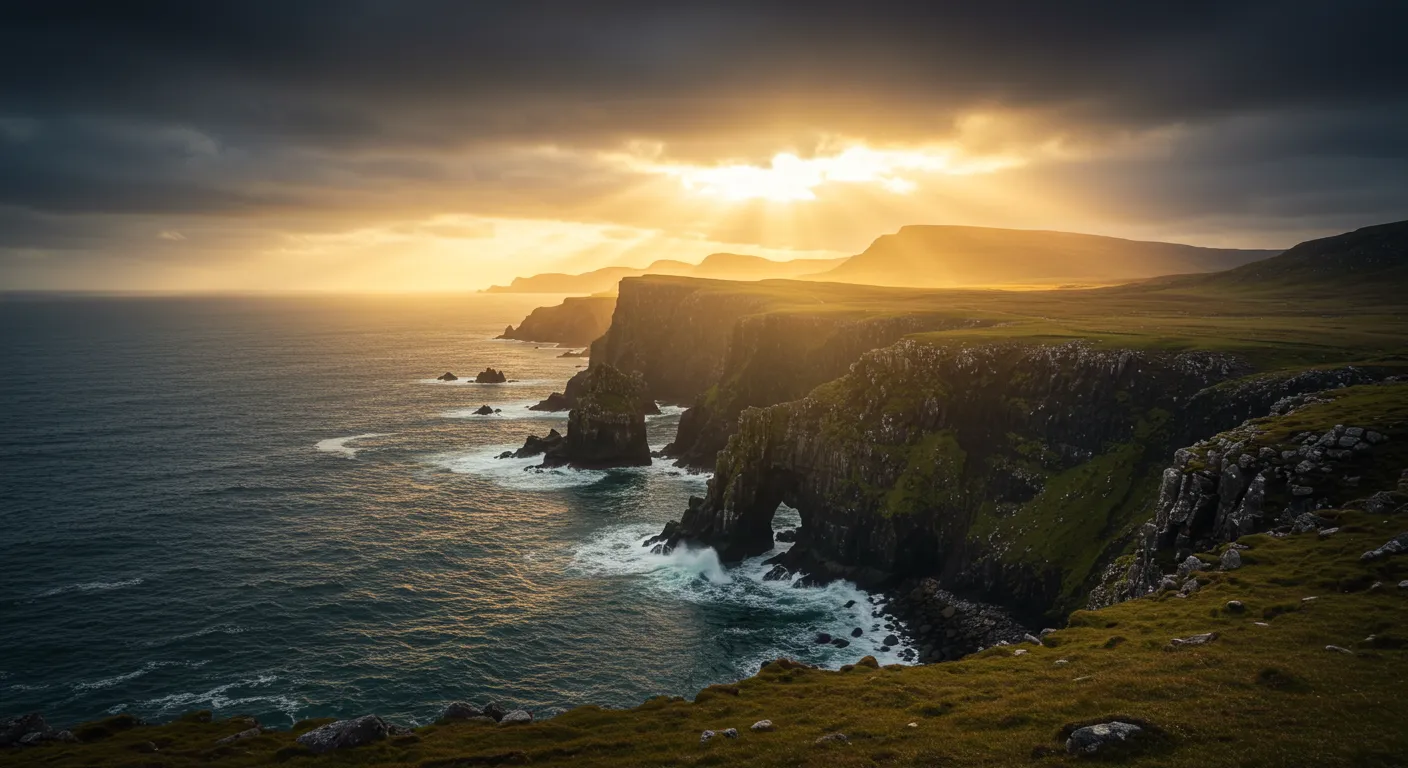
Lewis and Harris are two ends of a single island, yet they feel like different worlds: Lewis flattens out into blanket bog and ancient stone, while Harris erupts into jagged mountains and the impossibly white beaches of the west coast. This is the Gaelic heartland of Scotland, where the Sabbath still shapes the rhythm of the week and the light off the Atlantic does more for your photos than any filter ever will.
Sunday observance is real, not a quirk
The Free Church tradition is strong here, especially in Lewis. Many shops, fuel stations, and some cafes close on Sundays, and some communities still object to non-essential activity. Plan to refuel Saturday, stock groceries ahead, and treat Sunday as a quiet day for beaches and driving. Stornoway has loosened up (some restaurants, the leisure centre, and the Sunday ferry run now), but rural areas have not.
SEASONAL
Gaelic is a living language
Road signs are bilingual and often Gaelic-only in places, so navigate by Gaelic spellings: Steòrnabhagh is Stornoway, Tairbeart is Tarbert, Na Hearadh is Harris. Locals appreciate a 'tapadh leibh' (thank you). Harris Tweed (Clò Mòr) is the genuine local craft — look for the Orb certification mark to confirm it's hand-woven in the Outer Hebrides.
Getting here is the commitment
Most arrive by CalMac ferry — Ullapool to Stornoway (Lewis) or Uig on Skye to Tarbert (Harris). Book vehicle space well ahead in summer; the boats fill. Flights run to Stornoway from Glasgow, Edinburgh, and Inverness on Loganair. A common route is ferry in one end, drive the island, ferry out the other.
BOOK AHEAD · TRANSIT-FRIENDLY
Connectivity and offline prep
EE has the best rural coverage in the Hebrides; Vodafone and O2 are patchier on the west coast and in the hills. Expect dead zones — download offline maps in Google Maps or use OS Maps for hiking. UK eSIMs work fine for EU/overseas visitors. Contactless and Apple/Google Pay are accepted in Stornoway and most accommodation, but carry some cash for honesty-box farm stalls, small craft sellers, and remote cafes.
PLUGIN TIP
The Callanish Stones beat Stonehenge
Calanais (Callanish) is a 5,000-year-old stone circle older than Stonehenge, fully accessible, free, and usually near-empty at dawn. Go at sunrise or blue hour to have it to yourself — tour buses arrive mid-morning. The visitor centre cafe is genuinely good. [ASSUMPTION] Centre opening hours are reduced off-season.
ICONIC · FREE · SUNRISE · BLUE HOUR · PHOTO · CROWD WARNING
The west Harris beaches are the unlock
Luskentyre (Losgaintir) and Seilebost are the headline white-sand, turquoise-water beaches, and they earn the hype — best at low tide with side light. For solitude, push on to Hushinish at the end of a single-track road, or Scarista for sunset. These beaches face west, so light peaks late afternoon to golden hour.
HIDDEN GEM · GOLDEN HOUR · SUNSET · PHOTO · FREE
Single-track road etiquette
Most roads outside Stornoway are single-track with passing places. Pull into a passing place on your left to let oncoming traffic or faster cars behind you pass; a raised hand wave of thanks is standard. Never park in a passing place — it blocks the whole road. Watch for sheep on the carriageway day and night.
When to Go
Late May to early July is the single best window: long daylight (up to 18 hours), the machair wildflower meadows in full bloom, the driest stretch of the year, and golden-hour light that stretches for hours over Luskentyre's white sand. Walk and shoot before the worst of the midges in mid-summer; for food and crofting culture, May offers open businesses without August's crush.
Machair Bloom
The machair — fertile, shell-sand grassland fringing the west coast beaches — erupts into carpets of wildflowers including orchids, buttercups and clover. It is one of Europe's rarest habitats and at its most vivid in June. The contrast of flowers against white sand and turquoise sea is the islands' signature image.
Best window for wildflower and beach photography, but combine with midge precautions from late June.
Midge Season
Highland midges swarm in still, damp and overcast conditions, especially around dusk and dawn near inland water and moorland. Coastal breezes on the west-side beaches offer relief. They are a genuine factor in planning summer activity.
Carry repellent and a head net, and favour breezy coastal spots over sheltered inland areas in evenings.
Aurora Window
The islands' northerly latitude, dark skies and minimal light pollution make winter half the year a genuine chance for the Northern Lights on clear nights with the right solar activity. [ASSUMPTION] Best odds cluster around the equinoxes and on still, cloudless nights.
Plan flexible clear-night outings and scout dark north-facing coastal viewpoints in advance.
Atlantic Storm Season
Powerful Atlantic depressions bring sustained gales, big swells and frequent rain. Seas and skies are at their most dramatic and the islands at their emptiest. Daily life adapts around the weather.
Expect ferry cancellations and reduced services; build slack into every itinerary.
Autumn Light
As crowds and midges fade, the low sun produces long golden light across moor, machair and beach, with heather colour lingering early on. Weather is unsettled but bright spells are frequent. A favourite quiet window for serious photographers.
Excellent value and light, but plan tightly around shortening daylight hours.
Where to Stay
Lewis and Harris run thin on true luxury — the islands lean toward warm guesthouses, self-catering crofts, and a handful of standout boutique stays, with Stornoway holding most of the hotel beds. Value is decent off-season but evaporates May through September, when the best self-catering cottages and the few design-led rooms book out months ahead. The single biggest gotcha: many places close or run reduced hours in winter, and Sunday observance still limits some services on Lewis, so plan supplies and check-in times accordingly.
Broad Bay House
Back, near Stornoway (Lewis)
Guesthouse
VIEWS · BOOK AHEAD · SEASONAL
Scarista House
Scarista, South Harris
Boutique Hotel
ICONIC · SUNSET · BOOK AHEAD
Cabarfeidh Hotel
Stornoway (Lewis)
Hotel
CENTRAL · TRANSIT-FRIENDLY · VALUE
The Harris Hotel
Tarbert, Harris
Hotel
CENTRAL · TRANSIT-FRIENDLY · VALUE
Heb Hostel
Stornoway (Lewis)
Hostel
BUDGET · SOCIAL · CENTRAL · TRANSIT-FRIENDLY
Gatliff Trust Hostels (Garenin/Rhenigidale)
Rural Lewis & Harris (blackhouse villages)
Hostel
BUDGET · HIDDEN GEM · PHOTO · SEASONAL
Blue Reef Cottages
Scarista, South Harris
Villa
UNIQUE · SPLURGE · SUNSET · BOOK AHEAD
Self-Catering Croft Cottages (West Harris / Uig)
West Harris & Uig (Lewis)
Apartment
UNIQUE · FAMILY · SUNRISE · PHOTO
Top Attractions
№ 1 · Essential
Callanish Standing Stones (Calanais)
★ ICONIC · PHOTO · BLUE HOUR · SUNRISE · FREE · NIGHT SHOOT
A 5,000-year-old stone circle that genuinely rivals Stonehenge but with a fraction of the crowds and no rope keeping you back. You can walk right among the stones, which makes a huge difference for both atmosphere and photography. This is the single most compelling reason to visit Lewis.
Tip: Skip midday tour-bus windows entirely. The free visitor centre car park fills fast in summer; arrive before 9am or after 6pm to have the stones nearly to yourself.
Best: Blue hour or sunrise — the low light rakes across the gneiss and the silhouettes against the sky are unbeatable. Clear nights are also superb for astrophotography.
Fees: Free (stones); visitor centre exhibition has a small charge
Luskentyre Beach (Tràigh Losgaintir)
Turquoise water and white shell-sand that looks tropical until the wind reminds you you're in the North Atlantic. Regularly ranked among the best beaches in Europe and, unusually, it lives up to the hype. The shifting tidal channels make every visit photographically different.
ICONICBlackhouse Village, Gearrannan (Na Gearrannan)
A restored cluster of traditional thatched drystone blackhouses on a coastal headland, showing how Hebrideans lived into the mid-20th century. It's well done and atmospheric rather than gimmicky, with one house kept as a 1950s croft. Worth pairing with Callanish since they're close.
PHOTOButt of Lewis Lighthouse (Rubha Robhanais)
A striking unpainted red-brick lighthouse at the wild northern tip of Lewis, perched over cliffs that take the full force of Atlantic swells. Officially one of the windiest places in the UK, so it delivers drama. The lighthouse itself is closed to the public, but the cliffs and seabirds are the draw.
PHOTODay Trips
Callanish Standing Stones (Calanais)
Travel: 26 km / 35 min by car from Stornoway
Luskentyre Beach, Harris
Travel: 70 km / 1.5 hr by car from Stornoway
Butt of Lewis & Ness district (north tip)
Travel: 45 km / 50 min by car from Stornoway
Gearrannan Blackhouse Village & Dun Carloway Broch
Travel: 30 km / 40 min by car from Stornoway
Harris Distillery & Tarbert town
Travel: 60 km / 1 hr 15 min by car from Stornoway
St Kilda archipelago (boat day trip)
Travel: Approx 3 hr boat crossing each way from Harris/Uig area
The Golden Road (Bays of Harris) scenic drive
Travel: Loop from Tarbert, allow 2–3 hr driving plus stops
Scenic Routes
Golden Road (Bays of Harris)
Driving
Route: Tarbert to Rodel
PHOTO · ICONIC · HIDDEN GEM · GOLDEN HOUR
West Harris Beach Run (Luskentyre to Hushinish)
Driving
Route: Seilebost to Hushinish
PHOTO · ICONIC · GOLDEN HOUR · TRANSIT-FRIENDLY
Pentland Road (Stornoway to Carloway)
Driving
Route: Stornoway to Carloway
PHOTO · RAINY DAY · HIDDEN GEM
Callanish Standing Stones Circuit
Walking
Route: Visitor centre car park loop
ICONIC · PHOTO · EASY WALK · BLUE HOUR · SUNRISE · FREE · NIGHT SHOOT
Clisham Horseshoe
Hiking
Route: Maaruig road layby loop
HARD HIKE · PHOTO · SEASONAL · PERMIT NEEDED
Butt of Lewis to Eoropie Beach Walk
Walking
Route: Ness lighthouse to Eoropie
PHOTO · EASY WALK · SUNSET · SEASONAL · HIDDEN GEM
Culture & History
Lewis and Harris form the largest landmass of the Outer Hebrides and remain one of the strongest surviving heartlands of Scottish Gaelic language and culture. Shaped by Norse settlement, crofting life, the weaving trade, and a deep Presbyterian tradition, the islands carry a layered identity where ancient stone, living language, and modern craft coexist. What resonates is the sense of continuity — traditions here are not staged for visitors but woven into daily life.
Eat & Drink
Lewis and Harris food is shaped by what the land and sea give up in a hard climate: peat-smoked fish, Stornoway black pudding (a protected PGI product), Hebridean lamb grazed on machair, langoustines and scallops landed within sight of the kitchen. The scene is small and seasonal, clustered mostly around Stornoway with scattered gems in the rural west and south. Don't expect a dense restaurant grid; expect a handful of genuinely good places where booking matters because seats are limited.
Digby Chick ★★★★★
fresh-landed seafood, Hebridean langoustine, locally sourced lamb and venison
Stornoway, 5 Bank Street
Restaurant
The Crown Inn ★★★★★
seafood platters, fish and chips, harbour-view lunches
Stornoway, Castle Street
Restaurant
Croft 36 ★★★★
honesty-box takeaway: bread, pies, seafood chowder, vegetarian bakes
Northton, Isle of Harris
Restaurant · vegetarian_restaurant
The Anchorage Restaurant ★★★★
scallops, fresh fish, hearty plates with ferry-terminal views
Leverburgh, Isle of Harris
Restaurant
HS-1 Cafe Bar ★★★
casual bistro plates, burgers, some plant-based options
Stornoway, Cromwell Street
Restaurant · vegan_restaurant
An Lanntair Cafe
arts-centre cafe with good coffee, light lunches and a warm rainy-day refuge
Stornoway, Kenneth Street
Coffee · cafe
The Coffee Pot
proper espresso, home baking, friendly local hub
Stornoway town centre
Coffee · cafe
Skoon Art Cafe
soups, cakes and coffee inside a working art studio on the east coast Golden Road
Geocrab, Isle of Harris
Coffee · cafe
Cafe Kisimul
coffee and surprising curries alongside cafe staples
Stornoway
Coffee · cafe
Stag Bakery
savoury pies, pastries and the local mainstay for baked goods
Stornoway
Bakery · bakery
The Bakehouse
fresh bread, breakfast rolls and morning pastries
Stornoway
Bakery · bakery · breakfast_restaurant
Croft 36 Bakery Hut
fresh-baked bread and seafood pies via honesty box
Northton, Isle of Harris
Bakery · bakery
An Lanntair Cafe
veggie soups, salads and bakes in the arts centre
Stornoway
Vegetarian · vegetarian_restaurant
HS-1 Cafe Bar
plant-based burgers and bowls
Stornoway, Cromwell Street
Vegetarian · vegan_restaurant
Skoon Art Cafe
homemade soups and cakes, usually with a vegetarian option
Geocrab, Isle of Harris
Vegetarian · vegetarian_restaurant · vegan_restaurant
Shopping
Shopping on Lewis and Harris is about provenance, not volume — this is the home of genuine Harris Tweed, woven on the islands by law, alongside a scattering of crofthouse weavers, potters, and gift shops. The shopper who loves a traceable, handmade object with a story will be in heaven; anyone after a high street will be disappointed.
An Lanntair Craft & Maker Events
Craft
Island-made textiles, jewellery, ceramics and prints from local makers, often sold direct by the artists themselves.
Market · LOCAL · CRAFT
Harris Tweed Hebrides & Weaver Sheds
Mixed
Buying tweed by the metre, off-cuts, caps, bags and accessories direct from the loom — far cheaper and more authentic than city shops.
Market · ICONIC · LOCAL · PHOTO · HIDDEN GEM
Cromwell Street & Point Street, Stornoway
The island's main retail hub — a compact mix of independent gift shops, outdoor gear, bookshops and a few chains, anchoring practical and souvenir shopping on Lewis.
Harris Tweed retailers, the Baltic Bookshop, outdoor and wool clothing stores, and gift shops stocking island prints and crafts. Best place to stock up before heading rural.
District · LOCAL · TRANSIT-FRIENDLY
Tarbert, Harris
Small ferry-port village that punches above its weight for craft and gin retail, the gateway for South Harris weaver visits.
Isle of Harris Distillery shop for gin and merchandise, Harris Tweed and craft outlets, and locally made jewellery and ceramics.
District · LOCAL · HIDDEN GEM
Golden Road & South Harris Crofts
A scenic single-track loop dotted with individual artists' studios and weaver workshops rather than a conventional shopping street.
Independent potters, painters, and tweed weavers selling from home studios — signposted as you drive. Genuinely one-of-a-kind buys.
District · LOCAL · HIDDEN GEM · PHOTO
Photo Spots
Seasonal light on Lewis and Harris is defined by extreme latitude (around 58°N), so daylight swings dramatically. In June you get nearly 18 hours of light with golden hour stretching from roughly 9pm to past 10:30pm, plus a long lingering 'simmer dim' twilight where it never fully darkens — gorgeous for blue-hour seascapes but useless for the Milky Way. December flips this: sunrise near 9am, sunset before 4pm, but the sun stays so low all day that you get continuous golden, raking light across the machair and standing stones. Winter is also your astrophotography and aurora window — the Hebrides see northern lights on clear nights from September through March. Weather is the wild card year-round: shoot the breaks between fronts when the low sun fires through clearing squalls.
Callanish Standing Stones (Calanais I)
The cruciform arrangement of Neolithic monoliths against open Hebridean sky. Shoot low with a wide lens to exaggerate the tallest central stone; the avenue of stones leads the eye north. Best when stones are side-lit, raking shadows define the lichen texture and gneiss surface.
Luskentyre Beach
Turquoise shallows over white shell sand with the Sound of Taransay and mountains of North Harris behind. Shoot the tidal channels as leading lines at low tide; long exposures smooth the water to pastel. The dunes and marram grass give foreground at the south end.
Butt of Lewis Lighthouse
Unpainted red-brick lighthouse on dramatic cliffs at the island's northern tip — one of the windiest places in the UK. Shoot the lighthouse against churning Atlantic surf; the cliffs and rock stacks give powerful seascape foregrounds. Gannets and seabirds add motion.
Garry Beach (Tràigh Gheàrraidh) Sea Stacks
Dramatic sea arches and stacks on a quiet east-coast beach near Tolsta. The natural rock arch frames the surf beautifully; tide pools and the curve of golden sand give compositional depth. Far less visited than Luskentyre.
Mangersta Sea Stacks
Towering Atlantic sea stacks on the wild west coast near Uig. Frame the stacks against breaking swell with a telephoto to compress, or wide for the full cliff drama. A small bothy ('eagle's nest') perches above for an elevated viewpoint.
Gearrannan Blackhouse Village
Restored thatched stone blackhouses with turf roofs against the Atlantic. Shoot the cluster of cottages from the rising ground to the east, or get low along the drystone walls leading toward the sea. Smoke from peat fires (when lit) adds atmosphere.
Huisinis (Hushinish) Beach and Crola Road
End-of-the-road white sand beach with the island of Scarp offshore and rugged North Harris mountains behind. The single-track approach road itself is a photographic journey past Amhuinnsuidhe Castle and salmon weirs. Excellent for minimal, empty-coast compositions.
Suggested Itinerary
Nightlife
Nightlife on Lewis and Harris is a quiet, pub-driven affair centred almost entirely on Stornoway, the only town of any size. Things wind down early — most venues close around 11pm to midnight, and the islands' strong Free Presbyterian heritage means Sunday is genuinely dead, with most pubs, shops and even some attractions shut. This is a local-dominated scene of hotel bars, harbour pubs and the occasional ceilidh or trad session; if you're after clubs and late cocktails, you've come to the wrong rock.
An Lanntair Arts Centre Bar
A bright, modern arts-centre bar overlooking the harbour where Gaelic culture, gig-goers and gallery crowds mix over local ales before and after events.
Best on event nights when there's live music or a film. Family-friendly early, more lively when something's on. Check the programme before you go — the bar follows the events schedule.
The Crown Inn
A long-standing harbourside pub where fishermen, locals and visitors prop up the bar; unpretentious, occasionally rowdy, the kind of place that feels like the town's living room.
No cover, no dress code. Weekend evenings are busiest. Good spot for a pint and overhearing island gossip. [ASSUMPTION] Opening hours can vary seasonally — check ahead.
MacNeills
A proper town-centre boozer with a loyal regular crowd, sport on the telly and the odd impromptu trad session when the right people walk in with instruments.
No cover. Casual dress. Friday and Saturday are the liveliest. One of the better bets for catching informal live music. Closes around 1am on weekends [ASSUMPTION].
Lewis Bar (County Hotel)
A traditional hotel bar that doubles as a reliable late-ish drinking spot, drawing a mixed crowd of guests and locals into the evening.
No cover. Smart casual works fine. Quieter and more comfortable than the harbour pubs if you want conversation over chaos.
The Harbour View / Caladh Inn Bar
A hotel bar that's one of Stornoway's most dependable late venues, hosting occasional discos and live acts that pull a younger weekend crowd.
Sometimes a small cover for ticketed events or live music nights. This is about as close as Lewis gets to a club night. Check posters around town or the hotel's social media for what's on.
Harris Hotel Bar
A characterful Victorian hotel bar in Harris's main village — wood-panelled, whisky-stocked and the social hub for a settlement where there's almost nowhere else to drink.
No cover. Good whisky and gin selection, including local Isle of Harris Gin. Essentially the only proper evening venue in Tarbert, so it's where everyone ends up.
Isle of Harris Distillery (Visitor Experience)
Not a night spot but a daytime/early-evening tasting destination where the islands' famous gin and emerging whisky are sampled in a stylish, community-rooted distillery.
BOOK AHEAD for tours and tastings. Closes early evening, not a late venue. Worth it for the gin and the story even if you don't drink late.
Whaler's Rest / Newton Street pubs
Generic-feeling town pubs that fill the gaps on a Stornoway pub crawl; functional rather than memorable, but fine for a swift pint between the better options.
[ASSUMPTION] Names and exact venues shift over time on the islands — ask a local which town pubs are currently worth your time, as turnover happens.
Build your own Itinerary from this guide
Pick the places you care about — attractions, photo spots, map markers — and we'll lay out a day-by-day starting point. Yours to edit; guide updates never touch it.
Premium section
Special Interest
This part of the guide is included with a NextTripLabs account. Sign in to read it here — full guide unlocks and itineraries are available in the NextTripLabs app.
Premium section
Walkability Scores
This part of the guide is included with a NextTripLabs account. Sign in to read it here — full guide unlocks and itineraries are available in the NextTripLabs app.
Premium section
Hidden Gems and Off the Beaten Path
This part of the guide is included with a NextTripLabs account. Sign in to read it here — full guide unlocks and itineraries are available in the NextTripLabs app.
Premium section
Sustainability Guide
This part of the guide is included with a NextTripLabs account. Sign in to read it here — full guide unlocks and itineraries are available in the NextTripLabs app.