Essentials
Currency, language, transit & safety — tap to expand.
Currency — US Dollar (USD / $). No exchange needed for American travelers. EUR to USD roughly €1 = $1.08 as of mid-2025
Cash vs card — Card accepted almost everywhere — Inner Harbor, Fells Point restaurants, museums. Carry $20-40 cash for Lexington Market vendors, street parking meters in older neighborhoods, and small carryouts. Tipping: 18-22% at restaurants, $1-2 per drink at bars, $2-5 for hotel housekeeping per night. Baltimore service workers rely heavily on tips.
Budget — Budget: $80-120/day (hostel or budget hotel, market food, free museums, transit). Mid-range: $200-300/day (boutique hotel in Fells Point or Federal Hill, sit-down crab house dinners, rideshare). Luxury: $400-600/day (Four Seasons Harbor East, fine dining at Charleston or Tagliata, private water taxi tours).
Language — English is the sole primary language. Spanish spoken widely in Highlandtown and Upper Fells Point neighborhoods. You will hear a distinctive Baltimore accent — Bawlmerese — which can genuinely confuse first-time visitors.
Language barrier — Zero language barrier for English speakers. Signage, menus, and transit info all in English. Some Spanish-language signage in Latino neighborhoods.
Getting around — Baltimore is not a great transit city — be honest with yourself about that. Rideshare (Uber/Lyft) is the easiest way to get between neighborhoods for most visitors. The Light Rail connects BWI Airport to downtown cheaply. The Charm City Circulator (free bus) is useful but limited. Walking works well within individual neighborhoods like Fells Point, Federal Hill, and Canton. A rental car helps for day trips but street parking in popular areas is tight.
Safety — Baltimore has real crime challenges — don't pretend otherwise, but don't panic either. Tourist areas (Inner Harbor, Fells Point, Harbor East, Federal Hill, Canton, Hampden, Mount Vernon) are generally safe during the day and reasonably safe at night with normal urban awareness. Violent crime is overwhelmingly concentrated in specific residential neighborhoods well away from visitor zones. Specific practical tips: Don't leave anything visible in parked cars — smash-and-grabs happen even in decent areas. Stay on well-lit main streets at night. The blocks immediately north and west of Inner Harbor get sketchy fast — don't wander aimlessly past Martin Luther King Blvd. Use rideshare after dark if you're unsure of the route. The Harbor East to Fells Point waterfront walk is fine at night; the parallel streets one or two blocks inland are dimmer and less populated. Camden Yards area empties out quickly after games — head to Federal Hill or rideshare out rather than lingering.
Highlights
Baltimore is a scrappy, creative waterfront city with a singular identity — part blue-collar port town, part world-class museum district, part crab-cake obsession. It runs on neighborhood pride, from the painted rowhouses of Hampden to the marble stoops of Fells Point, and rewards visitors who look past the Inner Harbor tourist zone to find one of the East Coast's most underrated food and art scenes.
Neighborhood-Driven City
Baltimore is really a collection of 250+ distinct neighborhoods. The tourist hub is Inner Harbor, but the real character lives in Hampden (quirky shops on 36th Street aka The Avenue), Fells Point (cobblestone streets, historic pubs), Federal Hill (young professionals, rooftop views), Remington (emerging food scene), and Station North (arts district with galleries and murals). Each has its own personality, and locals identify strongly by neighborhood. Plan your days around neighborhoods, not individual attractions.
ICONIC · EASY WALK
The Crab Culture Is Real
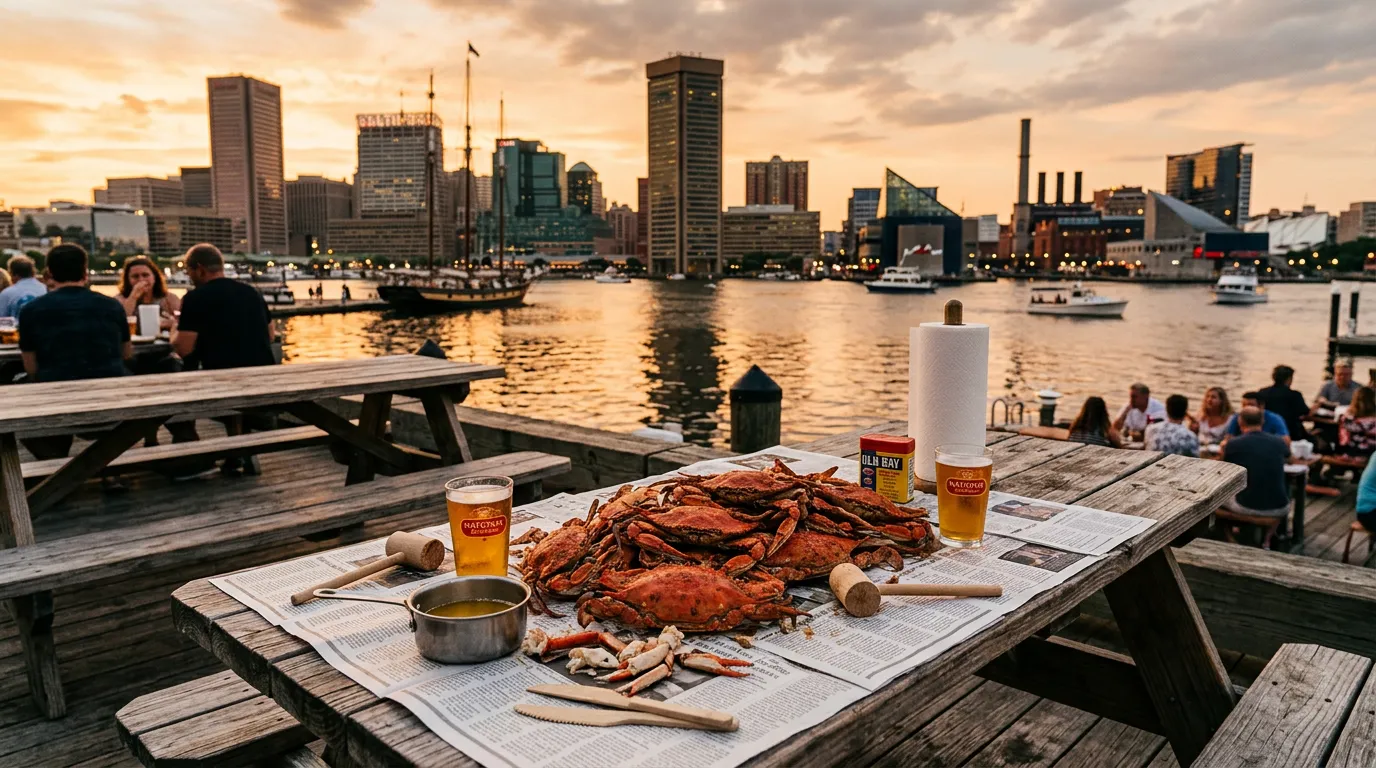
Old Bay seasoning is a genuine cultural touchstone here, not a gimmick. Steamed blue crabs are eaten communally at paper-covered tables with mallets and knives — LP Steamers in Locust Point and Thames Street Oyster House in Fells Point are field-tested picks. Crab cakes vary wildly; avoid tourist-trap versions at Inner Harbor chains. For authentic crab cakes, try Faidley's Seafood inside Lexington Market (one of the oldest continuously running public markets in the US, recently renovated). Peak crab season runs June through October.
ICONIC · SEASONAL
World-Class Free Museums
Baltimore has an embarrassment of free museum riches. The Baltimore Museum of Art (housing the largest collection of Matisse works in the world) and the Walters Art Museum (spanning 5,500 years of art) are both completely free, always. The American Visionary Art Museum (AVAM) on the south side of the Inner Harbor charges admission but is unlike any museum you have visited — outsider art that is bizarre, moving, and deeply photogenic. The Reginald F. Lewis Museum covers African American history in Maryland and is essential context for understanding the city.
FREE · ICONIC · RAINY DAY
Connectivity and Payment Setup
International visitors can grab prepaid SIM cards at T-Mobile or AT&T stores near Inner Harbor or in Towson Town Center mall. Most of Baltimore is well-covered by LTE/5G. Google Maps works perfectly for navigation including transit routes. Apple Pay, Google Pay, and contactless cards are accepted almost everywhere — Baltimore is largely cashless-friendly, though some crab houses and market stalls are cash-only. Download the CharmPass app for mobile bus and light rail tickets on the MTA system.
TRANSIT-FRIENDLY
The Hon Culture and Local Etiquette
Baltimore's working-class roots show in the local dialect — the city is pronounced 'Bawlmer' by natives, and the affectionate term 'hon' (short for honey) is still used. People here are direct and friendly but proud — do not compare Baltimore unfavorably to DC or reference only The Wire. Tipping 20% is standard at restaurants. The city has a complicated relationship with its national reputation; showing genuine curiosity about neighborhoods and local institutions goes a long way.
HIDDEN GEM
Fort McHenry and Literary History
Fort McHenry is where the Star-Spangled Banner was literally written — Francis Scott Key watched the British bombardment from the harbor in 1814. It is a genuinely moving site, especially at sunset facing the water. Edgar Allan Poe lived, died, and is buried in Baltimore; his grave at Westminster Hall is free to visit, and the Edgar Allan Poe House in the west side is a small but atmospheric museum. These two sites give Baltimore historical weight that surprises most visitors.
ICONIC · SUNSET · PHOTO
The Inner Harbor Tourist Trap Warning
The Inner Harbor is fine for the National Aquarium (genuinely excellent, book tickets online in advance to skip lines) and a waterfront walk, but the chain restaurants and mall-like Harborplace area are overpriced and generic. Eat and drink in Fells Point, Canton, Federal Hill, or Hampden instead. The water taxi is a legitimately useful and scenic way to hop between waterfront neighborhoods rather than driving or ridesharing.
CROWD WARNING · BOOK AHEAD · BUDGET
When to Go
Late September through mid-October is Baltimore's sweet spot — temperatures hover around 18–24°C (65–75°F), humidity drops, and fall foliage lights up Patterson Park, Druid Hill Park, and the neighborhoods of Roland Park. It is the best window for walking Fells Point and Federal Hill, eating at outdoor crab houses, and shooting golden hour over the Inner Harbor without summer's oppressive heat or winter's short days.
Chesapeake Crab Season
Maryland blue crab season defines Baltimore's culinary identity. Crab houses across the city pile steamed crabs seasoned with Old Bay on brown paper-covered tables. The best crabs come mid-summer when they are fattest and most plentiful.
Best for food-focused trips; book popular crab houses like LP Steamers or Thames Street Oyster House ahead on weekends.
Crab Off-Season
Blue crabs become scarce and expensive as the Chesapeake Bay waters cool. Many crab houses close or switch to imported crab. The city's food scene pivots to oysters, soups, and hearty comfort food.
Don't plan a trip around crabs in winter — shift focus to oyster bars, crab cakes (available year-round from frozen stock), and Baltimore's excellent restaurant scene.
Cherry Blossom Season
While DC gets the fame, Baltimore has its own beautiful cherry blossom displays in Patterson Park, along the Inner Harbor promenade, and at Sherwood Gardens. Peak bloom is typically late March to mid-April, roughly a week after the DC peak.
Excellent for photography with fewer crowds than the National Mall — combine with a day trip to DC's Tidal Basin for a blossom double-header.
Festival Season
Baltimore packs its summer with outdoor festivals including HonFest in Hampden, Artscape (the largest free arts festival in the US), Fourth of July at Fort McHenry, and numerous neighborhood block parties. The city's creative energy peaks despite the heat.
Book accommodation early for Artscape weekend in July; plan outdoor festival visits for morning or evening to avoid heat exhaustion.
Fall Foliage Season
Foliage begins to turn in late September and peaks mid-to-late October across Druid Hill Park, Cylburn Arboretum, and the neighborhoods of Roland Park and Guilford. The warm tones against red brick rowhouses create Baltimore's most photogenic moments.
Best overall travel window — combine foliage photography with comfortable walking temps and the tail end of crab season for the ideal Baltimore trip.
Where to Stay
Baltimore offers surprisingly good hotel value compared to nearby Washington, D.C., with rates often 30-50% lower for comparable quality. The Inner Harbor is the default tourist base but can feel sterile at night; Fells Point and Federal Hill deliver more neighborhood character. Weekends around Orioles and Ravens game days spike prices significantly, so check the sports calendar before booking.
Four Seasons Baltimore
Harbor East
Hotel
ICONIC · PHOTO · BOOK AHEAD
Sagamore Pendry Baltimore
Fells Point
Boutique Hotel
ICONIC · PHOTO · NEXTPIC
Hotel Revival
Mount Vernon
Boutique Hotel
HIDDEN GEM · PHOTO · TRANSIT-FRIENDLY
Inn at Henderson's Wharf
Fells Point
Boutique Hotel
HIDDEN GEM · BUDGET · FREE
Sleep Inn & Suites Downtown Inner Harbor
Inner Harbor / Downtown
Hotel
BUDGET · TRANSIT-FRIENDLY
HI Baltimore Hostel
Mount Vernon
Hostel
BUDGET · HIDDEN GEM · EASY WALK
1840s Carrollton Inn
Jonestown / Little Italy
Guesthouse
HIDDEN GEM · PHOTO · NEXTPIC
The Ivy Hotel
Mount Vernon
Boutique Hotel
ICONIC · BOOK AHEAD
Top Attractions
№ 1 · Essential
American Visionary Art Museum
★ ICONIC · PHOTO · NEXTPIC · EASY WALK
One of the most genuinely unique museums in America, dedicated entirely to self-taught and outsider art. The building itself is part of the experience with a wildly decorated exterior and a giant whirligig sculpture. This is not your typical stuffy museum — it is weird, moving, and deeply memorable.
Tip: Start on the top floor and work down. The outdoor sculpture garden facing the harbor is an overlooked photo spot. The museum gift shop is legitimately one of the best in the country.
Best: Weekday mornings for near-empty galleries. Saturday afternoons get busy with families.
Fees: $16 adults, discounts for students and seniors
Patterson Park Pagoda
A colorful octagonal pagoda from 1891 sitting atop the highest point in Patterson Park, offering panoramic views of east Baltimore and the harbor. Most tourists never make it here because it sits in a residential neighborhood rather than the Inner Harbor tourist zone. This is the Baltimore that locals actually love.
HIDDEN GEMLexington Market
The oldest continuously operating public market in America, recently renovated in 2022 with a stunning modern interior while keeping its gritty Baltimore soul. Faidley's raw bar has served some of the best crab cakes in Maryland since 1886. This is real Baltimore food culture, not a sanitized tourist version.
ICONICGraffiti Alley (Station North Arts District)
A constantly changing outdoor gallery of street art spanning multiple alley walls near North Avenue. The murals rotate as artists paint over each other, so every visit is different. It is raw, unpolished, and completely authentic to Baltimore's art scene.
PHOTONeighbourhoods
Fells Point
Historic cobblestone waterfront district with 18th-century row houses, working wharves, and a bar scene that has been going strong since before the American Revolution. Think maritime grit meets creative energy.
Must do: Walk Thames Street for waterfront pubs and the original The Horse You Came In On Saloon (allegedly Edgar Allan Poe's last bar). Browse the Broadway Market for crab cakes and local produce. Photograph the tugboats and historic ships along the docks at golden hour.
ICONIC · PHOTO · GOLDEN HOUR · NIGHT SHOOT · EASY WALK
Federal Hill
The definitive Baltimore postcard view lives at the top of Federal Hill Park, looking north across the harbor to the downtown skyline. Below the hill, a tight grid of brick row houses hides excellent restaurants and a proud local-bar culture.
Must do: Climb Federal Hill Park for the single best skyline photo in Baltimore, ideally at blue hour. Eat at Cross Street Market for updated food hall options. Grab a drink at Little Havana for Cuban food and salsa nights.
ICONIC · PHOTO · BLUE HOUR · SUNSET · NEXTPIC · FREE · EASY WALK
Hampden
A former mill village turned quirky-cool arts district centered on 36th Street, known locally as The Avenue. This is Baltimore's most unapologetically weird neighborhood — flamingo lawn ornaments, vintage shops, and John Waters energy.
Must do: Browse The Avenue for independent shops like Atomic Books (John Waters' favorite) and Bazaar for oddities and taxidermy. Eat at The Food Market for upscale comfort food. Visit during HonFest in June if you want full Baltimore kitsch immersion.
HIDDEN GEM · PHOTO · SEASONAL · BUDGET
Mount Vernon
Baltimore's old cultural center, anchored by the original Washington Monument and ringed with Gilded Age architecture, concert halls, and the Walters Art Museum. Quieter and more European-feeling than any other part of the city.
Must do: Visit the Walters Art Museum, which is free and genuinely world-class. Climb the Washington Monument for a 360-degree city view. Catch a show at the beautifully restored Lyric Baltimore or the intimate Meyerhoff Symphony Hall.
ICONIC · FREE · PHOTO · EASY WALK · TRANSIT-FRIENDLY
Canton
A polished waterfront neighborhood east of Fells Point with a lively town square, young professional energy, and a strip of restaurants and bars along O'Donnell Square. Feels more suburban-safe than other harbor-area neighborhoods.
Must do: Walk the Canton Waterfront Park promenade for harbor views without the Inner Harbor crowds. Eat at Mama's on the Half Shell for Baltimore's best raw bar experience. Explore the shops and weekend brunch scene around O'Donnell Square.
FAMILY · EASY WALK · BUDGET
Remington
An up-and-coming neighborhood north of Penn Station anchored by the R. House food hall and a growing cluster of independent shops along Howard and 25th Streets. This is where Baltimore's next wave of restaurants and makers are landing.
Must do: Eat through R. House food hall for a rotating roster of local chef concepts. Browse the shops and murals along 25th Street. Stop by The Baltimore Museum of Art on the neighborhood's eastern edge — it is free and has a stunning Matisse collection.
HIDDEN GEM · BUDGET · PHOTO · FREE
Inner Harbor
The gleaming, tourist-oriented waterfront that most visitors see first — home to the National Aquarium, the USS Constellation, and chain restaurants. It is well-maintained and safe but feels more like a convention center district than real Baltimore.
Must do: The National Aquarium is legitimately excellent and worth booking ahead. Walk the promenade for context and orientation. Photograph the Seven Foot Knoll Lighthouse, especially at sunrise when nobody else is around.
CROWD WARNING · BOOK AHEAD · FAMILY · TRANSIT-FRIENDLY
Day Trips
Washington, D.C.
Travel: 65 km / 1 hr by car, 1 hr by MARC Penn Line train
Annapolis, Maryland
Travel: 50 km / 45 min by car
Gettysburg National Military Park, Pennsylvania
Travel: 120 km / 1.5 hr by car
Harpers Ferry, West Virginia
Travel: 105 km / 1.25 hr by car, 1.5 hr by MARC Brunswick Line
Eastern Shore: St. Michaels and Easton
Travel: 110 km / 1.5 hr by car
Rocks State Park and Falling Branch (Kilgore Falls)
Travel: 55 km / 50 min by car
Longwood Gardens, Kennett Square, Pennsylvania
Travel: 100 km / 1.25 hr by car
Scenic Routes
Inner Harbor Waterfront Promenade
Walking
Route: Fells Point to Federal Hill Park
ICONIC · PHOTO · GOLDEN HOUR · SUNSET · EASY WALK · NEXTPIC · FREE
Jones Falls Trail
Cycling
Route: Inner Harbor to Druid Hill Park / Lake Roland
HIDDEN GEM · PHOTO · EASY WALK · FREE · FAMILY
Fort McHenry Loop and Locust Point Walk
Walking
Route: Fort McHenry Visitor Center loop to Locust Point waterfront
ICONIC · PHOTO · SUNRISE · EASY WALK · NEXTPIC
Falls Road Scenic Drive to Loch Raven Reservoir
Driving
Route: Hampden neighborhood to Loch Raven Reservoir Dam
PHOTO · SEASONAL · SUNSET · GOLDEN HOUR · FREE · HIDDEN GEM
Patterson Park Pagoda and Hilltop Circuit
Walking
Route: Patterson Park loop from Linwood Avenue entrance
HIDDEN GEM · PHOTO · GOLDEN HOUR · FREE · EASY WALK
Gwynns Falls Trail to Leakin Park
Hiking
Route: Middle Branch Park to Winans Meadow in Leakin Park
HIDDEN GEM · PHOTO · FREE · HARD HIKE
Street Art
Baltimore has one of the most vibrant and deeply rooted street art scenes on the East Coast. Station North Arts District is the undisputed epicenter, where warehouses, alley walls, and entire building facades serve as rotating canvases. But the scene extends well beyond that neighborhood: Highlandtown's Creative District, Bromo Arts District, and scattered corridors throughout West and South Baltimore all carry significant murals. The city actively encourages public art through programs like the Baltimore Mural Program and the Open Walls initiative, which has invited international artists since 2012. The result is an unusually high ratio of commissioned, high-quality large-scale works mixed with raw, unsanctioned pieces that give the city its gritty authenticity.
Station North Arts District
The heartbeat of Baltimore street art. Nearly every surface along North Avenue and the surrounding side streets and alleys carries murals, wheat pastes, or stencil work. The Open Walls Baltimore project transformed this area starting in 2012, bringing in artists like Gaia, Nanook, and Jet Martinez. The alley behind the copy shop on Charles Street is an ever-rotating gallery. Multi-story building murals dominate intersections. This is the one area where you could spend two hours and still miss things.
North Avenue between Charles Street and Maryland Avenue, including side alleys
ICONIC · PHOTO · GOLDEN HOUR · NEXTPIC · EASY WALK · FREE
Graffiti Alley (Howard Street Tunnel Area)
A long stretch of sanctioned graffiti walls tucked behind North Howard Street near the MICA campus. This is where local writers and visiting artists trade pieces constantly, making it one of the most dynamic rotating walls in the Mid-Atlantic. The colors are dense and layered, creating incredible photographic texture. The tunnel portions add dramatic lighting contrast that photographs beautifully.
W North Avenue near Howard Street, behind Maryland Institute College of Art
PHOTO · HIDDEN GEM · NEXTPIC · FREE
Highlandtown Arts District
Baltimore's second major mural corridor runs along Eastern Avenue and the surrounding blocks of this traditionally working-class neighborhood. The Creative Alliance at the Patterson has been a catalyst for murals celebrating the neighborhood's immigrant heritage and Latino community. Walls here tend to be more narrative and culturally specific than Station North, with vivid color palettes that photograph exceptionally well against the rowhouse brick.
Eastern Avenue between South Conkling Street and South Highland Avenue
PHOTO · GOLDEN HOUR · HIDDEN GEM · FREE · TRANSIT-FRIENDLY
Bromo Arts District
The area surrounding the iconic Bromo Seltzer Tower has been building its mural inventory steadily. Large-scale pieces adorn parking structures and building sides along West Franklin and Eutaw Streets. The juxtaposition of street art against classic Baltimore architecture creates compelling compositions. Several pieces here address social justice themes specific to Baltimore's history.
West Franklin Street and Eutaw Street corridor near Bromo Seltzer Tower
PHOTO · BLUE HOUR · EASY WALK · FREE
Pigtown / Washington Village
An under-the-radar neighborhood south of the stadiums where community-driven murals line Washington Boulevard and side streets. The work here is less polished than Station North but carries raw energy and deep neighborhood pride. Several pieces celebrate Baltimore music and sports culture. The rowhouse context gives everything an authentic Baltimore feel that the more curated districts sometimes lack.
Washington Boulevard between South Carey Street and South Monroe Street
HIDDEN GEM · PHOTO · FREE · BUDGET
Culture & History
Baltimore is a fiercely independent port city whose identity was forged by immigration, Black cultural innovation, and blue-collar resilience. It gave America its national anthem, shaped the trajectory of jazz and hip-hop, and remains a place where neighborhood identity matters more than any downtown skyline. Its contradictions — grand institutions alongside deep inequality — make it one of the most culturally honest cities in the United States.
Eat & Drink
Baltimore's food identity is built on Chesapeake Bay blue crabs, Old Bay seasoning, and a working-class port city attitude that prizes generous portions over pretension. Crab cakes here are a religion, pit beef is the local barbecue, and Berger cookies are the dessert you didn't know you needed. The Inner Harbor tourist corridor has its moments, but the real eating happens in Fells Point, Hampden, Remington, and Federal Hill.
Thames Street Oyster House ★★★★★
Award-winning crab cake, raw bar with East Coast oyster selection, lobster roll, pan-roasted rockfish
Fells Point, 1728 Thames St
Restaurant · msw:dinner
LP Steamers ★★★★★
Steamed blue crabs by the dozen with Old Bay, crab soup, fried shrimp, pit beef sandwich
Locust Point, 1100 E Fort Ave
Restaurant · msw:lunch
Woodberry Kitchen ★★★★
Farm-to-table Chesapeake cuisine, wood-grilled meats, seasonal vegetable plates, house-made charcuterie
Clipper Mill, 2010 Clipper Park Rd
Restaurant · vegetarian_restaurant · msw:dinner
Ekiben ★★★★
Asian-fusion steamed buns, Neighborhood Bird fried chicken bao, Spicy Bird rice bowl, tofu tempura buns
Fells Point, 1622 Eastern Ave
Restaurant · msw:lunch
Land of Kush ★★★
Vegan soul food: BBQ cauliflower, kush burger, mac and yease, collard greens, sweet potato pie
Downtown West, 840 N Eutaw St
Restaurant · vegan_restaurant · msw:dinner
Ceremony Coffee Roasters
Single-origin pour-overs, expertly pulled espresso, beautifully designed spaces with natural light perfect for photography
Harbor Point, 1531 Whetstone Way
Coffee · cafe
Dovecote Cafe
Specialty espresso drinks, rotating pastry case from local bakers, a warm community gathering space in a historic Reservoir Hill rowhouse
Reservoir Hill, 2501 Madison Ave
Coffee · cafe
Sophomore Coffee
Creative seasonal lattes, oat milk specialties, minimalist aesthetic with great window light
Fells Point, 1601 Eastern Ave
Coffee · cafe
Spro Coffee
Precision espresso from a veteran roaster, Japanese-influenced brewing methods, no-frills approach focused entirely on coffee quality
Hampden, 851 W 36th St
Coffee · cafe
Sacré Sucré
French macarons, croissants, opera cake, seasonal tarts, European-style pastries with Baltimore personality
Fells Point, 811 S Broadway
Bakery · bakery
Blue Moon Cafe
Captain Crunch french toast, enormous omelets, homemade biscuits, decadent brunch plates piled absurdly high
Fells Point, 1621 Aliceanna St
Bakery · bakery · breakfast_restaurant
Bramble Baking Co.
Artisan sourdough loaves, seasonal scones, morning buns, simple European-style breads
Remington, 411 W 28th St [ASSUMPTION]
Bakery · bakery
The Land of Kush
Vegan soul food buffet: BBQ cauliflower wings, black-eyed pea cakes, collard greens, mac and yease, sweet potato pie
Downtown West, 840 N Eutaw St
Vegetarian · vegan_restaurant
Harmony Bakery
100% vegan baked goods, savory hand pies, seasonal soups, the famous vegan crab cake made with artichoke hearts
Hampden, 3446 Chestnut Ave [ASSUMPTION]
Vegetarian · vegan_restaurant
Liquid Earth
Smoothie bowls, raw juices, grain bowls, vegan wraps, superfood salads
Mt. Vernon, 1626 Aliceanna St [ASSUMPTION]
Vegetarian · vegetarian_restaurant · vegan_restaurant
Shopping
Baltimore is a city of distinctive neighborhoods, each with its own shopping personality. Vintage lovers, book hounds, and anyone looking for handmade goods from a thriving maker community will find this city quietly rewarding — just don't expect polished tourist retail strips.
Baltimore Farmers' Market & Bazaar
Mixed
Beyond produce, the Bazaar section is the draw: local potters, letterpress printers, jewelry makers, candle makers, vintage clothing vendors, and Baltimore-themed screen-printed goods. One of the best single stops for locally made gifts.
Market · ICONIC · PHOTO · BUDGET · EASY WALK
The Fells Point Antique Dealers
Antiques
Mid-century furniture, nautical antiques, vintage glassware, estate jewelry, and maritime art. Fells Point's harbor history means genuine nautical items surface regularly — porthole mirrors, old ship hardware, navigational tools.
Market · HIDDEN GEM · EASY WALK
Hampden Honfest Weekend Markets
Craft
Handmade Baltimore kitsch, beehive-themed accessories, locally printed textiles, and quirky art. The best concentrated dose of Baltimore's self-deprecating humor in object form.
Market · SEASONAL · FREE · CROWD WARNING · PHOTO
32nd Street Farmers Market
Mixed
In addition to produce, look for handmade soaps, beeswax candles, local honey products, pottery, and knitted goods from Baltimore-area artisans. Strong year-round vendor presence even in winter.
Market · HIDDEN GEM · BUDGET · EASY WALK
Hampden — 36th Street (The Avenue)
Baltimore's most walkable indie shopping strip. Eclectic, proudly weird, and loaded with locally owned boutiques. Zero chain stores. Think vintage, handmade, books, and oddities.
Atomic Books for underground comics, zines, and John Waters memorabilia (Waters receives his fan mail here). The True Vine for vinyl records. Doubledutch Boutique for curated home goods and gifts from local designers. Ma Petite Shoe for hard-to-find shoe brands. Bazaar for vintage clothing with genuine inventory turnover.
District · ICONIC · PHOTO · EASY WALK · NEXTPIC
Fells Point
Historic waterfront neighborhood with cobblestone streets. Mix of antique shops, independent bookstores, vintage boutiques, and maritime-themed stores alongside some tourist-oriented shops near the water.
The Sound Garden for used vinyl and CDs (massive, well-organized inventory). Fells Point Antique dealers for nautical finds and estate jewelry. Su Casa for Latin American folk art imports. Avoid the generic souvenir shops right at the Broadway Pier — walk a block inland for the real finds.
District · ICONIC · PHOTO · EASY WALK · TRANSIT-FRIENDLY
Station North Arts & Entertainment District
Baltimore's designated arts district north of Penn Station. Gallery-heavy with a growing number of maker studios that sell direct. Grittier and less polished than Hampden but more creatively charged.
Motor House for rotating gallery shows with purchasable work. Area 405 artist studios (open studio events several times per year). Load of Fun Arts for studio visits and direct artist purchases. Good for original art at working-artist prices rather than gallery markup.
District · HIDDEN GEM · BUDGET
Photo Spots
Baltimore sits at roughly 39 degrees north latitude, giving it dramatic seasonal light swings. Summer sunrise comes before 5:45am with sunset past 8:30pm, delivering long golden hours and extended blue hour windows — June and July evenings are prime for harbor reflection work with over 90 minutes of usable dusk light. Winter compresses everything: sunrise around 7:15am, sunset by 4:45pm, but the low sun angle means golden light rakes across the rowhouse neighborhoods and harbor facades almost horizontally, creating rich texture and long shadows that summer cannot match. The best all-around months for photography are October (fall foliage in Mount Vernon and Patterson Park, comfortable temperatures, moderate crowds) and May (blooming trees, pleasant light, pre-tourist season). Baltimore gets significant rain year-round — pack a rain cover, but also embrace it. Wet cobblestones in Fell's Point and neon reflections on rain-slicked streets are among the city's strongest images.
Inner Harbor Promenade — Federal Hill View
The defining Baltimore skyline shot. From the top of Federal Hill Park you get the full Inner Harbor panorama: the World Trade Center, National Aquarium, USS Constellation, and Power Plant Live neon reflections in the water. The hill elevation gives you a clean foreground-to-skyline layering that no waterfront angle can match. Shoot wide and tight — both work.
Fell's Point Cobblestone Streets
Baltimore's oldest waterfront neighborhood. Thames Street's Belgian block cobblestones, 18th-century rowhouses, tugboats moored at the Broadway Pier, and neon bar signs reflecting on wet stones after rain. The combination of maritime grit and colonial architecture is uniquely photogenic. Street-level wide angles on the cobblestones with leading lines toward the waterfront are the money shots.
Domino Sugars Sign from Harbor East
The giant red neon Domino Sugars sign is Baltimore's most recognizable industrial landmark. Shoot it reflecting in the harbor water from the Harbor East waterfront promenade. The sign faces north, so you're shooting south — it works beautifully at blue hour and night when the red neon pops against deep blue sky and reflects in the calm inner harbor water.
George Peabody Library
One of the most beautiful libraries in the world. A six-story atrium of ornate cast-iron balconies, black-and-white marble floor, and a massive skylight ceiling. Interior architecture photography at its finest. Shoot straight up from the center of the ground floor for the symmetrical atrium shot, or frame the iron railings with book spines as a layered composition.
Patterson Park Pagoda
An octagonal Victorian observation tower painted bright white sitting on the highest point in southeast Baltimore. The pagoda itself is the subject — shoot it against sunrise color or frame it with the surrounding neighborhood rowhouses for Baltimore context. From inside the pagoda on open days, the 360-degree view shows Baltimore's working-class neighborhood grid beautifully.
Graffiti Alley (Station North Arts District)
A series of alleys behind North Howard Street covered in large-scale murals and street art that rotates regularly. The murals are vibrant, detailed, and photograph well as both wide environmental shots and tight abstract crops. Pair a person in frame for scale. The narrow alley creates interesting light shafts at midday.
Fort McHenry National Monument
The birthplace of the Star-Spangled Banner. The star-shaped fort is best captured from the waterfront seawall looking back at the ramparts with the massive American flag flying. Sunrise behind you lights up the fort walls in warm light. The flag against dawn color is the hero shot. Also excellent for long-exposure harbor shipping lane shots from the seawall.
Mount Vernon Place — Washington Monument
America's first major monument to George Washington — a tall column in a leafy square surrounded by elegant 19th-century mansions and churches. The four-square park layout creates symmetrical compositions with the column centered. In fall, the mature trees provide incredible foliage framing. The Walters Art Museum and the Peabody Conservatory flank the square, adding architectural variety.
Suggested Itinerary
Nightlife
Baltimore's nightlife is gritty, neighborhood-driven, and genuinely local. Things get moving around 10pm on weekends, with Fells Point and Federal Hill anchoring the bar-crawl circuit while Canton and Hampden offer more curated scenes. The dominant energy is dive bars and live music rather than velvet-rope clubs — this is a city that drinks Natty Boh and means it.
The Horse You Came In On Saloon
Allegedly the last bar Edgar Allan Poe drank in before dying, now a packed two-floor spot where cover bands play seven nights a week and tourists mix with locals who stopped caring about the Poe thing decades ago
No cover most nights. Live music starts around 9pm. Cash-friendly but cards accepted. Gets absolutely crushed on weekends after 11pm — arrive early or accept the crowd. Cheap domestics and shooters are the move here, not craft cocktails.
Cat's Eye Pub
A narrow, dark, genuinely sticky-floored blues and jazz bar where musicians who could play anywhere choose to play here because the room listens
Live music nightly, typically blues, jazz, or roots. No cover most nights. Tiny space fills fast — get there by 9pm on Fridays and Saturdays. The back room is slightly less chaotic. Strong pour on whiskey drinks.
W.C. Harlan
An unmarked door on a residential street opens into a candlelit room with exposed brick and bartenders who take their craft seriously without making you feel stupid for ordering simple
No sign outside — look for the address on W 36th St area. No reservations, first come first served. Seats maybe 30 people. Cash only. Cocktails are beautifully made and around $14-16. Closes at midnight on weeknights, 1am weekends. Not a place to get rowdy.
Club Charles
A neon-lit retro dive with art deco bones and a clientele split between film students, off-duty musicians, and people who've been drinking here since the John Waters era — because Waters actually drinks here
Cash only. Cheap drinks, no food. The jukebox is excellent. Best after 11pm when the after-show crowd from nearby venues filters in. Adjacent to the Charles Theatre. No pretension tolerated despite the cool factor.
Power Plant Live!
Baltimore's most unapologetically mainstream nightlife complex — multiple bars and a dance club arranged around an open courtyard where bachelorette parties and young professionals collide under string lights
Cover charges on weekends typically $5-10 depending on the venue within the complex. Dress code enforced at some spots — no athletic wear, no excessively baggy clothing. Mosaic is the main dance club. Luckie's Tavern for more casual drinking. Peaks around midnight on Saturdays. Tourist-heavy but functional.
The Brewer's Art
A gorgeous Mt. Vernon rowhouse with a civilized upstairs dining room and a dark, vaulted basement bar that feels like drinking in a medieval crypt — the Resurrection Ale is legendary for a reason
House-brewed Belgian-style beers are the reason to come. The basement bar has no reservations and no food service but strong atmosphere. Upstairs kitchen closes earlier. Basement gets busy after 10pm on weekends. One of the best beer bars on the East Coast, full stop.
Sugarvale
A tiny, intimate cocktail bar hidden above another restaurant where the bartender remembers your name by your second visit and the drink menu changes with quiet confidence
Seats about 25 people — if it is full, you wait or leave. No reservations. Look for the staircase entrance. Cocktails $13-16 and meticulously crafted. Closes around midnight. Not the place for large groups.
Ottobar
Baltimore's essential indie and punk venue — a sweaty, loud room with a balcony for watching and a downstairs bar for recovering, where touring bands play on the way up and come back after they've made it
Ticket prices vary by act, typically $10-25 for touring bands. Check calendar online. Upstairs is the main stage, downstairs bar is free to enter. Best shows are weeknight surprises when a bigger act plays a small room. Sound quality is better than you'd expect. All ages for some shows.
Grand Central
Baltimore's longtime anchor LGBTQ+ venue with multiple rooms, drag shows, dance floors, and the kind of welcoming chaos where everyone ends up dancing with strangers by 1am
Drag shows on weekends are popular — arrive early for good sightlines. Cover varies, usually $5-10 on event nights. Multiple bars inside so drink lines move. Saturday nights are the biggest. Inclusive and welcoming to all. The outdoor patio is a lifesaver in summer.
Max's Taphouse
A beer cathedral with 140+ taps and a multi-level layout that somehow stays manageable — the kind of place where you sit down for one flight and leave three hours later having befriended the couple next to you
The tap list is genuinely overwhelming — ask the bartender for guidance based on what you like. Second floor has more seating and is quieter. Gets packed on weekend nights. Good late-night food menu. One of the best beer selections in the mid-Atlantic.
Build your own Itinerary from this guide
Pick the places you care about — attractions, photo spots, map markers — and we'll lay out a day-by-day starting point. Yours to edit; guide updates never touch it.