Essentials
Currency, language, transit & safety — tap to expand.
Currency — Chinese Yuan Renminbi (CNY/RMB), symbol ¥. Roughly ¥7.2 = 1 USD, ¥7.8 = 1 EUR as of mid-2025
Cash vs card — China runs on mobile payment — WeChat Pay and Alipay dominate everything from street food to taxis. Foreign visitors can now link international Visa/Mastercard to both apps, which is a game-changer. Carry some cash (¥200-500) for small vendors and older markets, but you will use your phone for 90% of transactions. ATMs exist at major banks (ICBC, Bank of China) but withdrawal fees add up. Tipping is not expected and can cause confusion — don't tip at restaurants or taxis.
Budget — Budget: ¥250-400/day (roughly $35-55 USD) — hostels, street food, metro travel. Mid-range: ¥600-1200/day ($85-165 USD) — 3-4 star hotels, sit-down Sichuan restaurants, occasional DiDi rides. Luxury: ¥2000+/day ($280+ USD) — 5-star hotels like The Temple House, upscale hotpot, private tours to Leshan or panda bases.
Language — Mandarin Chinese (Putonghua) is the official language. Locals also speak Sichuanese dialect among themselves, which even Mandarin speakers from other regions find tricky. Younger people in tourism and tech sectors speak some Mandarin with a distinctive Chengdu lilt.
Language barrier — English proficiency is low outside international hotels and a handful of tourist-facing restaurants. Metro signs and announcements are bilingual. Google Translate (with downloaded Chinese pack for offline use) is essential — note that Google services require a VPN. Alternatively, use Baidu Translate or the translate feature built into WeChat. Restaurant menus increasingly have photos, which helps enormously.
Getting around — Chengdu is very navigable. The metro is excellent, clean, and expanding fast — it covers most tourist areas and costs almost nothing. DiDi (Chinese Uber) fills every gap the metro misses. The city is flat, making it bikeable via shared bikes. Avoid renting a car — traffic is chaotic and parking is a nightmare.
Safety — Chengdu is one of the safest major cities in China — violent crime targeting tourists is essentially nonexistent. Petty theft is rare but keep phones secure in crowded metro cars and at Chunxi Road. The real risks are practical: install a VPN before arrival (ExpressVPN or Astrill) since Google Maps, Instagram, WhatsApp, and most Western apps are blocked. Air quality can spike in winter — check AQI apps and carry a mask if sensitive. Sichuan cuisine is genuinely, aggressively spicy — ease in gradually or you will regret it physically. Crossing streets requires boldness; cars and scooters do not always yield at crosswalks. If visiting the Panda Base, book tickets online at least a day ahead — walk-up access has been restricted since 2023.
Highlights
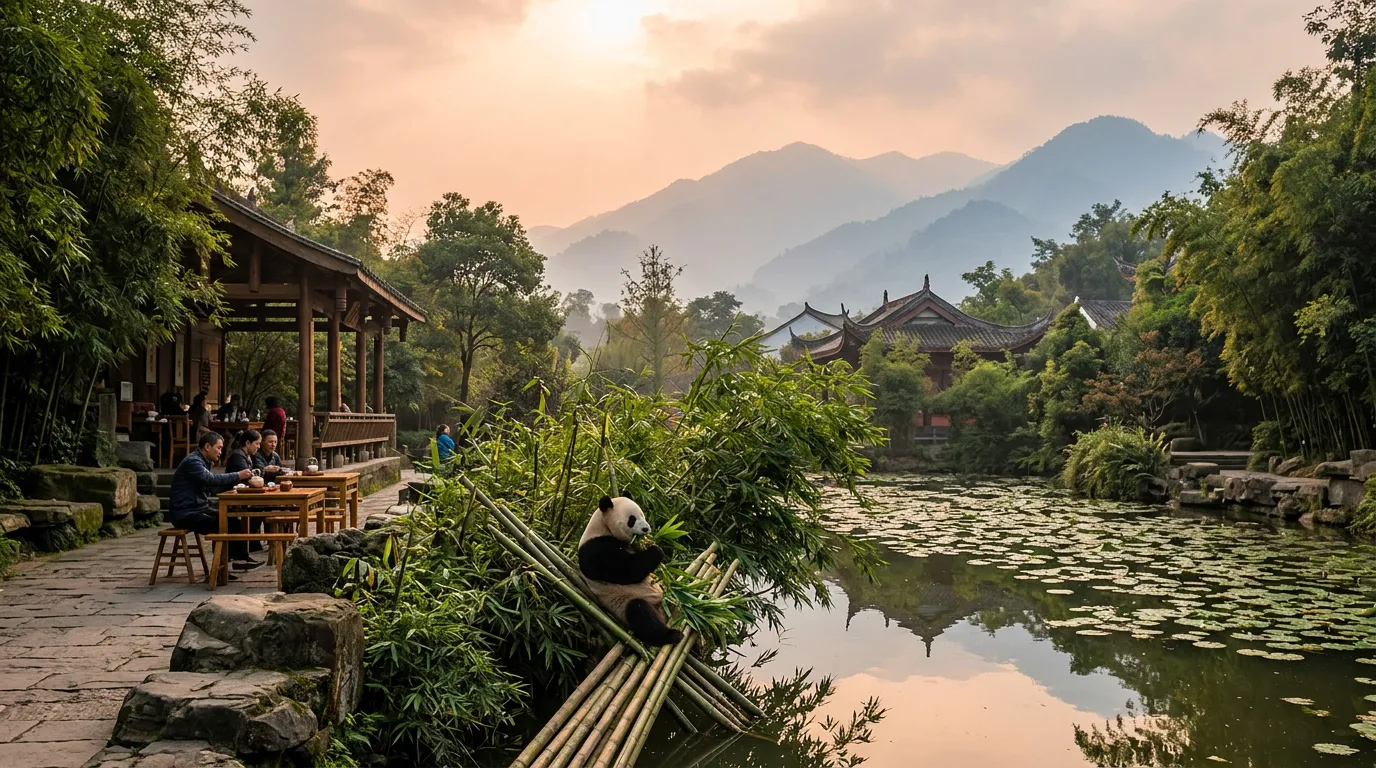
Chengdu is China's great slow city — a sprawling Sichuan capital where people drink tea for hours in bamboo-chair courtyards, eat face-numbing hotpot at midnight, and somehow maintain a laid-back pace that makes Beijing and Shanghai feel frantic. It is simultaneously ancient (2,300+ years of continuous settlement) and hyper-modern, with a creative arts scene, world-class street food, and the only place on Earth you can watch giant pandas in their native habitat zone.
Tea House Culture Is the Real Attraction
Chengdu's tea houses are not tourist traps — they are genuine social infrastructure. Locals spend entire afternoons playing mahjong, getting ear cleanings, and sipping covered-bowl gaiwan cha. Heming Tea House in People's Park is the most famous and still authentic. Daci Temple tea garden is quieter. Order jasmine flower tea (molihua cha) and expect unlimited hot water refills. Budget 15-30 RMB. Going before 10am on weekdays gives you the most local crowd.
ICONIC · BUDGET · PHOTO · EASY WALK
Sichuan Food Goes Far Beyond Hotpot
Yes, do hotpot — Xiaolongkan and Dazhai Hotpot are reliable chains, but locals love neighborhood joints with no English menus. Beyond hotpot: dan dan noodles, mapo tofu (the original is at Chen Mapo Tofu on Xiyulong Street), rabbit head (tou), Zhong dumplings, and sweet water noodles. Key phrase: wei la (slightly spicy) or bu la (not spicy). Street food alleys around Yulin Lu and Jianhe Lu are more authentic than Jinli Ancient Street, which is heavily touristed.
ICONIC · HIDDEN GEM · BUDGET
144-Hour Visa-Free Transit Policy
Citizens of 54 countries (including US, UK, Canada, Australia, most EU nations) can enter Chengdu visa-free for up to 144 hours when transiting to a third country. You must have a confirmed onward ticket to a different country than your origin. Apply at the immigration counter on arrival at Chengdu Tianfu International Airport (TFU) or the older Shuangliu Airport (CTU). This is NOT automatic — you fill out paperwork at the port of entry. Keep your 144-hour window in mind; overstaying is a serious offense. For longer stays, a standard L (tourist) visa is required in advance.
BOOK AHEAD
Payment and Connectivity Setup
China runs almost entirely on mobile payment. WeChat Pay and Alipay now allow foreign credit cards to be linked — set this up BEFORE arrival. Many small vendors, taxis, and even street food stalls accept ONLY QR code payment. Cash backup is wise but increasingly refused. For SIM cards, China Mobile and China Unicom offer tourist SIM packages at the airport (around 100-200 RMB for 7-14 days with data). Note: Google Maps, Instagram, YouTube, WhatsApp, and most Western social media are blocked. Download a VPN before you arrive (Astrill or ExpressVPN work best in China). Use Amap (Gaode Ditu) or Baidu Maps instead of Google Maps — they are far more accurate for Chinese addresses and transit routing.
PLUGIN TIP
Giant Panda Base Strategy
Chengdu Research Base of Giant Panda Breeding is the marquee attraction. Book tickets on the official WeChat mini-program or via Trip.com at least 1-2 days ahead — walk-up availability is not guaranteed. Arrive for the 7:30am opening or skip it; by 10am it is a zoo-like crush of tour groups. Pandas are most active during morning feeding (8-10am) and become lazy logs by noon. The new expansion area (opened 2023) has more space and fewer crowds than the original zone. Budget 3-4 hours total.
ICONIC · BOOK AHEAD · CROWD WARNING · PHOTO · NEXTPIC
Chengdu Metro and DiDi Are Your Best Friends
The Chengdu Metro system is extensive, clean, cheap (2-7 RMB per trip), and covers most tourist areas. Line 1 and Line 3 hit the main spots. Use the Chengdu Metro app or Amap for routing. For taxis, use DiDi (China's Uber) — the international version works with foreign phone numbers and credit cards. Regular taxi flagfall is 8 RMB. Avoid tuk-tuks near tourist streets; they overcharge consistently. Renting bikes via Meituan Bike (yellow bikes) is excellent for flat Chengdu — scan the QR code with Alipay or WeChat.
TRANSIT-FRIENDLY · BUDGET
Sichuan Opera Face-Changing Shows
Bian lian (face-changing) is a Sichuan-specific art form where performers swap painted masks in milliseconds. Shufeng Yayun Opera House in the Culture Park district is the most respected venue — shows nightly around 8pm, tickets 150-320 RMB depending on seating and tea/snack inclusion. Jinjiang Theatre is another option. Book same-day via Trip.com or at the door. The technique is a nationally protected secret. Photography is allowed but flash is frowned upon. Shows typically last 90 minutes and include other Sichuan folk arts.
ICONIC · PHOTO · BOOK AHEAD
When to Go
Late September through mid-October (avoiding Golden Week Oct 1–7) is the sweet spot: comfortable 22–25°C days, the most sunshine Chengdu gets all year, and peak autumn color for both city ginkgo streets and Jiuzhaigou. This window is ideal for walking the old lanes, shooting golden-hour street food scenes, and eating outdoors at Yulin Lu night stalls without sweating through your shirt.
Misty Winter
Chengdu's famous grey blanket descends — fog, drizzle, and overcast skies define daily life. Locals retreat into tea houses and hotpot restaurants, and the city's indoor culture reaches its coziest. Temperatures hover around 5–10°C but the damp makes it feel colder.
Best for food-focused and cultural trips; outdoor photography is challenging without dramatic light, but moody tea house and street scenes are atmospheric.
Spring Festival Season
Chinese New Year (dates vary) brings temple fairs, lantern festivals at Wuhou Shrine, and a burst of festive energy. The city is decorated and celebratory, though many small businesses close for 1–2 weeks. Domestic tourism spikes during the holiday week.
Book flights and hotels well in advance; expect inflated prices during the holiday week but incredible cultural immersion.
Warming Spring
Cherry blossoms and rapeseed flowers bring color to the grey-green basin. Temperatures climb into the comfortable mid-teens to low twenties. The city wakes up outdoors — mahjong tables and tea sets appear in parks again.
Ideal shoulder season for comfortable walking and blossom photography with moderate crowds.
Monsoon Rains
The Sichuan Basin traps moisture, creating Chengdu's wettest and most humid period. Afternoon thunderstorms are near-daily in July and August. Flooding occasionally disrupts mountain road access to Jiuzhaigou, Siguniang, and other western Sichuan destinations.
Carry rain gear always; plan mountain excursions with buffer days for weather delays and check road conditions before departing.
Golden Autumn
The best weather Chengdu offers all year. Skies clear, humidity drops, and the Sichuan Basin gets its rare sunshine. Ginkgo-lined boulevards turn gold, and on exceptional mornings the Himalayan foothills appear on the western horizon from the city center.
Prime window for photography and day-trips, but avoid October 1–7 Golden Week unless you enjoy extreme crowds at every attraction.
Cool Late Autumn
A brief transitional window where autumn color lingers in early weeks before the winter grey takes over. Temperatures cool quickly but remain above freezing. The city settles into its winter rhythm of indoor socializing and hearty cuisine.
Best value-for-money month with low crowds, late autumn color, and the start of hotpot season — ideal for food-focused visitors.
Where to Stay
Chengdu offers exceptional value compared to Beijing and Shanghai, with luxury hotels running 30-50% cheaper and budget options plentiful near the metro. The best areas to stay cluster around Chunxi Road for walkability, Kuanzhai Alley for atmosphere, and the High-Tech Zone south of the river for modern business hotels. Book via Trip.com (Ctrip) rather than Western OTAs for better rates and smoother check-in at Chinese properties — foreign passport holders should confirm acceptance before booking smaller guesthouses.
The Temple House
Taikoo Li / Chunxi Road
Boutique Hotel
ICONIC · PHOTO · BOOK AHEAD
The Ritz-Carlton Chengdu
Tianfu Square / City Center
Hotel
ICONIC · SUNSET · FAMILY
BuddhaZen Hotel
Wenshu Monastery area
Boutique Hotel
HIDDEN GEM · PHOTO · BOOK AHEAD
Jinjiang Hotel Chengdu
Jinjiang District / Riverside
Hotel
ICONIC · TRANSIT-FRIENDLY
Lazybones Hostel
Wuhou District / near Wuhou Shrine
Hostel
BUDGET · FAMILY · TRANSIT-FRIENDLY
Dreams Travel Hostel
Chunxi Road area
Hostel
BUDGET · TRANSIT-FRIENDLY · EASY WALK
Diaoyutai Boutique Hotel Chengdu
Kuanzhai Alley area
Boutique Hotel
HIDDEN GEM · ICONIC · BOOK AHEAD
Chengdu Panda Themed Apartment
Various locations / Chenghua District
Apartment
FAMILY · PHOTO · NEXTPIC
Top Attractions
№ 1 · Essential
Wenshu Monastery
★ ICONIC · PHOTO · FREE · GOLDEN HOUR · EASY WALK · TRANSIT-FRIENDLY · BUDGET
Chengdu's best-preserved Buddhist temple complex is a living, breathing place of worship rather than a tourist museum. The surrounding Wenshu Fang street has been tastefully restored with teahouses, vegetarian restaurants, and local craft shops. The monastery's own vegetarian restaurant is genuinely excellent and absurdly cheap.
Tip: Eat lunch at the monastery's own vegetarian canteen on the grounds — the mushroom dishes are outstanding and most meals cost under 15 RMB. Arrive before 9am to watch locals doing morning prayers with minimal tourist crowds.
Best: Early morning, 7:30–9:00am, when incense smoke catches golden light and the courtyards are peaceful
Fees: Free
Chengdu Museum
A modern, well-curated museum in Tianfu Square that traces Chengdu's 4,500-year history with excellent English signage. The shadow puppet and Sichuan opera costume exhibits are highlights that most visitors rush past. Far less crowded than the Sichuan Provincial Museum and arguably better organized.
FREEHeming Teahouse in People's Park
This is where you truly understand Chengdu's legendary slow pace. Heming Teahouse has operated in People's Park since 1920 and remains the city's most authentic outdoor tea-drinking experience. Hundreds of locals spend entire afternoons here playing mahjong, getting ear cleanings, and doing absolutely nothing productively.
ICONICAnshun Bridge and Hejiang Pavilion
This illuminated covered bridge over the Jin River is Chengdu's most photogenic night scene. The current structure is a 2003 reconstruction inspired by a Marco Polo-era original, so don't expect ancient authenticity — but the LED-lit reflections on the water are genuinely stunning. The adjacent Hejiang Pavilion area is lively with riverside bars and restaurants.
PHOTONeighbourhoods
Kuanzhai Xiangzi (Wide and Narrow Alleys)
Qing-dynasty alley complex restored into Chengdu's most photogenic heritage district. Three parallel lanes mixing traditional courtyard houses with teahouses, craft shops, and street food stalls.
Must do: Photograph the grey-brick courtyard doorways at dawn before crowds arrive. Eat a bowl of dan dan noodles at one of the alley stalls. Sit for an ear-cleaning session at a traditional teahouse.
ICONIC · PHOTO · CROWD WARNING · EASY WALK · TRANSIT-FRIENDLY · FREE
Jinli Ancient Street & Wuhou District
A lantern-lit pedestrian street built alongside the Wuhou Shrine (Zhuge Liang memorial). Feels like a theme-park version of old Sichuan at night, but the atmosphere is genuinely magical after dark.
Must do: Visit Wuhou Shrine in the morning for the Red Wall bamboo corridor photo. Walk Jinli at night for the best lantern-lit shots. Try zhong shui jiao (sweet-water dumplings) and san da pao mochi from street vendors.
ICONIC · NIGHT SHOOT · PHOTO · FAMILY · TRANSIT-FRIENDLY · NEXTPIC
Chengdu Research Base of Giant Panda Breeding (North Suburb)
A sprawling bamboo-forested research center in the northern suburbs. This is the world's best place to see giant pandas and red pandas in semi-natural enclosures, and it is not overrated.
Must do: Arrive at 7:30 AM opening to see pandas during active feeding time. Head to the nursery building for baby pandas (seasonal, best Aug-Nov). Photograph red pandas in the smaller enclosures where crowds thin out.
ICONIC · PHOTO · FAMILY · BOOK AHEAD · SUNRISE · CROWD WARNING
Taikoo Li & Chunxi Road (Jinjiang District)
Chengdu's commercial heart where luxury open-air mall Taikoo Li wraps around the ancient Daci Temple. The juxtaposition of a Tang-dynasty monastery against glass-and-steel fashion houses defines modern Chengdu's duality.
Must do: Photograph the Daci Temple pagoda framed by IFS mall's climbing panda sculpture. Browse the independent bookstore Fangsuo Commune in the basement level. People-watch from a rooftop bar on Chunxi Road at golden hour.
ICONIC · PHOTO · GOLDEN HOUR · EASY WALK · TRANSIT-FRIENDLY
Yulin & Tongzilin (South of River)
The real neighborhood Chengdu that locals fight to protect from redevelopment. Tree-lined streets packed with hole-in-the-wall Sichuan restaurants, independent bars, vinyl shops, and the best hotpot in the city.
Must do: Eat at any packed local hotpot restaurant on Yulin West Road (follow the queues). Browse the small vintage and craft shops along Tongzilin South Road. Drink craft beer at the cluster of bars near Yulin Heng Jie.
HIDDEN GEM · BUDGET · PHOTO · TRANSIT-FRIENDLY · EASY WALK
Anshun Bridge & Hejiang Pavilion (Jiuyanqiao Area)
The neon-lit stretch along the Jin River centered on a covered bridge that looks like it belongs in a video game. This riverside zone is Chengdu's nightlife spine, with bars and clubs lining both banks.
Must do: Photograph Anshun Bridge lit up at blue hour from the south bank. Walk along the Jin River promenade to Hejiang Pavilion for a calmer riverside tea session. Cross into the Lan Kwai Fong bar district for late-night drinks.
PHOTO · BLUE HOUR · NIGHT SHOOT · NEXTPIC · EASY WALK · TRANSIT-FRIENDLY
Huanglongxi Ancient Town
A water town about 40 km south of downtown with genuine Ming and Qing architecture, far less commercialized than the central heritage streets. Locals come here for day trips, dipping feet in the river and eating tofu pudding.
Must do: Walk the three ancient streets along the river in the morning mist. Eat freshly made huang douhua (yellow tofu pudding) at any riverside stall. Photograph the stone bridge and hanging lanterns along the main canal.
HIDDEN GEM · PHOTO · FAMILY · SEASONAL · GOLDEN HOUR
Day Trips
Leshan Giant Buddha
Travel: 150 km / 2 hr by high-speed rail to Leshan then local bus
Mount Qingcheng (Qingcheng Shan)
Travel: 68 km / 35 min by high-speed rail to Qingchengshan station
Dujiangyan Irrigation System
Travel: 60 km / 30 min by high-speed rail
Jiezi Ancient Town (Jiezi Gucheng)
Travel: 65 km / 1.5 hr by bus from Chadianzi Bus Station
Sanxingdui Museum
Travel: 40 km / 1 hr by bus or taxi from Chengdu
Bifengxia Panda Base & Valley
Travel: 150 km / 2.5 hr by bus from Xinnanmen Station to Ya'an
Huanglongxi Ancient Town
Travel: 42 km / 1 hr by tourist bus from Xinnanmen Station
Scenic Routes
Dujiangyan to Mount Qingcheng Drive
Driving
Route: Dujiangyan Irrigation System to Mount Qingcheng Back Mountain
ICONIC · PHOTO · GOLDEN HOUR · BOOK AHEAD
Jinli Ancient Street to Wuhou Temple Walking Loop
Walking
Route: Jinli Street East Gate to Wuhou Shrine back exit, loop via Wuhouci Heng Street
ICONIC · EASY WALK · PHOTO · BLUE HOUR · CROWD WARNING · NEXTPIC
Chengdu Greenway锦城绿道 Cycling Loop
Cycling
Route: Jincheng Lake to Guixi Ecological Park (northeast section)
BUDGET · SUNSET · PHOTO · TRANSIT-FRIENDLY · EASY WALK
Sichuan-Tibet Highway G318 to Bifengxia
Driving
Route: Chengdu West to Bifengxia Valley, Ya'an
PHOTO · HIDDEN GEM · FAMILY · GOLDEN HOUR
People's Park to Kuanzhai Alley Walking Route
Walking
Route: People's Park South Gate to Wide and Narrow Alleys (Kuanzhai Xiangzi)
FREE · EASY WALK · PHOTO · CROWD WARNING · ICONIC
Mount Xiling Snow Mountain Day Drive
Driving
Route: Chengdu to Xiling Snow Mountain Ski Resort via G5 and S106
SEASONAL · PHOTO · SUNRISE · NEXTPIC
Street Art
Chengdu's street art scene is quietly expanding, driven by the city's creative economy and its status as a UNESCO City of Gastronomy and a hub for contemporary Chinese art. While not on par with Berlin or Bogota, Chengdu has pockets of genuinely interesting murals and graffiti, particularly in regenerated industrial zones and university-adjacent neighborhoods. The Eastern Suburb Memory (East Music Park), Taikoo Li fringe streets, and the neighborhoods around Sichuan University all host rotating murals, commissioned installations, and guerrilla-style paste-ups. Panda imagery is everywhere — sometimes kitschy, sometimes subversive — and local artists increasingly blend Sichuan opera motifs, hot pot culture, and cyberpunk aesthetics into large-scale wall pieces.
Eastern Suburb Memory (East Music Park)
A repurposed industrial district built from a former state-owned electronics factory. Massive murals cover old warehouse walls, mixing pop art, Sichuan cultural references, and music iconography. Several walls rotate seasonally with commissioned pieces. The raw concrete and rusted steel backdrops make for powerful street photography compositions. This is the most concentrated and accessible street art area in Chengdu.
No. 4 Jianshe South Road, Chenghua District (建设南路4号)
ICONIC · PHOTO · EASY WALK · TRANSIT-FRIENDLY · FREE · NEXTPIC
NU Space & Jiuyanqiao Riverside Area
A creative compound near the Jiuyanqiao bar district where Chengdu's younger creative class hangs out. Walls around the complex feature paste-ups, stencil art, and smaller murals with a more underground feel than Eastern Suburb Memory. The adjacent riverside walkways also have sporadic art installations. Less polished, more authentic.
Near Jiuyanqiao, south bank of Jin River, Jinjiang District
HIDDEN GEM · PHOTO · GOLDEN HOUR · FREE
Sichuan University South Gate Neighborhood
The alleys and side streets around Sichuan University's south gate have an organic accumulation of paste-ups, small murals, band posters, and sticker art typical of Chinese university neighborhoods. The vibe is gritty and real — cheap noodle shops and milk tea stalls sit below walls tagged with everything from political commentary to anime fan art. Walk slowly and look up at second-floor walls for the best pieces.
Side streets off Kehua North Road near SCU South Gate, Wuhou District
HIDDEN GEM · PHOTO · EASY WALK · BUDGET · FREE
Yulin Neighborhood Side Streets
Yulin is Chengdu's most beloved lived-in neighborhood and a food destination, but its narrow residential lanes also harbor surprising street art — small murals on shop shutters, hand-painted signage that blurs the line between commerce and art, and occasional commissioned walls celebrating neighborhood life. The art here is inseparable from the food and daily rhythms. Combine a street art walk with a Yulin food crawl for the most Chengdu afternoon possible.
Yulin West Road and surrounding lanes, Wuhou District
HIDDEN GEM · PHOTO · GOLDEN HOUR · EASY WALK · FREE · BUDGET
IFS & Taikoo Li Fringe Walls
The commercial heart of Chengdu around IFS and Sino-Ocean Taikoo Li features high-end commissioned murals and branded art walls on the surrounding side streets. The famous IFS climbing panda sculpture is not street art per se but is the city's most photographed public artwork. Fringe streets one block off the main plazas sometimes feature pop-up murals and brand collaborations that are surprisingly well-executed.
Around Chunxi Road and Shamao Street, Jinjiang District
ICONIC · PHOTO · CROWD WARNING · BLUE HOUR · TRANSIT-FRIENDLY
Culture & History
Chengdu is the ancient capital of the Shu Kingdom, a civilization that developed in parallel with — and often independently from — the Central Plains dynasties. Its geographic isolation behind mountain ranges fostered a distinct regional identity defined by leisure culture, fiery cuisine, Daoist spirituality, and artistic innovation. Chengdu's ethos of 'slow living' (安逸 ānyi) is not a modern branding exercise — it is a deeply rooted cultural posture stretching back millennia.
Eat & Drink
Chengdu is the undisputed capital of Sichuan cuisine, a tradition built on the layered interplay of mala (numbing-spicy) sensations from Sichuan peppercorns and dried chilies. But the city's food identity goes far deeper than heat: sweet-water noodles, rabbit heads, zhong dumplings, and dan dan mian each showcase distinct flavor profiles from sour-sweet to smoky-savory. Street stalls, fly restaurants, and Michelin-starred dining rooms coexist within the same block, and the locals eat out constantly, often three meals a day.
Chen Mapo Tofu (Qingyang District) ★★★★★
The original mapo tofu, fiery and deeply savory with fermented bean paste, ground beef, and a thick layer of Sichuan peppercorn oil
Qingyang District, 197 Xi Yulong Jie
Restaurant · msw:lunch
Yu's Family Kitchen ★★★★★
Multi-course private Sichuan banquet featuring heritage recipes: tea-smoked duck, twice-cooked pork with leeks, ginger-braised fish
Kuixinglou Jie, Qingyang District
Restaurant · msw:dinner
Wenshu Monastery Vegetarian Restaurant ★★★★
Buddhist vegetarian Sichuan cuisine including mock meat dishes, mushroom hotpot, and mapo tofu made fully plant-based
Inside Wenshu Monastery compound, Qingyang District
Restaurant · vegetarian_restaurant
Yan Jiu Ju (Flame Nine Residences) ★★★★
Upscale modern Sichuan tasting menus: chili oil wontons deconstructed, Sichuan peppercorn ice cream, smoked rabbit
Taikoo Li South, Jinjiang District
Restaurant · msw:dinner
Lucky Veggie (Xing Fu Su) ★★★
Fully vegan Sichuan and pan-Asian bowls, vegan mapo tofu, mushroom dan dan noodles, jackfruit kung pao
Tongzilin South Road, Wuhou District
Restaurant · vegan_restaurant
% Arabica (Taikoo Li) ★★★★
Perfectly pulled espresso in a stunning glass-box space tucked inside Taikoo Li, one of the most photogenic cafe locations in western China
Taikoo Li, Jinjiang District
Coffee · cafe
Maji Coffee ★★★★
Third-wave single-origin pour-overs roasted in-house, strong Yunnan bean selection, knowledgeable baristas
Kuanzhai Alley area, Qingyang District
Coffee · cafe
The Bookworm (Lao Shu Chong) ★★★
Cafe-bookstore hybrid with strong flat whites, English-language book library, and occasional literary events
Yushuang Road, Jinjiang District [ASSUMPTION]
Coffee · cafe
Taste Buds Coffee ★★★
Locally roasted specialty beans, relaxed neighborhood vibe, creative seasonal drinks like Sichuan peppercorn latte
Yulin area, Wuhou District
Coffee · cafe
Zao Zi Shu Bakery Counter ★★★★
Chinese-style pastries including rose bean paste cakes, egg yolk puff pastry, and red bean bao
Near People's Park, Qingyang District
Bakery · bakery
Pain Chaud ★★★★
French-trained bakers producing excellent croissants, pain au chocolat, and savory breakfast sandwiches alongside Chinese tea
Taikoo Li North, Jinjiang District
Bakery · bakery · breakfast_restaurant
Grandma's Baozi (Nai Nai Bao) ★★★
Hand-pleated steamed buns with pork, mushroom-vegetable, and red bean fillings, made fresh every morning
Shuangqiao Road, Chenghua District [ASSUMPTION]
Bakery · bakery
Ci Xiang Vegetarian (Ci Xiang Su Shi) ★★★★
Elaborate Buddhist vegetarian banquet with mock duck, sesame-crusted tofu steaks, and dozens of vegetable-forward Sichuan small plates
Near Wenshu Monastery, Qingyang District
Vegetarian · vegetarian_restaurant
Sattva Vegan Bistro ★★★★
Fully plant-based modern menu blending Sichuan flavors with Western techniques: vegan kung pao cauliflower, beet dumplings, cashew cream dan dan noodles
Tongzilin, Wuhou District
Vegetarian · vegan_restaurant
Su Yuan Zhai ★★★
Simple and affordable Buddhist vegetarian canteen with daily rotating set meals, tofu in many forms, and seasonal vegetables
Near Zhaojue Temple, Chenghua District
Vegetarian · vegetarian_restaurant · vegan_restaurant
Shopping
Chengdu is one of China's most rewarding shopping cities, blending ancient Shu culture craftsmanship with a booming contemporary design scene. Lovers of tea, silk, lacquerware, and Sichuan embroidery will find world-class products at local prices, while streetwear and indie-design enthusiasts will discover a thriving creative underground.
Songxianqiao Antique & Art Market
Antiques
Calligraphy supplies, ink stones, vintage Mao-era porcelain, jade carvings, old Tibetan silver jewelry, antique Sichuan embroidery panels, and secondhand scroll paintings. One of China's largest art and antique markets.
Market · ICONIC · PHOTO · BUDGET · HIDDEN GEM
Jinli Ancient Street Market Stalls
Mixed
Shadow puppets, Sichuan opera face-changing masks, lacquerware trinkets, handmade paper fans, and embroidered panda-themed accessories. Photogenic but heavily touristic.
Market · ICONIC · PHOTO · CROWD WARNING · FAMILY
Tongrentang / Qinglong Night Market Area
Night
Trendy streetwear, phone accessories, affordable fashion jewelry, vintage clothing stalls, and local indie brand pop-ups. More authentic youth culture than tourist markets.
Market · NIGHT SHOOT · BUDGET · TRANSIT-FRIENDLY · HIDDEN GEM
Wenshu Monastery Flea Area
Flea
Buddhist prayer beads (mala), sandalwood incense, Tibetan-style jewelry, vintage tea sets, and secondhand books in Chinese. The surrounding Wenshufang pedestrian streets have quality craft shops.
Market · EASY WALK · PHOTO · TRANSIT-FRIENDLY
Taikoo Li / Chunxi Road
Chengdu's premier open-air luxury and contemporary retail district. A striking mix of traditional Sichuan courtyard architecture housing global luxury brands, flagship Chinese designer stores, and major international chains.
The IFS building with its iconic climbing panda sculpture is a must-photograph. Concept stores for Chinese designers like ZUCZUG and Exception de Mixmind. The basement levels of Sino-Ocean Taikoo Li have excellent sneaker stores. The surrounding Chunxi Road pedestrian zone has mid-range Chinese brands and electronics. Apple's flagship store here is architecturally notable.
District · ICONIC · PHOTO · TRANSIT-FRIENDLY
Kuanzhai Alley (Wide and Narrow Alleys)
Restored Qing Dynasty alleyways turned into a curated shopping and cultural experience. Upmarket souvenir shops, tea houses, and artisan workshops line three parallel lanes.
Look for shops selling Shu embroidery (distinct from Suzhou embroidery — bolder colors, panda and nature motifs). Several quality lacquerware studios. The ear-cleaning and face-changing performance vendors are cultural experiences worth paying for. Skip the mass-produced magnets and keychains.
District · ICONIC · CROWD WARNING · PHOTO · EASY WALK
NU SPACE / East Suburb Memory (Eastern Music Park)
Converted industrial zone turned creative district. Independent designers, vinyl record shops, vintage clothing stores, and contemporary art galleries in repurposed factory buildings.
Indie Chengdu fashion labels with original designs you will not find elsewhere. Vinyl and cassette shops with Chinese indie rock and Sichuan dialect hip-hop. Pop-up markets on weekends featuring local jewelry designers and illustrators. Several excellent photography bookshops.
District · HIDDEN GEM · PHOTO · WORKSHOP SPOT
Photo Spots
Chengdu sits in the Sichuan Basin and is famously overcast — locals joke the city has no sun. From October through March, expect heavy haze, fog, and flat gray skies on most days. This is actually advantageous for portraits, street photography, and temple interiors where even diffused light prevents harsh shadows on intricate carvings. Summer (June through August) brings occasional clear mornings, but afternoon thunderstorms are common. The best window for golden-hour shooting is a narrow 2-3 week stretch in September and late April when skies clear and humidity drops. Sunrise ranges from roughly 6:10am in June to 7:55am in December; sunset from 8:10pm in June to 6:05pm in December. Plan night shoots early in winter and late in summer accordingly. Air quality impacts visibility significantly — check AQI forecasts and prioritize skyline or cityscape shoots on days below 75 AQI. Gear-wise, fast glass is non-negotiable in Chengdu. The persistent overcast means you are almost always one to two stops darker than you would expect. A 24-70mm f/2.8 and 70-200mm f/2.8 cover 90% of situations. Bring a 35mm or 50mm f/1.4 for tea houses, temples, and street food stalls where light is low and intimacy matters. A circular polarizer earns its place for cutting haze and enriching the red and gold temple paintwork. In post-processing, lift shadows aggressively — Chengdu's ambient light is flat but rich in color information once you recover it. White balance tends warm under overcast skies so consider cooling 200-400K in post for a more neutral look, especially on food and architecture shots. For the panda base, shoot in burst mode with continuous AF; pandas move unpredictably and the keepers change quickly. Noise reduction software like Topaz DeNoise is a real asset here given how much high-ISO work you will do indoors.
Chengdu Research Base of Giant Panda Breeding
Giant pandas feeding, playing, and sleeping in naturalistic enclosures. The morning feeding session gives you active pandas with bamboo — shoot through gaps in vegetation for a wildlife documentary feel. Baby pandas in the nursery building are the money shot but glass reflections are a challenge. Outdoor enclosures with climbing structures give clean backgrounds.
Anshun Bridge (Anlian Bridge) over Jin River
The illuminated covered bridge is Chengdu's most photogenic night scene. Reflected neon in the Jin River creates perfect symmetry. Shoot from the south bank walkway for the classic composition with the bridge centered and modern buildings flanking it. Wide-angle works best. Include the riverside tea houses for context.
Jinli Ancient Street
Traditional Sichuan architecture with red lanterns, carved wooden facades, and dense street life. The lantern-lit alleyway at dusk is the signature shot. Compress the scene with a telephoto to stack the lanterns. Vendors making sugar paintings and face-changing opera performers add human interest. The entrance archway from the Wuhou Shrine side frames nicely.
Wenshu Monastery Morning Prayers
Active Buddhist monastery with incense smoke, devoted worshippers, and classical Chinese temple architecture. Morning prayers create shafts of incense smoke through courtyard light — atmospheric and emotional. The main hall interior with golden Buddha statues works with available light. The garden pond with koi and reflections of pagodas is a quieter composition.
Heming Tea House in People's Park
The most authentic slice of Chengdu daily life. Elderly locals playing mahjong, ear cleaners working their trade, bamboo chairs under leafy canopy. This is documentary photography at its best — real life, not tourism. Shoot with a 50mm or 85mm for environmental portraits. The covered pavilion over the lake provides leading lines and layered compositions with tea drinkers in the foreground.
Sichuan Opera Face-Changing at Shufeng Yayun Theatre
Bian lian (face-changing) performers in full costume under theatrical lighting. The rapid mask changes happen in fractions of a second — burst mode is mandatory. Fire-breathing acts also photograph dramatically. The intimate venue means even mid-range lenses get tight crops of performers.
Qingyang Palace at Dawn
The oldest and largest Taoist temple in southwest China. Morning light illuminates the ornate roof dragons and painted eaves with warm directional glow. The Eight Trigrams Pavilion is architecturally unique — shoot upward with a wide-angle for dramatic ceiling geometry. Resident Taoist priests in traditional robes add authenticity no other Chengdu location offers.
Taikoo Li and IFS Rooftop Panda
The giant panda sculpture climbing the IFS building is Chengdu's most recognizable modern landmark. Shoot from the Taikoo Li pedestrian plaza for a ground-up perspective with the panda appearing to scale the building against sky. At street level, the open-air luxury shopping district mixes ultra-modern architecture with preserved Daci Temple — the contrast of ancient and modern in one frame is compelling.
Suggested Itinerary
Nightlife
Chengdu's nightlife runs late and loose, fueled by the city's famously laid-back culture and a deep love of socializing over drinks and hotpot. The scene kicks off around 10pm and doesn't peak until midnight, with clubs running until 4-6am. The dominant energy is local — young Chengdu professionals and university crowds fill craft cocktail bars around Taikoo Li and Jiuyanqiao, while a thriving underground live music and hip-hop scene gives the city genuine countercultural credibility rare among Chinese cities.
Bar Lotus (He She)
Dimly lit, design-forward cocktail bar where Chengdu's creative class sips Sichuan-pepper-infused drinks amid brutalist concrete and soft amber light
Cocktails run 68-128 RMB. No cover. Reservations recommended on Friday and Saturday nights. Known for incorporating local ingredients like Sichuan peppercorn and loquat into cocktails. Closed Mondays.
Jellyfish
The big-room EDM and techno anchor of Chengdu's club strip, sweaty and loud with a young crowd that dresses up and dances hard past sunrise
Cover typically 80-150 RMB on weekends, often includes one drink. Dress code is relaxed but no flip-flops. Friday and Saturday are the main nights. International DJs rotate through. Gets packed after midnight. Table service available but pricey.
Little Bar (Xiao Jiuba)
A sweaty, standing-room shoebox where indie bands from across China play to a crowd that knows every lyric — this is where Chengdu's reputation as China's indie music capital was built
Cover 50-100 RMB depending on the act. Cheap beer at 15-25 RMB. Check their WeChat account for listings. Best nights are Thursday through Saturday. Gets uncomfortably hot in summer. Cash or WeChat Pay.
TAG Club
Hip-hop-forward club with a reputation for booking serious Chinese rap talent, dark interiors, heavy bass, and a crowd that skews young and fashion-conscious
Cover 60-120 RMB weekends. Chengdu is the birthplace of Chinese hip-hop and this venue reflects that lineage. Table minimums apply for VIP. Gets going after 11:30pm. WeChat booking recommended for tables.
Ming Tang
Rooftop terrace bar overlooking traditional Qing-dynasty alleyways, surprisingly chill considering the tourist-heavy location below — locals come for the view and cold Tsingtao after 10pm when day-trippers leave
Beer 30-50 RMB, cocktails 58-88 RMB. No cover. Best visited after 9pm when the alley crowds thin out. Outdoor seating only in warm months. Not the place for late-night revelry but perfect for a 9-11pm drink.
Niu Beer (aka Niupai)
Open-air beer garden crammed with plastic chairs and local office workers getting rowdy over craft beer and skewers — the platonic ideal of Chengdu's casual drinking culture
Local craft pints 20-40 RMB. No cover, no reservations — just show up and grab a table. Pairs perfectly with street-side BBQ skewers from neighboring vendors. Busiest 8pm-midnight. Bring mosquito repellent in summer.
Commune
Industrial-chic live house in a converted factory complex that books everything from post-punk to electronic acts, with sound quality that actually respects the music
Ticket prices vary 80-280 RMB depending on act — buy via Damai or Xiudong apps. The surrounding East Music Park area has multiple smaller venues worth exploring. Standing room. Bar inside with decent drinks at fair prices.
The Beer Nest (Pijiu Chao)
Expat-friendly craft beer pub with a well-curated tap list of Chinese microbrews, worn wooden tables, and the kind of easy English-speaking atmosphere that's a relief if you've been navigating Mandarin all day
Craft pints 40-65 RMB. No cover. Good selection of Sichuan-brewed craft beers alongside imports. Staff speak English. Popular with expats and international travelers. Kitchen serves decent Western pub food. Closes around 1am on weekends.
Space Club
Chengdu's techno-leaning superclub with a proper Funktion-One sound system, strobes cutting through haze, and a crowd that actually cares about the DJ rather than just table service
Cover 100-200 RMB weekends. Has hosted international techno and house DJs. Table minimums start around 1500 RMB. Best nights Friday and Saturday after midnight. More underground-credible than Jellyfish. Check WeChat for lineups.
He Ming Teahouse
Not a bar but the quintessential Chengdu night experience — locals playing mahjong and sipping covered-bowl tea under string lights in the park, a scene that hasn't changed in decades
Tea 15-30 RMB. Open until around 10pm. Ear-cleaning services available from roaming vendors. This is how most Chengdu locals actually spend their evenings. No alcohol but culturally essential. Go at dusk for the best atmosphere.
Build your own Itinerary from this guide
Pick the places you care about — attractions, photo spots, map markers — and we'll lay out a day-by-day starting point. Yours to edit; guide updates never touch it.