Essentials
Currency, language, transit & safety — tap to expand.
Currency — Indonesian Rupiah (IDR/Rp). Roughly 15,800 IDR = 1 USD / 17,500 IDR = 1 EUR. You will be a millionaire here — a million rupiah is about $63.
Cash vs card — Cash is still king in warungs, street food stalls, and older markets. Cards (Visa/Mastercard) work in malls, hotels, and chain restaurants. ATMs are everywhere — BCA, Mandiri, and BNI machines are the most reliable and usually dispense up to Rp 1,250,000 per withdrawal. GoPay and OVO (mobile wallets) are widely used and worth setting up if your phone supports them. Tipping is not mandatory but appreciated — round up or leave 5-10% at sit-down restaurants. Hotel porters expect Rp 10,000-20,000 per bag.
Budget — Budget: Rp 400,000-600,000 / $25-38 USD per day (hostel, street food, public transit). Mid-range: Rp 1,000,000-2,000,000 / $63-127 USD per day (3-star hotel, mix of restaurants, ride-hailing). Luxury: Rp 4,000,000+ / $250+ USD per day (5-star hotel, fine dining, private drivers).
Language — Bahasa Indonesia — the national language, spoken by everyone. Betawi (a local Malay-based creole) and Javanese/Sundanese are also common among locals, but Bahasa Indonesia is what you will encounter in all transactions.
Language barrier — English proficiency is moderate. Staff at international hotels, malls, and tourist-facing businesses speak functional English. Taxi and ojek drivers, warung owners, and market vendors generally speak very little. Google Translate works well for Bahasa Indonesia — download the offline pack. Younger Jakartans in south and central Jakarta tend to be more English-comfortable.
Getting around — Jakarta traffic is legendary for a reason — it can take 2 hours to go 10 km during rush hour (7-9 AM, 4-8 PM). The MRT and TransJakarta BRT are game-changers for routes they cover. For everything else, use Grab or Gojek ride-hailing apps. Do not rent a car and drive yourself — it is genuinely not worth the stress. Plan your day around geography to minimize crosstown trips.
Safety — Jakarta is generally safe for travelers exercising normal urban awareness. Petty theft and phone snatching happen — keep your phone secure on motorcycle taxis and in crowded markets. Avoid displaying expensive jewelry or cameras carelessly in areas like Kota Tua and Tanah Abang market. Flooding is a real issue from November through February — low-lying north Jakarta neighborhoods can become impassable during heavy rains, so check weather forecasts and have flexible plans during rainy season. Tap water is not drinkable anywhere — stick to bottled or gallon water, even for brushing teeth if you have a sensitive stomach. Street food is generally safe if the stall has high turnover (busy = fresh), but ease into the spice levels gradually. Download Grab and Gojek before arrival — flagging random taxis off the street is less safe and more expensive than app-booked rides. Bluebird is the only metered taxi brand worth trusting if you go old-school. Air quality can be poor, especially May through October — sensitive travelers should carry an N95 mask. Be aware of protest activity around the Monas area and government buildings — usually announced in advance and avoidable.
Highlights
Jakarta is a sprawling megacity of contradictions — gleaming skyscrapers tower over kampung neighborhoods where street vendors grill satay over charcoal, and air-conditioned mega-malls sit minutes from centuries-old Dutch colonial quarters. It is not a city that reveals itself easily or politely; it rewards patience, curiosity, and a willingness to sit in traffic with a good attitude. Unlike Bali or Yogyakarta, Jakarta is rarely romanticized, but its sheer energy, world-class street food, and cultural depth make it one of Southeast Asia's most underrated capital cities.
Betawi Culture and Jakarta's Layered Identity
Jakarta's indigenous Betawi culture — a blend of Malay, Chinese, Arab, and Portuguese influences — is visible in Setu Babakan cultural village in South Jakarta, where you can see lenong theater, eat Betawi soto, and hear traditional tanjidor music. The city also has major Javanese, Sundanese, Chinese-Indonesian, and Arab-Indonesian communities, each with distinct neighborhoods and food scenes. Glodok (Chinatown) and Pekojan (Arab Quarter) near Kota Tua are essential walks for understanding this layered identity.
ICONIC · EASY WALK · FREE
Visa on Arrival and e-VOA System
Most nationalities (60+ countries including US, UK, EU, Australia, Canada) can get a 30-day Visa on Arrival for 500,000 IDR (about $32), extendable once for another 30 days. Since 2023, Indonesia offers e-VOA through the Molina immigration portal (molina.imigrasi.go.id) — apply and pay online before departure to skip VOA queues at Soekarno-Hatta Airport. The e-VOA line is significantly faster. Passport must have 6+ months validity. For stays over 60 days, you need a B211A visa arranged through a sponsor or agent before arrival.
BOOK AHEAD
SIM Cards and Connectivity
Buy a Telkomsel or XL Axiata SIM at the airport — Telkomsel has the best nationwide coverage and offers tourist SIM packages (around 100,000-150,000 IDR for 15-30GB). You must register the SIM with your passport number at point of sale. Wi-Fi in malls and cafes is generally strong, but cellular data is essential for ride-hailing apps. Download offline Google Maps for Jakarta — data can be spotty in older neighborhoods and basement food courts. GrabMaps within the Grab app also works offline for navigation.
BUDGET · PLUGIN TIP
QRIS, GoPay, and the Cash Reality
Indonesia has gone heavily digital with QRIS (universal QR payment standard). GoPay (inside the Gojek app) and OVO are the two dominant e-wallets — most restaurants, convenience stores, and even many street vendors accept them. Foreign visitors can top up GoPay with cash at Alfamart/Indomaret convenience stores. However, traditional warungs, angkot minibuses, and market stalls still run on cash. Carry small bills — breaking 100,000 IDR notes at street stalls is a hassle. ATMs dispensing 50,000 IDR denominations are more useful than the 100,000 ones.
BUDGET · PLUGIN TIP
Social Etiquette and Religious Sensitivity
Jakarta is majority Muslim but cosmopolitan — you will hear the adhan (call to prayer) five times daily from countless mosques, and during Friday prayer (around 12:00-13:00) expect many restaurants to close briefly and traffic to shift. Remove shoes when entering homes and many small businesses. Use your right hand for giving, receiving, and eating. Dress modestly when visiting Istiqlal Mosque (free entry, scarves provided). Alcohol is available in hotels, bars, and upscale restaurants but not in most local warungs or convenience stores — Circle K and certain Lawson stores stock beer.
ICONIC
Mastering Gojek and Grab
Ride-hailing apps Gojek and Grab are not optional in Jakarta — they are the city's actual transport system. GoCar/GrabCar for air-conditioned cars, GoRide/GrabBike for motorcycle taxis that weave through legendary traffic jams in a fraction of the time. GoFood and GrabFood deliver from virtually every restaurant and street stall. Pro tip: set your pickup pin precisely, as drivers navigate by GPS dot, not address. In malls, use designated ride-hailing pickup zones (usually basement level) — security will direct you. A GoRide across central Jakarta costs 15,000-30,000 IDR ($1-2).
BUDGET · TRANSIT-FRIENDLY · PLUGIN TIP
Timing Your Day Around Traffic
Jakarta traffic is not an inconvenience — it is a defining feature that will shape your entire itinerary if you let it. Rush hours (7:00-10:00 and 16:00-20:00) can turn a 5 km trip into 90 minutes by car. Schedule Kota Tua and North Jakarta visits for early morning (before 9:00), use the MRT/LRT for the Sudirman-Blok M corridor, and save South Jakarta cafe-hopping for midday when roads ease. Friday afternoons are particularly brutal. The MRT runs from Lebak Bulus to Bundaran HI and is clean, air-conditioned, and game-changing for the north-south axis.
CROWD WARNING · TRANSIT-FRIENDLY
When to Go
June through August is the sweet spot for Jakarta — minimal rain means you can walk the Kota Tua old town district, explore street food alleys in Pecenongan, and shoot golden hour at Monas without dodging downpours. July offers the driest conditions and the best light for photography, though expect domestic tourist crowds around Independence Day in mid-August. For the best balance of weather, manageable crowds, and lower prices, aim for June or early September.
Peak Wet Season
Jakarta's monsoon peak brings torrential rain, frequent flooding, and daily thunderstorms that can shut down parts of the city. January is historically the worst month for flooding, with some areas seeing water levels rise over a meter. The upside is dramatically lower hotel prices and empty tourist sites.
Best for budget-focused indoor exploration — museums, malls, food — but avoid North Jakarta and carry waterproof bags daily.
Wet-to-Dry Transition
Rainfall eases gradually and the city begins to dry out. This period often overlaps with Ramadan and Eid al-Fitr, which profoundly changes Jakarta's rhythm — quieter days, vibrant dusk markets, and a mass exodus during Lebaran that leaves the city uniquely calm.
Great for experiencing Jakarta's Islamic cultural calendar, but expect many restaurants to close during daytime Ramadan hours and extreme traffic before Lebaran.
Dry Season
The most reliable window for outdoor exploration with significantly less rainfall, lower humidity, and clearer skies. July and August are the driest months. Air quality can worsen due to regional haze from agricultural burning in Sumatra and Kalimantan, particularly in August and September.
Best overall window for first-time visitors, outdoor photography, and island day trips to Kepulauan Seribu.
Domestic Holiday Season
Indonesian school holidays and Independence Day celebrations create a domestic tourism surge. Theme parks, beaches, and family attractions fill up. The mood is festive and patriotic, with red and white decorations everywhere and community events in every neighbourhood.
Book accommodation early, expect crowds at Ancol and Ragunan Zoo, but enjoy the unique festive atmosphere especially around August 17.
Dry-to-Wet Transition
Afternoon thunderstorms return with increasing intensity. Mornings remain generally dry through October but become less reliable in November. The city shifts back to wet season mode with drainage systems being tested and flood preparation beginning in low-lying areas.
Still workable for morning sightseeing and food exploration, but plan indoor afternoon activities and start watching flood news by late November.
Ramadan Period
Timing shifts annually by approximately 10 days earlier each year based on the Islamic lunar calendar. During Ramadan, Jakarta transforms — many warungs and restaurants close during daylight, but spectacular iftar markets (pasar takjil) spring up at dusk offering unique street food you cannot find the rest of the year. [ASSUMPTION] Exact Ramadan dates vary year to year.
Non-Muslim travellers can eat in malls and hotels during the day, but should experience the pasar takjil markets at sunset for an unforgettable food photography opportunity.
Where to Stay
Jakarta punches well above its price point at the luxury and mid-range levels — international five-stars here cost a fraction of what you'd pay in Singapore or Bangkok, and even boutique stays include breakfast, pools, and serious service. The trade-off is that budget beds are less charming than in Bali or Yogyakarta, and the city sprawls, so choosing an area near your actual plans matters more than chasing the lowest rate. Book directly with big chains for status perks, but OTAs often win on Indonesian mid-range properties.
Hotel Indonesia Kempinski Jakarta
Thamrin / Central Jakarta
Hotel
ICONIC · PHOTO · BLUE HOUR · CENTRAL
The Langham Jakarta
SCBD / Sudirman
Hotel
PHOTO · VIEWS · CENTRAL · SPLURGE
Ashley Wahid Hasyim
Menteng / Central Jakarta
Boutique Hotel
CENTRAL · VALUE · TRANSIT-FRIENDLY
Aloft Jakarta TB Simatupang
South Jakarta / TB Simatupang
Hotel
VALUE · WORKSHOP SPOT
Six Degrees Hostel
Menteng / Central Jakarta
Hostel
BUDGET · SOCIAL · CENTRAL
Wonderloft Hostel Kota Tua
Kota Tua / Old Town
Hostel
BUDGET · PHOTO · SUNRISE
Padma Hotel Jakarta (Rooftop Villa Suites)
Gatot Subroto / South-Central
Resort
UNIQUE · SPLURGE · VIEWS
Airbnb Serviced Apartment at Sudirman/SCBD Towers
SCBD / Sudirman
Apartment
UNIQUE · PHOTO · GOLDEN HOUR · FAMILY
Top Attractions
№ 1 · Essential
Kota Tua (Old Town Jakarta)
★ ICONIC · PHOTO · GOLDEN HOUR · EASY WALK · BUDGET · CROWD WARNING
Jakarta's colonial-era heart centered around Fatahillah Square, lined with Dutch VOC-era buildings now converted into museums. It's genuinely atmospheric early morning before the heat and crowds hit. The surrounding alleys have more character than the square itself.
Tip: Rent a colorful Dutch-era bicycle from vendors on the square for photos, but negotiate hard — 50,000 IDR for 30 minutes is fair. Walk down Kali Besar canal behind the square for moody colonial warehouse shots that most tourists completely miss.
Best: 7:00–9:00 AM weekdays for empty square shots and soft light; avoid Sundays when it becomes overwhelmingly crowded
Fees: Square is free; individual museums 2,000–5,000 IDR each
Istiqlal Mosque
The largest mosque in Southeast Asia, sitting directly across from Jakarta Cathedral in a powerful symbol of religious tolerance. The interior is staggeringly vast with clean modernist lines. Non-Muslim visitors are welcome outside prayer times and given free guided tours.
ICONICMACAN Museum of Modern and Contemporary Art
Jakarta's standout contemporary art museum with rotating international and Indonesian exhibitions in a sleek, well-curated space. The permanent Yayoi Kusama Infinity Room alone justifies the visit. Quality rivals major global modern art museums, which surprises most first-time visitors.
BOOK AHEADSunda Kelapa Harbor
A working traditional harbor where massive wooden pinisi schooners still dock, looking almost unchanged for centuries. It's gritty, real, and visually stunning — towering wooden masts against Jakarta's skyline creates an incredible contrast. This is not a tourist attraction per se, it's a living port.
HIDDEN GEMNeighbourhoods
Kota Tua (Old Town)
Jakarta's Dutch colonial heart with crumbling European facades, cobblestone Fatahillah Square, and museums packed into a walkable cluster. It feels like a time warp dropped into a megacity.
Must do: Wander Fatahillah Square at dawn before crowds and heat hit, explore the Jakarta History Museum and Wayang Museum, then walk north to Sunda Kelapa harbour to photograph the iconic pinisi schooners still docked like it's the 17th century.
ICONIC · PHOTO · GOLDEN HOUR · BLUE HOUR · TRANSIT-FRIENDLY · CROWD WARNING · NEXTPIC
Menteng
Jakarta's old-money garden district with wide tree-lined avenues, grand Art Deco homes, and a quieter, more liveable pace. This is where Indonesia's elite have lived since independence — Sukarno's house is here.
Must do: Browse the Menteng flea market (Pasar Menteng) on weekends for vintage finds, eat at Sate Khas Senayan or Kopi Oey for reliable Indonesian classics, and walk the leafy residential blocks around Jalan Teuku Umar for gorgeous colonial architecture.
ICONIC · EASY WALK · PHOTO · BUDGET
Kemang
Jakarta's expat-friendly nightlife and brunch strip. A long road lined with cafes, cocktail bars, galleries, and international restaurants. It has an easygoing, slightly bohemian energy by Jakarta standards.
Must do: Hit Eastern Promise for cocktails in a speakeasy vibe, browse contemporary art at Dia.Lo.Gue artspace, and eat your way through the Kemang Food Festival strip — from Korean BBQ to artisan pizza to legit Padang food.
HIDDEN GEM · NIGHT SHOOT · SEASONAL · CROWD WARNING
Glodok (Chinatown)
Sensory overload in the best way — Jakarta's centuries-old Chinatown is a maze of narrow alleys, incense-filled temples, herbal medicine shops, and some of the best street food in Southeast Asia. Raw, unpolished, and utterly real.
Must do: Eat at Pantjoran Tea House (free tea, stunning restored shophouse), explore the Jin De Yuan Buddhist temple with its coiling incense spirals, and graze through the Petak Sembilan street food market for pork noodles, bakpao, and kue keranjang.
ICONIC · PHOTO · BUDGET · HIDDEN GEM · NEXTPIC · TRANSIT-FRIENDLY
SCBD & Sudirman (Central Business District)
Jakarta's gleaming skyscraper corridor — think glass towers, rooftop bars, and mega-malls. It is aggressively modern and gives you the other side of Jakarta that most travel guides underplay. The MRT runs right through it.
Must do: Sunset drinks at SKYE Bar on the 56th floor of Menara BCA for panoramic city views, explore the surprisingly excellent National Gallery of Indonesia, and walk the car-free Sudirman avenue on Sunday mornings when the whole road becomes a pedestrian party.
PHOTO · SUNSET · TRANSIT-FRIENDLY · FAMILY · FREE
Ancol & Thousand Islands Gateway
Jakarta's waterfront escape — a sprawling bayfront recreation area with a theme park, beach pools, and the ferry terminal to the Thousand Islands. Not beautiful, but functional and surprisingly fun with kids.
Must do: Take the early morning ferry from Ancol Marina to Pulau Tidung or Pulau Pari for genuinely clear water and snorkelling just 1-2 hours from a megacity. Ancol's Dunia Fantasi theme park is decent for a family half-day. Sea World is better than expected.
FAMILY · SUNRISE · BOOK AHEAD · CROWD WARNING
Tebet & Cikini
Jakarta's emerging creative-class neighbourhood. Tebet Eco Park revitalized the area, and now indie coffee shops, co-working spaces, and vinyl bars are filling in the gaps. Cikini adds an artsy edge with galleries and the TIM arts centre. This is where young Jakarta hangs out.
Must do: Chill at Tebet Eco Park — a genuinely well-designed urban green space that is free and photogenic, grab specialty coffee at Kopi Tuku (the drink Obama ordered when he visited Jakarta [ASSUMPTION]), and catch a performance or exhibition at Taman Ismail Marzuki (TIM) arts complex in Cikini.
HIDDEN GEM · FREE · EASY WALK · PHOTO · TRANSIT-FRIENDLY · BUDGET
Day Trips
Thousand Islands (Kepulauan Seribu)
Travel: 45 km offshore / 1–2.5 hr by speedboat from Muara Angke or Marina Ancol
Bogor — Botanical Gardens and Presidential Palace
Travel: 60 km south / 1–1.5 hr by KRL Commuter Line from Jakarta Kota or Manggarai station
Bandung — Tea Plantations, Volcanoes, and Art Deco Heritage
Travel: 150 km southeast / 2.5–3.5 hr by toll road or Argo Parahyangan train (3 hr)
Old Banten (Banten Lama) — Sultanate Ruins and Grand Mosque
Travel: 95 km west / 2–2.5 hr by car via toll road
Taman Safari Indonesia (Cisarua, Puncak)
Travel: 80 km south / 2–2.5 hr by car via Puncak Pass
Pelabuhan Ratu — Wild South Coast and Geopark
Travel: 150 km south / 3–4 hr by car via winding mountain roads
Tangerang Selatan — BSD City and Serpong Food Crawl
Travel: 30 km west / 45 min–1.5 hr by car or KRL Commuter Line
Scenic Routes
Kota Tua Heritage Walk
Walking
Route: Fatahillah Square to Sunda Kelapa Old Harbor
ICONIC · PHOTO · EASY WALK · GOLDEN HOUR · BUDGET · NEXTPIC
PIK to Ancol Coastal Drive
Driving
Route: Pantai Indah Kapuk (PIK 2) to Ancol Dreamland
SUNSET · PHOTO · CROWD WARNING
Sudirman-Thamrin Golden Mile Evening Walk
Walking
Route: Bundaran HI (Hotel Indonesia Roundabout) to Gelora Bung Karno Stadium
ICONIC · BLUE HOUR · NIGHT SHOOT · FREE · EASY WALK · NEXTPIC
Thousand Islands Day Trip by Boat
Driving
Route: Muara Angke or Marina Ancol to Pulau Tidung or Pulau Pari
HIDDEN GEM · PHOTO · BOOK AHEAD · NEXTPIC · FAMILY
Menteng Heritage and Garden Walk
Walking
Route: Taman Suropati to Taman Menteng via Jalan Diponegoro
EASY WALK · FREE · HIDDEN GEM · GOLDEN HOUR · FAMILY
Puncak Highland Drive
Driving
Route: South Jakarta to Puncak Pass via Bogor
SCENIC · PHOTO · CROWD WARNING · FAMILY · SEASONAL
Street Art
Jakarta has a growing and increasingly confident street art scene that blends Indonesian folk motifs, political commentary, and global aerosol culture. The city's rapid development means walls appear and disappear fast, but a few neighborhoods have become semi-permanent canvases thanks to government-backed beautification projects and grassroots collectives. You will find everything from massive commissioned murals in gentrifying South Jakarta to raw, unsanctioned paste-ups in the narrow gang (alleyways) of older kampungs. The scene accelerated after 2015 when city authorities began inviting local and international artists to paint underpasses and retaining walls, and independent collectives like Ruang Rupa (the group behind documenta fifteen) helped legitimize public art as a serious practice. Expect bold color, calligraphic lettering influenced by Javanese and Arabic scripts, and a healthy dose of social satire.
Kota Tua (Old Town) Underpasses and Alleys
The revitalized alleys around Fatahillah Square and the railway underpasses near Jakarta Kota station host some of the city's most photogenic large-scale murals. Themes range from Betawi cultural heritage to surreal portraits. The contrast of colonial Dutch architecture with vivid spray-paint makes this the single best street-art photo location in Jakarta.
Jalan Kali Besar Timur and underpasses near Jalan Jembatan Batu, Kota Tua
ICONIC · PHOTO · GOLDEN HOUR · TRANSIT-FRIENDLY · FREE · NEXTPIC
Glodok Chinatown Gang Art
The narrow gang walkways of Glodok have been painted with murals celebrating Chinese-Indonesian heritage, traditional medicine imagery, and temple motifs. These intimate alleyways are barely a meter wide in places, creating dramatic compressed compositions. The art is embedded in a living neighborhood so you will be shooting alongside laundry lines and food carts, which adds authenticity.
Gang Gloria and surrounding alleys off Jalan Pancoran, Glodok
HIDDEN GEM · PHOTO · EASY WALK · FREE · CROWD WARNING
Kemang Art and Cafe District Walls
Kemang's reputation as Jakarta's expat-and-creative hub means cafe owners and bar operators regularly commission murals on exterior walls. The style skews more polished and design-forward compared to the rawer kampung work elsewhere. Look for the walls along Jalan Kemang Raya and the side streets (Kemang Dalam) where new pieces rotate every few months.
Jalan Kemang Raya and Jalan Kemang Dalam, South Jakarta
PHOTO · GOLDEN HOUR · EASY WALK · FREE
Taman Ismail Marzuki and Cikini Corridor
The cultural corridor around Taman Ismail Marzuki arts center in Cikini hosts paste-ups, stencils, and smaller murals that lean toward political and environmental commentary. Less Instagram-polished but more intellectually rewarding. The surrounding streets have a bohemian university-town energy with bookshops and old cinemas.
Jalan Cikini Raya near Taman Ismail Marzuki, Central Jakarta
HIDDEN GEM · PHOTO · EASY WALK · FREE · TRANSIT-FRIENDLY
Blok M MRT Underpass Murals
When Jakarta opened its MRT in 2019, the Blok M station area became a canvas for large government-commissioned murals in the pedestrian underpasses. The works celebrate Indonesian biodiversity and urban diversity. Well-lit even at night, making this one of the few spots where you can shoot street art after dark without security concerns.
Pedestrian underpass connecting Blok M Plaza to MRT Blok M station, Jalan Sultan Hasanuddin
PHOTO · NIGHT SHOOT · TRANSIT-FRIENDLY · FREE · FAMILY
Culture & History
Jakarta is Indonesia's chaotic, magnetic capital — a megacity built on the layered legacy of the Sunda Kingdom, Dutch colonial Batavia, and post-independence nation-building. Its identity is defined by the indigenous Betawi people alongside waves of migrants from across the archipelago, making it a compressed portrait of Indonesia's staggering diversity. It resonates because it refuses to be a single thing: colonial, Islamic, Chinese, Javanese, and hyper-modern all at once.
Eat & Drink
Jakarta is one of Southeast Asia's most underrated food cities, a sprawling melting pot where Javanese, Sundanese, Padang, Betawi, Chinese-Indonesian, and dozens of other regional cuisines collide across every price point. Street-side warungs dishing out nasi goreng at 2 AM sit just blocks from glossy fine-dining rooms helmed by internationally trained chefs, and the city's sheer density means you can eat three completely different regional Indonesian cuisines in a single afternoon without crossing more than two neighbourhoods.
Lara Djonggrang ★★★★★
Rijsttafel-style Indonesian tasting platters, rendang, grilled whole fish in banana leaf, black rice pudding dessert
Menteng, Jl. Teuku Cik Ditiro No.4
Restaurant · msw:dinner
Sate Khas Senayan ★★★★★
Chicken and mutton satay with peanut sauce, soto betawi, nasi timbel set with fried chicken and sambal
Senayan, Jl. Kebon Sirih No.31A (multiple branches)
Restaurant · msw:lunch
Burgreens ★★★★
Plant-based nasi campur, jackfruit rendang burger, cold-pressed juices, raw desserts
Menteng, Jl. Teuku Cik Ditiro No.26 (also Bintaro and Alam Sutera)
Restaurant · vegetarian_restaurant · vegan_restaurant
Nasi Uduk Kebon Kacang Hj. Ellah ★★★★
Nasi uduk with fried chicken, sambal, tempeh orek, emping crackers
Tanah Abang, Jl. Kebon Kacang Raya
Restaurant · msw:lunch
Kaum ★★★
Heritage Indonesian recipes from remote islands, slow-cooked beef cheek rendang, smoked papaya flower salad, turmeric-based curries
SCBD, Jl. Dr. Ide Anak Agung Gde Agung
Restaurant · msw:dinner
Filosofi Kopi ★★★★
Single-origin Indonesian beans from Flores, Toraja, and Gayo. Manual brew bar with V60, siphon, and cold drip options. Great es kopi susu.
Melawai, Blok M, South Jakarta
Coffee · cafe
Tanamera Coffee ★★★★
Award-winning Indonesian specialty roaster. Signature Sumatra Lintong espresso and honey-process Java beans. Excellent flat whites.
Kuningan, Jl. Mega Kuningan Barat Blok E4
Coffee · cafe
Kopi Toko Djawa ★★★
Heritage Javanese coffee house aesthetic, traditional tubruk-style coffee, plus modern espresso drinks. Vintage decor and warm lighting.
Braga area influence but Jakarta branch in Cipete, South Jakarta
Coffee · cafe
Common Grounds Coffee Roasters ★★★
Spacious specialty coffee spot with strong brunch menu. Good cortado and batch brew. Reliable across multiple locations.
Senopati, South Jakarta
Coffee · cafe
Tous Les Jours ★★★★
Korean-French hybrid bakery with outstanding milk bread, garlic cream cheese bread, croissants, and seasonal mochi buns
Widely available; best experience at Grand Indonesia Mall, Central Jakarta
Bakery · bakery
Union ★★★★
Artisan sourdough, shakshuka, brioche French toast, house-made granola bowls. Strong brunch identity.
Senopati, Jl. Senopati No.66, South Jakarta
Bakery · bakery · breakfast_restaurant
Beau by Talita Setyadi ★★★
French-trained pastry chef producing exceptional tarts, choux pastry, seasonal fruit cakes, and macarons
Gunawarman, South Jakarta
Bakery · bakery
Burgreens Express ★★★★
Quick-service plant-based meals including nasi campur bowls, tempeh satay wraps, acai bowls, and cold-pressed juices
Pacific Place Mall, SCBD, South Jakarta
Vegetarian · vegetarian_restaurant · vegan_restaurant
Loving Hut ★★★★
International vegan chain but the Jakarta branches serve excellent Indonesian-adapted dishes including vegan rendang, gado-gado, and nasi goreng with plant-based protein
Kemang, South Jakarta (also Kelapa Gading branch)
Vegetarian · vegan_restaurant
Dharma Kitchen ★★★
Chinese-Indonesian vegetarian cuisine including mock-meat dishes, vegetable dumplings, mushroom rendang, and tofu skin rolls
Pantai Indah Kapuk, North Jakarta
Vegetarian · vegetarian_restaurant · vegan_restaurant
Shopping
Jakarta shopping swings between air-conditioned mega-malls and sprawling, sweaty traditional markets — and the good stuff is genuinely in both. Bargain hunters and batik collectors will love it; anyone allergic to crowds and haggling should stick to the malls.
Pasar Baru
Mixed
Textiles, tailored shoes, cameras and photo gear, and old-school fabric shops. One of Jakarta's oldest shopping streets with heritage colonial-era facades.
Market · PHOTO · BUDGET · TRANSIT-FRIENDLY
Jalan Surabaya Antique Market
Antiques
Vintage brass, old vinyl, wayang puppets, colonial-era knick-knacks, ship compasses and reproduction 'antiques'. A browser's paradise more than a guaranteed-authentic one.
Market · PHOTO · BARGAIN · HIDDEN GEM · BUDGET
Thamrin City
Mixed
Wholesale and retail batik of every quality tier, from cheap printed cottons to hand-drawn tulis pieces. Best value batik hunting in the city center.
Market · BUDGET · BARGAIN
Blok M / Pasar Santa area
Mixed
Independent coffee roasters, vinyl, secondhand books, small local design and vintage clothing in the revived Pasar Santa upstairs; general goods below.
Market · HIDDEN GEM · LOCAL · TRANSIT-FRIENDLY
Grand Indonesia & Plaza Indonesia (Thamrin/Bundaran HI)
High-end and mid-range mall shopping, international brands, and a strong roster of local designer boutiques under one roof.
Look past the global chains for Indonesian labels and batik-forward designers; the local fashion and craft sections are where Jakarta shows its own style. MRT-connected.
District · LUXURY · TRANSIT-FRIENDLY
Tanah Abang
Southeast Asia's largest textile and garment wholesale district — chaotic, cheap, and enormous.
Fabric by the meter, batik, prayer garments, and cheap fashion in bulk. Come for volume and price, not curation. Best for those who enjoy the hunt.
District · BUDGET · LOCAL · BARGAIN
Kota Tua & Glodok
Old-town heritage zone plus adjacent Chinatown; mix of tourist-oriented craft stalls and a genuine, gritty electronics and trading district.
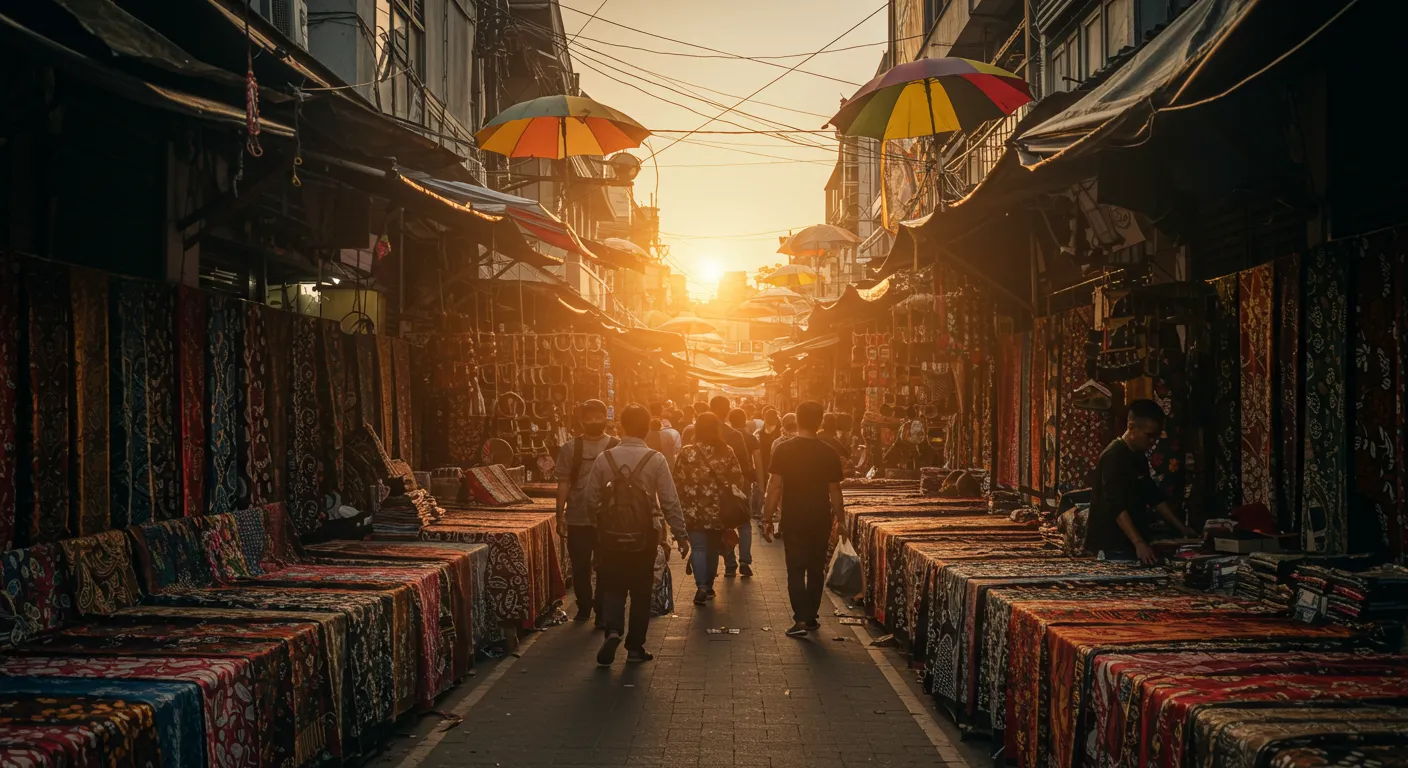
Glodok is the real find — traditional herbs, Chinese-Indonesian goods, and street-level texture. Kota Tua's plaza stalls skew touristy; buy your postcards elsewhere.
District · LOCAL · PHOTO · HIDDEN GEM
Photo Spots
Jakarta sits almost exactly on the equator (6 degrees south), so sunrise and sunset times barely shift year-round — expect sunrise between 5:45am and 6:10am, sunset between 5:35pm and 5:55pm. The real variable is not the clock but the atmosphere. Dry season (May through September) delivers clearer skies and better visibility for skyline and cityscape work, especially after a late-afternoon rain clears the haze. Wet season (October through April) brings dramatic cloud formations and theatrical storm light, but persistent haze and humidity can flatten distant views. The best single month for photography is probably June or July — longest dry stretches, clean air after rain, and reliable golden hour color. Overcast wet-season days are actually ideal for market and street photography where harsh shadows would be a problem. For gear, bring a versatile zoom like a 24-70mm f/2.8 as your workhorse — it handles architecture, street, and environmental portraits equally well. Add a 70-200mm for compressing the harbor ships at Sunda Kelapa and isolating skyline layers. A fast prime (35mm or 50mm f/1.8) is essential for markets and low-light interiors like Istiqlal Mosque. Humidity is relentless — keep silica gel packs in your bag and wipe down gear nightly to prevent fungus. A circular polarizer cuts haze and reflection on glass buildings. In post-processing, Jakarta shots typically need dehaze adjustment, selective warming of golden hour tones, and careful highlight recovery because tropical sunsets blow out fast. Shoot RAW without exception — the dynamic range between Jakarta's bright skies and shadowed street-level scenes is extreme and you will need every stop of latitude your sensor can give you.
Monas (National Monument) from Medan Merdeka
The 132m marble obelisk is Jakarta's defining landmark. Best compositions come from the northwest corner of Medan Merdeka Barat, where you can frame the monument against open sky with the reflecting pool in the foreground. At blue hour the monument lights up gold against a deep blue sky — this is the postcard shot. From the top observation deck you get a 360-degree cityscape, but haze kills it by mid-morning.
Istiqlal Mosque and Cathedral Juxtaposition
Southeast Asia's largest mosque sits directly across the street from the neo-gothic Jakarta Cathedral — a powerful visual statement about Indonesian pluralism. The money shot is from the pedestrian bridge connecting the two, or from Jl. Lapangan Banteng Utara looking north to frame both structures. Interior of Istiqlal features massive columns and geometric ceiling patterns that work beautifully with wide-angle and symmetrical compositions.
Kota Tua (Old Town) — Fatahillah Square
Dutch colonial architecture surrounding a cobblestone square — Jakarta's most photogenic heritage zone. The old City Hall (Jakarta History Museum) with its green shutters is the hero building. Early morning gives you the square empty and side-lit. Street-level compositions with colorful rental bikes, local vendors, and the worn textures of 300-year-old facades. The nearby Kali Besar canal has moody reflections if the water is calm.
SKYE Bar Rooftop — BCA Tower
One of Jakarta's best elevated vantage points for skyline photography. The 56th-floor open-air deck faces south and west, giving you the Sudirman–Thamrin corridor of skyscrapers at sunset and blue hour. You can capture layered cityscapes with dramatic tropical cloud formations. On clear days after rain the visibility is exceptional — haze is your enemy here, so time it right.
Sunda Kelapa Old Harbor
Wooden pinisi schooners — traditional Indonesian sailing vessels — still dock here for cargo runs. The forest of masts and bowsprits makes for extraordinary graphic compositions. Shoot from the dock looking along the row of hulls for repeating-pattern depth. Workers loading sacks of goods give human scale and documentary storytelling. The weathered wood textures are incredible in raking side light.
Pasar Baru Market Street
A covered market street with gorgeous natural light filtering through the roof structure. This is Jakarta's best spot for street photography — textile vendors, Indian-Indonesian food stalls, tailor shops with old Singer sewing machines. The mix of cultures (Indian, Chinese, Betawi) gives visual diversity. Shoot at medium focal lengths for environmental portraits. The covered walkway creates beautiful shafts of light around midday.
Ancol Beach Boardwalk — Dunia Fantasi Area
Jakarta's waterfront gives surprisingly good sunrise compositions over the Java Sea. The boardwalk pilings and fishing boats provide foreground interest. On weekday mornings you will often find lone fishermen silhouetted against orange skies. Not a pristine beach — this is gritty, real Jakarta — but the light is genuine and the compositions feel honest rather than postcard-perfect.
Bundaran HI (Hotel Indonesia Roundabout) Elevated Walkway
The Selamat Datang Monument (Welcome Statue) in the center of Jakarta's most famous roundabout, with the Grand Hyatt and skyscrapers rising behind it. The elevated pedestrian walkway gives a clean shooting angle above traffic. At night the fountain lights up and long exposures turn traffic into light trails circling the monument. This is your establishing shot that says Jakarta immediately.
Suggested Itinerary
Nightlife
Jakarta's nightlife is sprawling, expensive, and heavily concentrated in the SCBD, Senopati, and Kemang districts, where the city's affluent set drink imported spirits at prices that would make Singapore blush. Things start late — dinner runs past 9pm, bars fill after 11pm, and clubs don't peak until 1am. The scene is overwhelmingly local (the wealthy expat-adjacent crowd), with genuine tourist nightlife being rare outside a few hotel rooftops. Note that alcohol is heavily taxed, so budget accordingly.
Lucy in the Sky
A loud, high-energy indoor-outdoor bar packed with a young professional crowd downing tequila and dancing on the semi-open terrace once the DJ ramps up.
No cover but drinks are steep. Smart casual — no shorts or flip-flops. Busiest Thursday to Saturday. Arrive before 11pm or expect a wait.
Bengkel Night Park
A cavernous multi-zone complex with EDM, hip-hop, and lounge areas under one roof — Jakarta's mainstream club experience at full volume.
Cover varies by event (roughly IDR 100k–300k), sometimes with a drink included. Table bookings dominate the good spots. Weekends only really worth it. Dress up.
Union Brasserie, Bakery & Bar
A polished bistro-bar where Senopati's see-and-be-seen crowd sips well-made classics over dinner that spills into late drinks.
Reservation strongly recommended for dinner. Closes earlier than clubs — more a stylish drinks stop than an all-nighter. Smart casual.
Eastern Promise (Eastern)
A long-running British-style expat pub with football on the screens, cheap-ish pints by Jakarta standards, and a relaxed unpretentious crowd.
No cover, no dress code hassle. Good for a casual, no-agenda night. Popular during major sporting events. [ASSUMPTION] Kitchen serves standard pub grub.
H Gourmet & Vibes
An upscale supper-club where soul, jazz, and top-40 cover bands play to a well-dressed dining crowd that gradually loosens into dancing.
Reserve a table, especially for weekend live sets. Minimum spend may apply for prime tables. Smart dress essential.
SKYE Bar & Restaurant
A 56th-floor rooftop with sweeping city-skyline views, decent cocktails, and a golden-hour-to-blue-hour crowd of couples and tourists.
Best visited at sunset for the view and photography. No cover. Smart casual. Gets busy at golden hour — come early for the terrace edge.
Awan Lounge
A leafy semi-open rooftop atop the Kosenda Hotel with a lower-key, arty feel than the SCBD giants and a genuinely good cocktail list.
No cover. More intimate and less scene-y than SCBD. Good rainy-day-adjacent covered seating. Smart casual.
Dragonfly
A long-standing glamorous club-lounge with an Asian-fusion supper element, heavy on bottle service and the moneyed weekend crowd.
Table/bottle service is the norm for the main floor. Cover possible on event nights. Strict dress code — dress sharp. Weekends only.
Beer Hall by Paulaner
A German-style brewhall with house lagers, communal tables, and a boozy after-work-into-night crowd.
No cover. Come for the beer, not the atmosphere-hunting. [ASSUMPTION] Kitchen leans Bavarian. Good group option.
Build your own Itinerary from this guide
Pick the places you care about — attractions, photo spots, map markers — and we'll lay out a day-by-day starting point. Yours to edit; guide updates never touch it.
Premium section
Special Interest
This part of the guide is included with a NextTripLabs account. Sign in to read it here — full guide unlocks and itineraries are available in the NextTripLabs app.
Premium section
Walkability Scores
This part of the guide is included with a NextTripLabs account. Sign in to read it here — full guide unlocks and itineraries are available in the NextTripLabs app.
Premium section
Hidden Gems and Off the Beaten Path
This part of the guide is included with a NextTripLabs account. Sign in to read it here — full guide unlocks and itineraries are available in the NextTripLabs app.
Premium section
Sustainability Guide
This part of the guide is included with a NextTripLabs account. Sign in to read it here — full guide unlocks and itineraries are available in the NextTripLabs app.