Essentials
Currency, language, transit & safety — tap to expand.
Currency — Japanese Yen (¥ / JPY). As of mid-2025, roughly ¥155 = $1 USD, ¥170 = €1 EUR. Rates have been volatile so check before you go.
Cash vs card — Japan has shifted significantly toward cards post-COVID, but Kyoto still leans cash-heavy compared to Tokyo. Small temples, street food vendors, local izakayas, and market stalls often accept cash only. 7-Eleven and Japan Post ATMs are your best friends — they reliably accept foreign cards with no drama. Tipping is not practiced and can actually cause confusion. Do not tip at restaurants, taxis, or hotels. IC cards (ICOCA or Suica via Apple Wallet) work on transit and at convenience stores.
Budget — Budget: ¥8,000–12,000/day ($52–77 USD) — hostels, konbini meals, temple-hopping on foot. Mid-range: ¥20,000–35,000/day ($130–225 USD) — ryokan or boutique hotel, sit-down meals, bus/train pass, a couple paid temples. Luxury: ¥60,000+/day ($390+ USD) — high-end ryokan with kaiseki dinner, private taxi, premium experiences like tea ceremony with a master.
Language — Japanese is the sole official language. Kyoto Japanese includes the Kansai dialect (Kansai-ben), which locals use casually. You will hear 'ookini' instead of 'arigatou' from older shopkeepers.
Language barrier — English proficiency is limited but improving at major tourist sites, hotels, and train stations. Menus increasingly have English or photos. Google Translate camera mode is genuinely essential for reading menus, signs, and temple information boards. Most locals are extremely helpful even with a language gap — pointing and gestures go a long way. Download Google Translate Japanese offline before arriving.
Getting around — Kyoto is deceptively spread out along a north-south axis. There is no comprehensive subway — buses are the backbone but can be painfully slow during peak tourist season due to traffic. Honest recommendation: use trains (JR and private lines) to cover major distances between areas, buses for specific temple access, and rent a bicycle for the flat central and eastern districts. Walking is essential and often the fastest option in congested areas like Higashiyama.
Safety — Kyoto is extraordinarily safe. Violent crime against tourists is essentially nonexistent. Your real concerns: heat illness in July-August is genuinely dangerous — temperatures hit 38C with brutal humidity, carry water and electrolytes constantly. Cyclists share narrow sidewalks with pedestrians so stay aware. Deer in nearby Nara can bite and headbutt if you tease them with crackers. Earthquakes happen — know your hotel's evacuation plan and download the NERV or Safety Tips app for real-time alerts in English. Pickpocketing is rare but crowded buses during peak season attract occasional opportunists [ASSUMPTION]. Be aware of photography restrictions at temples and especially in Gion — photographing geiko and maiko without permission is strongly discouraged and locals will confront you. Some temple paths have uneven stone steps that get dangerously slick in rain.
Highlights
Kyoto is where Japan's aesthetic soul lives — a city of 1,600 temples, 400 shrines, and exacting seasonal rituals that have been refined over twelve centuries as the imperial capital. It feels unlike Tokyo's electric sprawl or Osaka's boisterous energy; Kyoto moves slower, rewards patience, and reveals its best layers to travellers who learn when to show up and when to stay quiet. The city is compact enough to explore by bicycle yet deep enough to fill weeks without repeating an experience.
Kyoto's Layered Cultural Identity
Kyoto was Japan's capital from 794 to 1868 and remains the headquarters of most traditional arts — tea ceremony (urasenke and omotesenke schools are both based here), ikebana, Noh theater, and kaiseki cuisine. The geiko (Kyoto's term for geisha) culture in Gion is real and active, not a museum piece. Understanding that Kyoto people communicate indirectly (the famous Kyoto politeness called 'iken wo iu' — suggesting rather than stating) helps you read social situations. Many artisan workshops (wagashi sweets, Kiyomizu pottery, Nishijin textiles) welcome visitors but expect quiet observation before questions.
ICONIC
Japan Visa and Entry Reality (2024–2025)
Citizens of 70+ countries (US, Canada, UK, EU, Australia, and others) get visa-free entry for 90 days. You must complete the Visit Japan Web registration before arrival — upload your passport, fill customs and immigration forms digitally, and generate a QR code. Immigration at Kansai International Airport (KIX) is fast with this. If arriving from Tokyo, no additional entry process needed. Japan has fully reopened with no COVID-era restrictions remaining.
BOOK AHEAD
SIM Cards, Payments, and Connectivity
Buy an eSIM before you fly — Ubigi, Mobal, or IIJmio work well. Physical SIM vending machines exist at KIX airport from providers like Softbank and Docomo. Japan is still more cash-heavy than you expect: small temples, market stalls, local restaurants, and buses often require yen. 7-Eleven and Lawson ATMs reliably accept foreign cards for cash withdrawals. IC cards (ICOCA for Kansai) work on transit and at convenience stores — get one at any JR station. Google Maps is excellent for Kyoto transit routing including bus times. Download offline maps since temple grounds can have weak signal.
PLUGIN TIP · BUDGET
Temple and Shrine Etiquette That Actually Matters
Remove shoes when stepping onto wooden floors (look for shoe shelves or plastic bags provided). At shrines, rinse hands at the chozuya water basin — left hand first, then right, then pour water into your left palm to rinse your mouth, never drink directly from the ladle. Bow twice, clap twice, bow once at shrine prayer halls. Photography is almost always prohibited inside temple main halls even if no sign is posted. Incense smoke at temples is meant to be wafted toward your body for purification. Talking loudly in temple gardens is the single fastest way to mark yourself as an inconsiderate tourist.
ICONIC
The Bicycle Unlock
Renting a bicycle transforms Kyoto. The city is flat except for the eastern hills, and cycling between temples is faster than buses during peak season. Rent from J-Cycle near Kyoto Station or Kyoto Cycling Project in central Kyoto — expect 1,000-1,500 yen per day. Register your bike at the rental shop to avoid police stops (officers do check). Park only in designated areas; illegally parked bikes get impounded for a 2,300 yen retrieval fee. The philosopher's path corridor, Nishijin textile district, and the stretch between Kinkaku-ji and Ryoan-ji are all ideal cycling routes.
HIDDEN GEM · BUDGET · EASY WALK
Seasonal Timing Is Everything
Cherry blossom season (late March to mid-April) and autumn foliage (mid-November to early December) are transcendent but brutally crowded. Maruyama Park and Philosopher's Path during peak sakura can feel like a concert crowd. The real unlock: visit in late January through February (empty temples, occasional snow on golden pavilions) or late June during hydrangea season at Mimurotoji Temple and Sanzen-in. Summer (July-August) is sweltering but delivers the Gion Matsuri festival — one of Japan's three greatest. Check tenki.jp for hyperlocal weather and sakura/koyo forecasts.
SEASONAL · CROWD WARNING · PHOTO · NEXTPIC
Early Morning Temple Strategy
Most tourists arrive at major temples between 10am and 2pm. Fushimi Inari opens 24 hours — arrive at 6am for empty torii gates and perfect golden-hour light shooting downhill. Kinkaku-ji opens at 9am; be in line at 8:45. Tofuku-ji during autumn opens at 8:30 and the bridge viewpoint fills by 9:15. Several temples offer early-morning zazen meditation sessions (Shunkoin Temple offers English-language sessions, book via their website). The quiet morning hours are when Kyoto actually feels like the contemplative city the guidebooks promise.
SUNRISE · GOLDEN HOUR · PHOTO · NEXTPIC
When to Go
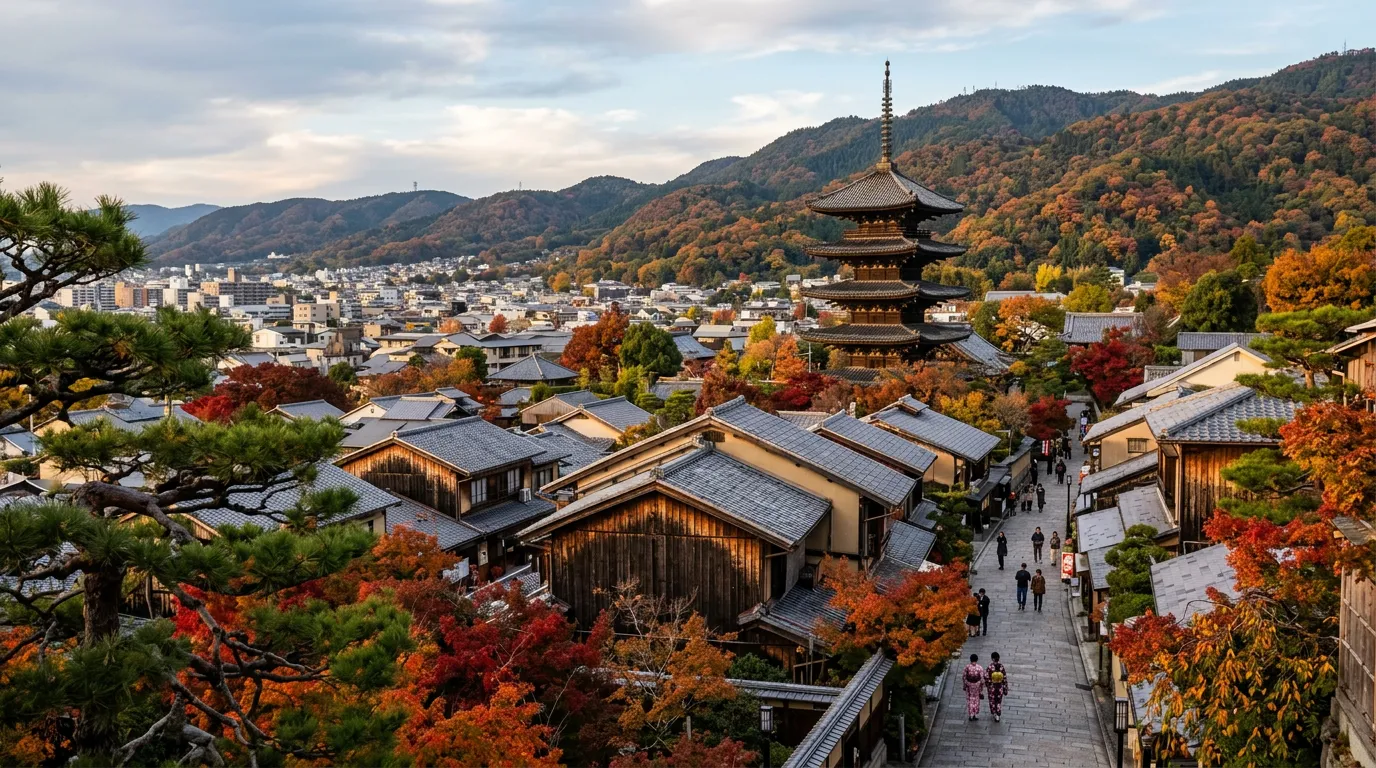
Late November offers Kyoto at its most breathtaking — fiery maple canopies over temple gardens, crisp walking weather around 15°C, and peak kaiseki dining season. For photography, early-to-mid April cherry blossoms are unmatched, but November koyo has slightly more manageable crowds and better golden-hour light angles. If you want the sweet spot of weather, food, and fewer elbows in your shots, target Nov 15–30.
Plum Blossom Season
Ume (plum blossoms) are the understated prelude to cherry blossoms, blooming in whites, pinks, and deep reds. Kitano Tenmangu hosts the finest display with over 1,500 trees, plus a geisha-served tea ceremony in late February.
Far fewer crowds than sakura season with similar beauty — ideal for photographers wanting blossoms without the chaos.
Cherry Blossom Season
Sakura season is Kyoto's global calling card. The bloom front typically hits Kyoto between March 25 and April 5, lasting roughly 10–14 days at peak. Hundreds of varieties stagger the season, with late-blooming cherries extending into mid-April.
Book accommodation 3–6 months ahead; expect 2–3x pricing and peak-level crowds at every major site.
Tsuyu Rainy Season
The East Asian monsoon brings weeks of persistent drizzle and oppressive humidity. While many travellers avoid this window, it transforms Kyoto's moss gardens into luminous green carpets and brings hydrangeas into spectacular bloom.
Budget-friendly with empty temples, but waterproofing for gear and clothing is essential.
Gion Matsuri
Japan's most famous festival spans the entire month, centered on the Yamahoko float processions on July 17 and 24. Massive decorated floats roll through downtown streets accompanied by centuries-old music. The yoiyama street parties on preceding evenings draw hundreds of thousands.
Downtown hotels book up fast for mid-July; transit is packed but the cultural payoff is enormous.
Typhoon Season
Western Japan sits in the typhoon corridor. While direct hits on Kyoto are uncommon, strong storms can disrupt trains, close mountain temples, and cause flash flooding. The 2018 typhoon caused significant damage to Fushimi Inari and other sites.
Always have a flexible itinerary and travel insurance; check Japan Meteorological Agency forecasts daily.
Koyo Autumn Foliage Season
Peak maple color arrives mid-to-late November, turning Kyoto's temple gardens into tunnels of crimson and gold. Night illuminations (lightups) at Eikando, Kiyomizu-dera, and Kodai-ji create an entirely different photographic experience after dark. Early December catches stragglers at lower elevations.
Crowds at top koyo spots rival spring sakura — arrive at opening time or visit during night illuminations for slightly thinner numbers.
Where to Stay
Kyoto's accommodation scene ranges from world-class luxury ryokan to minimalist hostels in converted machiya townhouses. Peak seasons — cherry blossom (late March to mid-April) and autumn foliage (mid-November to early December) — can triple prices and sell out months ahead. Staying near Kyoto Station maximizes transit convenience, while Higashiyama and Gion offer atmosphere at a premium.
The Ritz-Carlton Kyoto
Higashiyama / Kamogawa riverfront
Hotel
ICONIC · BOOK AHEAD · PHOTO
Hoshinoya Kyoto
Arashiyama
Resort
ICONIC · BOOK AHEAD · HIDDEN GEM · PHOTO
Hotel Kanra Kyoto
Shimogyo-ku, near Kyoto Station
Boutique Hotel
CENTRAL · TRANSIT-FRIENDLY
Piece Hostel Sanjo
Sanjo / Central Kyoto
Hostel
BUDGET · CENTRAL · TRANSIT-FRIENDLY
K's House Kyoto
Higashiyama / Shichijo
Hostel
BUDGET · EASY WALK
Sowaka
Gion / Yasaka Shrine
Boutique Hotel
ICONIC · HIDDEN GEM · BOOK AHEAD · PHOTO
Nazuna Kyoto Gosho
Kyoto Imperial Palace area
Guesthouse
HIDDEN GEM · BOOK AHEAD · PHOTO
RAKURO Kyoto by THE SHARE HOTELS
Kawaramachi / Sanjo
Boutique Hotel
CENTRAL · TRANSIT-FRIENDLY · BUDGET
Top Attractions
№ 1 · Essential
Kiyomizu-dera
★ ICONIC · PHOTO · SUNRISE · CROWD WARNING · EASY WALK
This UNESCO World Heritage temple perches on a hillside with a massive wooden stage offering sweeping views over Kyoto. It is genuinely stunning and earns its iconic status, though the approach streets (Ninenzaka and Sannenzaka) are packed with tourists by mid-morning. The wooden terrace was built without a single nail and the engineering alone is worth the visit.
Tip: Arrive right at 6:00 AM opening to have the main hall and terrace nearly to yourself. The famous approach streets are also ghost-town empty at this hour, perfect for photography. Walk the Otowa waterfall area below the stage where most early visitors skip.
Best: 6:00–7:30 AM year-round; autumn illumination evenings in November are spectacular but extremely crowded
Fees: 400 JPY (about $2.70 USD)
Nishiki Market
Kyoto's 400-year-old kitchen stretches five blocks and is the best place to taste your way through local specialties like dashimaki tamago, pickled vegetables, fresh yuba, and matcha sweets. It is touristy but still functions as a real market with vendors who have been here for generations. Much more rewarding than department store food halls for understanding Kyoto's food culture.
ICONICTofuku-ji Temple
One of Kyoto's great Zen temple complexes with arguably the finest garden designs in the city, created by modernist landscape architect Shigemori Mirei in 1939. The Hojo garden with its checkered moss-and-stone pattern is unlike anything else in Japan. In autumn the Tsutenkyo bridge view is world-class, but the gardens reward a visit in any season.
PHOTOKurama to Kibune Hike
A forested mountain trail connecting two atmospheric villages north of central Kyoto. The hike passes through ancient cedar groves, the mystical Kurama-dera temple complex, and ends in the riverside village of Kibune where restaurants serve kaiseki meals on platforms over the water in summer. This is the best single half-day escape from temple fatigue.
HARD HIKENeighbourhoods
Higashiyama
Kyoto's most photogenic historic district, where stone-paved lanes wind past wooden machiya townhouses, centuries-old temples, and geisha culture. This is the Kyoto you came to see.
Must do: Walk the Ninenzaka and Sannenzaka slopes at dawn before crowds arrive. Visit Kiyomizu-dera for the iconic wooden stage view. Wander Hanamikoji-dori in Gion at dusk for possible maiko sightings.
ICONIC · PHOTO · GOLDEN HOUR · CROWD WARNING · EASY WALK · NEXTPIC · SUNRISE
Arashiyama
Western Kyoto's bamboo groves, river scenery, and mountain-temple atmosphere feel like stepping into a Japanese scroll painting. Equal parts natural beauty and cultural depth.
Must do: Enter the Bamboo Grove before 7:30am for empty-path photos. Cross Togetsukyo Bridge for mountain backdrop shots. Visit Tenryu-ji's Sogenchi Garden, a UNESCO World Heritage site.
ICONIC · PHOTO · SUNRISE · CROWD WARNING · FAMILY · NEXTPIC
Fushimi
Home to the mesmerizing ten thousand vermillion torii gates of Fushimi Inari and a lesser-known sake brewing district along canal-lined streets. Two very different experiences in one neighbourhood.
Must do: Hike the full Fushimi Inari loop at dawn or after dark for empty torii tunnels. Explore Fushimi sake district and sample at Gekkeikan Okura Sake Museum. Eat at the street food stalls near the shrine base.
ICONIC · PHOTO · SUNRISE · NIGHT SHOOT · CROWD WARNING · FREE · HARD HIKE
Nishiki & Nakagyo (Downtown)
Kyoto's commercial and culinary heart, where the 400-year-old Nishiki Market corridor meets modern shopping arcades, riverside dining, and the city's best concentration of restaurants and bars.
Must do: Graze through Nishiki Market trying dashimaki tamago, pickles, and fresh yuba. Walk the Pontocho alley at twilight for its lantern-lit riverside atmosphere. Explore Teramachi and Shinkyogoku covered arcades for local shopping.
ICONIC · RAINY DAY · TRANSIT-FRIENDLY · CROWD WARNING · BOOK AHEAD · EASY WALK
Kinkaku-ji & Kitayama (Northern Kyoto)
The quieter, greener north holds Kyoto's most famous single building — the Golden Pavilion — plus Zen rock gardens, forested temple grounds, and a residential calm that the eastern districts lack.
Must do: See Kinkaku-ji's gold reflection in the mirror pond, ideally on a still morning. Experience the enigmatic rock garden at Ryoan-ji. Walk the mossy grounds of Daitoku-ji's sub-temples for meditative quiet.
ICONIC · PHOTO · GOLDEN HOUR · CROWD WARNING · EASY WALK
Kurama & Kibune
Twin mountain villages north of the city connected by a mystical forest hiking trail, offering onsen hot springs, riverside dining on platforms above a rushing stream, and a complete escape from tourist Kyoto.
Must do: Hike the ancient cedar-lined trail from Kurama-dera over the mountain to Kibune (about 90 minutes). Eat kawadoko riverside lunch at Hirobun or Kifune Kisaku in summer. Soak at Kurama Onsen's open-air rotenburo bath.
HIDDEN GEM · HARD HIKE · SEASONAL · BOOK AHEAD · PHOTO
Uji
A small riverside town 20 minutes south of Kyoto, famous as Japan's matcha capital and home to the Phoenix Hall temple printed on the 10-yen coin. Calm, unhurried, and deeply rewarding for tea lovers.
Must do: Tour Byodo-in's Phoenix Hall and its museum. Walk Uji's matcha-shop-lined Omotesando street, tasting at Nakamura Tokichi or Tsuen Tea. Stroll across Uji Bridge and along the riverside path to Ujigami Shrine, Japan's oldest shrine building.
HIDDEN GEM · PHOTO · EASY WALK · BUDGET · BOOK AHEAD · TRANSIT-FRIENDLY
Day Trips
Nara
Travel: 42 km / 45 min by JR Nara Line from Kyoto Station
Fushimi (Sake District) + Uji
Travel: Fushimi: 15 km / 20 min by Keihan Line. Uji: 30 km / 35 min from Fushimi by Keihan
Himeji
Travel: 130 km / 50 min by Shinkansen or 95 min by JR Special Rapid (free with JR Pass)
Mount Kurama + Kibune
Travel: 12 km / 30 min by Eizan Railway from Demachiyanagi Station
Osaka
Travel: 43 km / 15 min by Shinkansen or 30 min by JR Special Rapid or Hankyu Railway
Amanohashidate
Travel: 120 km / 2 hr by Limited Express Hashidate from Kyoto Station
Hikone
Travel: 80 km / 50 min by JR Tokaido-Sanyo Line Special Rapid
Scenic Routes
Philosopher's Path (Tetsugaku no Michi)
Walking
Route: Ginkaku-ji (Silver Pavilion) to Nanzen-ji Temple
ICONIC · PHOTO · EASY WALK · SEASONAL · CROWD WARNING · FREE · NEXTPIC
Arashiyama to Saga-Toriimoto Walking Route
Walking
Route: Togetsukyo Bridge to Saga-Toriimoto Preserved Street
ICONIC · HIDDEN GEM · PHOTO · GOLDEN HOUR · EASY WALK · CROWD WARNING · NEXTPIC
Fushimi Inari Full Summit Trail
Hiking
Route: Fushimi Inari Shrine main gate to Ichinomine Summit and back
ICONIC · PHOTO · SUNSET · BLUE HOUR · NIGHT SHOOT · FREE · NEXTPIC
Higashiyama Walking Course
Walking
Route: Kiyomizu-dera to Yasaka Shrine via Ninenzaka and Sannenzaka
ICONIC · PHOTO · SUNRISE · GOLDEN HOUR · EASY WALK · CROWD WARNING · NEXTPIC
Kitayama Cycling Route (North Kyoto)
Cycling
Route: Kinkaku-ji area to Takagamine and Koetsu-ji Temple
HIDDEN GEM · PHOTO · BUDGET · SEASONAL
Kibune to Kurama Mountain Trail
Hiking
Route: Kurama-dera Temple to Kibune Shrine (or reverse)
HIDDEN GEM · PHOTO · HARD HIKE · SEASONAL · TRANSIT-FRIENDLY
Street Art
Kyoto is not a street art city in the Western graffiti-mural sense. The cultural weight of its machiya townhouses, temple districts, and historic preservation laws means large-scale murals are extremely rare and unsanctioned graffiti is treated seriously. That said, Kyoto has a quietly growing scene of commissioned murals, gallery-adjacent outdoor installations, and subtle artistic interventions that reward a curious eye. The energy sits at the intersection of contemporary art, craft tradition, and community revitalization — think hand-painted shop shutters, ceramic tile art, artist-run spaces with exterior works, and occasional pop-up installations in renovated machiya neighborhoods.
Demachi Masugata Shotengai
This covered shopping arcade near Demachiyanagi Station features hand-painted shop shutters and seasonal art installations organized by local merchant associations. The shutters are most visible early morning before shops open or after closing. Several feature folk-art-inspired designs celebrating Kyoto traditions.
Demachi Masugata Shotengai, near Demachiyanagi Station, Kamigyo-ku
HIDDEN GEM · PHOTO · EASY WALK · FREE · GOLDEN HOUR
Teramachi and Shin-Kyogoku Arcades
The covered arcades running parallel south of Sanjo have scattered commissioned murals, artistic signage, and seasonal art installations. The side alleys (roji) between the two arcades hide small gallery facades with rotating exterior art. This is the closest Kyoto gets to a walkable street art corridor. Look up — some of the best work is on upper floors and above doorways.
Teramachi-dori and Shin-Kyogoku-dori between Sanjo and Shijo, Nakagyo-ku
ICONIC · PHOTO · EASY WALK · TRANSIT-FRIENDLY · FREE
Nishijin Textile District
The historic weaving district northwest of the Imperial Palace has seen quiet creative revitalization. Several renovated machiya now host artist studios with exterior installations, and a handful of walls feature textile-inspired murals commissioned during community art projects. The aesthetic is uniquely Kyoto — contemporary art filtered through craft heritage. Wander Omiya-dori and the small streets east of Horikawa.
Nishijin area around Imadegawa-Omiya intersection, Kamigyo-ku
HIDDEN GEM · PHOTO · GOLDEN HOUR · FREE · EASY WALK
Kyoto Art Center and Muromachi Area
The former elementary school turned art center occasionally hosts outdoor installations in its courtyard and surrounding streets. The Muromachi-dori corridor nearby has some of Kyoto's more contemporary artistic interventions on building facades, often tied to seasonal exhibitions or Parasophia-related events. Check their schedule before visiting.
546-2 Yamabushiyama-cho, Muromachi-dori, Nakagyo-ku
PHOTO · FREE · TRANSIT-FRIENDLY · EASY WALK
Tanbaguchi Rail Corridor
The rail underpasses and warehouse walls near Tanbaguchi Station (JR Sagano line) have some of Kyoto's only visible unsanctioned graffiti alongside a few newer commissioned pieces aimed at softening the industrial corridor. It is raw compared to the rest of Kyoto, and honestly modest by global standards, but it is real and unpolished. Photograph with discretion and do not romanticize the unsanctioned work to locals.
Rail underpasses near JR Tanbaguchi Station, Shimogyo-ku
HIDDEN GEM · PHOTO · RAINY DAY · FREE
Culture & History
Kyoto served as Japan's imperial capital for over a millennium (794–1868), making it the crucible of nearly every defining Japanese art form, spiritual practice, and aesthetic philosophy. Deliberately spared from Allied bombing in World War II, the city retains an unbroken continuum from ancient court culture to living artisan workshops. Kyoto is where the tension between preservation and modernity plays out most visibly in Japan — a city that doesn't just display tradition but actively practices it.
Eat & Drink
Kyoto's food culture is inseparable from its identity as Japan's ancient capital. Kaiseki ryori, the multi-course haute cuisine rooted in tea ceremony aesthetics, reaches its highest expression here, with chefs sourcing from Kyoto's legendary Kyo-yasai heirloom vegetables, pristine tofu from local wells, and seasonal ingredients dictated by centuries of tradition. Nishiki Market remains the city's culinary backbone, a narrow covered arcade packed with over a hundred vendors selling pickles, mochi, fresh yuba, and dried goods that define the Kyoto pantry.
Kikunoi Honten ★★★★★
Multi-course kaiseki showcasing seasonal Kyoto ingredients, famous hassun platter and delicate dashi
Higashiyama, 459 Shimokawaracho, Higashiyama-ku
Restaurant · msw:dinner
Menbakaichidai ★★★★★
Fire ramen — the chef literally sets your bowl of green onion-topped ramen on fire tableside for a smoky, charred flavor
Kamigyo-ku, near Kitano Tenmangu, 757-2 Minamiisonokamicho
Restaurant · msw:lunch
Shigetsu at Tenryuji ★★★★
Shojin ryori (Buddhist temple cuisine) served in a tatami room overlooking the UNESCO-listed Tenryuji garden
Arashiyama, inside Tenryuji Temple, 68 Susukinobabacho, Saga Tenryuji, Ukyo-ku
Restaurant · vegetarian_restaurant
Gogyo ★★★★
Kogashi (burnt) miso ramen with an intentionally charred, deeply savory broth unlike anything else in Japan
Nakagyo-ku, Nishikiyamachi-dori, Shijo-sagaru
Restaurant · msw:lunch
Veg Out ★★★
Creative fully vegan bowls, curries, and burgers using local organic produce with global flavor influences
Nakagyo-ku, near Karasuma Oike station, Takoyakushi-dori
Restaurant · vegan_restaurant
% Arabica Kyoto Higashiyama ★★★★
World-class single origin espresso served from a tiny shop with a direct view of the Yasaka Pagoda — arguably Japan's most photogenic coffee window
Higashiyama, 87-5 Hoshinocho, Higashiyama-ku
Coffee · cafe
Weekenders Coffee ★★★★
Specialty pour-overs and espresso in a minimalist machiya townhouse setting, beans roasted in-house with meticulous attention
Nakagyo-ku, Tominokoji-dori, near Nijo Castle
Coffee · cafe
Walden Woods Kyoto ★★★
Specialty coffee roaster in a beautifully renovated space with excellent seasonal drinks and a curated design-book library
Nakagyo-ku, near Shijo-Karasuma
Coffee · cafe
Kissa Master ★★★
Old-school kissaten (retro Japanese coffee house) experience with hand-drip coffee, cream soda floats, and Showa-era atmosphere
Higashiyama, near Gion, Nawate-dori
Coffee · cafe
Le Petit Mec ★★★★
Outstanding French-style baguettes, croissants, and tartines baked daily in a tiny shop that rivals Parisian bakeries
Kamigyo-ku, Imadegawa-dori, near Imadegawa station
Bakery · bakery
Flip Up! ★★★★
Fluffy Japanese-style pancakes and freshly baked goods in a bright cafe setting, excellent egg sandwiches for breakfast
Nakagyo-ku, near Karasuma Oike
Bakery · bakery · breakfast_restaurant
Sizuya ★★★
Kyoto's beloved local bakery chain famous for karneh (curry bread) and affordable anpan, a staple since 1948
Multiple locations, flagship near Kyoto Station on Karasuma-dori
Bakery · bakery
Bon ★★★★
Formal shojin ryori temple cuisine using centuries-old recipes, featuring handmade fu (wheat gluten), seasonal vegetables, and elaborate tofu preparations
Higashiyama, Daigo area, near Daigoji Temple [ASSUMPTION]
Vegetarian · vegetarian_restaurant
Mumokuteki Cafe ★★★★
Stylish vegan and macrobiotic cafe serving creative plant-based plates, organic brown rice sets, and excellent vegan desserts
Nakagyo-ku, Teramachi-dori, near Shijo
Vegetarian · vegan_restaurant
Tosca Teriha ★★★
Italian-Japanese fusion with robust vegetarian and vegan pasta, pizza, and grain bowls using Kyoto organic produce
Sakyo-ku, near Demachiyanagi station
Vegetarian · vegetarian_restaurant · vegan_restaurant
Shopping
Kyoto is Japan's capital of traditional craft and refined aesthetics. Shoppers who love handmade ceramics, textiles, incense, paper goods, and artisan tools will find centuries-old family workshops still producing at the highest level — this is not a city of mass-produced souvenirs but of living craft traditions.
Toji Temple Flea Market (Kobo-san)
Flea
Vintage kimono and obi fabric, antique ceramics, old woodblock prints, calligraphy brushes, secondhand tea ceremony utensils, and retro Showa-era housewares.
Market · ICONIC · PHOTO · BUDGET · HIDDEN GEM
Kitano Tenmangu Flea Market (Tenjin-san)
Flea
Antique pottery, vintage tansu chests, old maps, kimono accessories like obijime cords, and secondhand Japanese knives. Slightly more antiques-heavy than Toji.
Market · HIDDEN GEM · BUDGET · EASY WALK
Chion-ji Handicraft Market (Hyakumanben)
Craft
Contemporary handmade crafts: ceramics by young potters, hand-dyed tenugui towels, botanical candles, leather goods, handmade jewelry. This is where Kyoto's younger artisan scene sells directly.
Market · HIDDEN GEM · BUDGET · EASY WALK
Nishiki Market
Mixed
Beyond food: quality Japanese kitchen knives at Aritsugu, ceramic chopstick rests, lacquerware, pickled-vegetable-themed packaging and furoshiki wrapping cloths. Several shops sell excellent Kyoto-made cooking utensils.
Market · ICONIC · CROWD WARNING · TRANSIT-FRIENDLY
Teramachi and Shinkyogoku Shopping Streets
Covered arcade streets running parallel in central Kyoto. Teramachi leans traditional and independent — old tea shops, stationery stores, incense houses. Shinkyogoku skews younger and more commercial. Together they cover a wide range.
Kyukyodo for washi paper and incense (operating since 1663). Ippodo Tea for matcha and hojicha. Several excellent stamp and seal carving shops. The vintage kimono boutiques clustered near the Sanjo end of Teramachi are worth browsing.
District · ICONIC · TRANSIT-FRIENDLY · EASY WALK
Gion and Higashiyama
The most atmospheric shopping in Kyoto, running along stone-paved lanes near temples. Mix of high-end Kyo-yaki ceramics, traditional cosmetics, incense, and refined souvenir shops. Touristy but the quality is real if you know where to look.
Kagoshin for bamboo baskets. Yojiya for traditional oil-blotting paper and cosmetics. Asahi-do for Kiyomizu-yaki ceramics. Shoyeido for premium incense. Ichizawa Shinbichirodo for hand-stitched canvas tote bags — cult following, made in Kyoto only.
District · ICONIC · PHOTO · CROWD WARNING
Kitayama and Takaragaike area
Northern Kyoto's quieter, more residential design district. Contemporary galleries, independent ceramics studios, and modern Japanese design shops. Far fewer tourists.
Kyoto Botanical Gardens area has small gallery shops. Good for contemporary ceramics, modern lacquerware, and Japanese textile design that feels more Muji-meets-mingei than traditional tourist craft.
District · HIDDEN GEM · EASY WALK
Photo Spots
Kyoto sits at roughly 35 degrees north latitude, giving dramatic seasonal light shifts. Summer (June-August) sunrise is around 4:50-5:15am with sunset near 7:10-7:15pm — long golden hours but brutal midday heat and humidity that fogs lenses when stepping from air conditioning outside. The June-July rainy season (tsuyu) sounds bad but delivers moody mist shots at temples and saturated greens. Autumn (mid-November) is peak season: sunrise around 6:30am, sunset 4:50pm, with low-angle golden light that rakes through maple canopies. Winter sunrise at 7:00am and sunset at 4:50pm gives short shooting days but rare snowfall on temple roofs creates once-in-a-year images. Cherry blossom season (late March to early April) has balanced 6:00am sunrise and 6:20pm sunset. Spring and autumn deliver the richest color but plan for overcast skies — Kyoto averages 40-50 percent cloud cover year-round, which actually helps with the contrast issues in dense temple gardens. Gear-wise, Kyoto rewards a versatile two-lens kit: a wide zoom (16-35mm) for temple interiors, bamboo groves, and garden compositions, paired with a fast 50mm or 85mm for street scenes, details, and available-light work in Gion at night. A circular polarizer is non-negotiable — it manages reflections on lacquered temple surfaces, deepens autumn colors, and cuts haze on humid days. Bring a compact tripod for blue hour work at Yasaka Pagoda and Gion canal shots. For editing, Kyoto images tend to lean warm and oversaturated in auto mode — pull back reds and oranges, especially on autumn torii gate and maple shots, and watch for magenta color casts in shadow areas under tree canopy. Shoot RAW without exception; the subtle tonal gradations in moss gardens, bamboo forests, and twilight temple scenes need the latitude. If shooting on a phone, use the 2x telephoto lens more than you think — Kyoto compositions often benefit from compression rather than wide establishing shots.
Fushimi Inari Taisha — Senbon Torii Gates
The endless tunnel of vermillion torii gates snaking up the mountainside. Best compositions come from shooting through the gates with a compressed telephoto look (70-200mm) to stack them tight. The light filtering through gaps between gates creates ethereal shafts, especially when morning mist sits in the valley. The backside of the gates shows kanji inscriptions — shoot both directions for variety.
Kinkaku-ji — Golden Pavilion Reflection
The gold-leaf pavilion reflected in Kyoko-chi mirror pond. The classic shot is from the designated viewpoint just past the entrance gate where the full building and its reflection align. What separates a good shot from a great one: wait for perfectly still water. Wind dies down earliest in the morning. Autumn foliage framing adds another layer. In winter, rare snowfall on the gold roof is legendary.
Arashiyama Bamboo Grove
Towering bamboo stalks forming a natural cathedral canopy over a curving path. Shoot wide (16-24mm) pointing straight up for the canopy convergence shot. At path level, use a longer lens (85-135mm) to compress the bamboo density. The path curves are the composition — position yourself at the bend for leading lines. Overcast days are actually better; direct sun creates harsh contrast stripes.
Yasaka Pagoda from Yasaka-dori Street
The iconic five-story Hokan-ji pagoda framed at the end of a traditional stone-paved slope lined with machiya townhouses. This is the single most recognizable Kyoto street scene. Shoot from the middle of the slope looking uphill with the pagoda centered. Kimono-clad visitors add color and scale. Works in all seasons but cherry blossom and autumn maple framing elevate it to extraordinary.
Nanzen-ji Suirokaku Aqueduct
A massive Romanesque brick aqueduct inside a Zen temple complex — an unexpected collision of European engineering and Japanese garden aesthetics. Shoot the repeating arches as leading lines. In autumn, red maples frame the brick arches brilliantly. Stand beneath the aqueduct and shoot upward through the arches for dramatic perspective. The water channel on top still flows — include it for context.
Philosopher's Path — Cherry Blossom Tunnel
A 2km canal-side stone path canopied by hundreds of cherry trees. In peak bloom (late March to early April), the petals carpet the canal water in pink. Shoot the canal from small bridges with a medium telephoto to compress the tree tunnel. Fallen petals floating on the water surface make a stunning macro subject. Outside cherry season, the path is pleasant but not a priority for photography.
Komyo-ji Temple — Autumn Carpet
A relatively unknown temple southwest of central Kyoto where fallen maple leaves blanket the entire approach stairway in deep crimson. The long stone staircase framed by maple canopy is the hero shot — shoot from the bottom looking up, or from the top looking down at the leaf carpet. Far fewer tourists than Tofuku-ji but equally dramatic autumn color.
Gion Shirakawa — Traditional Geisha District at Night
A narrow canal lined with willow trees, traditional teahouses, and stone bridges in the heart of Gion. This is where you have the best chance of photographing geiko (geisha) and maiko walking to evening appointments. Shoot the canal reflections of warm teahouse lanterns. The weeping willows over the canal with traditional architecture behind is the composition. Respectful distance from geiko is essential — do not chase, block, or use flash.
Suggested Itinerary
Nightlife
Kyoto's nightlife is quieter and more intimate than Osaka or Tokyo, but far from dead. The action clusters around Kiyamachi-dori and Pontocho alley starting around 8-9pm, with a mix of tiny standing bars, craft cocktail dens, and a handful of clubs that keep going until 5am. The scene skews local on weeknights and tourist-heavy on weekends, with a distinctive undercurrent of university students from Kyoto University and Doshisha keeping things unpretentious.
Bar Rocking Chair
A reverent, dimly lit cocktail temple where a single bartender in a waistcoat carves ice by hand and speaks to you in near-whispers — the antithesis of a party bar.
No cover charge. Seats maybe 8-10 people. No reservations, first come first served. Cocktails run 1500-2000 yen. Best experienced solo or as a couple. Closes around midnight. Dress neatly — no flip-flops.
Bee's Knees
A narrow, friendly gin-focused bar with hundreds of bottles lining the walls and a bartender who will geek out about botanicals if you let him.
No cover. Strong gin selection with over 200 varieties. Cocktails 1000-1500 yen. Opens 6pm, closes around 2am. English-friendly. Walk-in fine, but it only fits about 12 people so you may wait on weekends.
Bar K6
Old-school Showa-era cocktail bar with dark wood paneling, a long mahogany counter, and a bartender who treats every highball like a ceremony — the kind of place where you lower your voice instinctively.
Operating since 1946. No cover charge. Cocktails 1200-1800 yen. Smart casual expected. Closes around midnight. Small space, maybe 15 seats. Best visited early evening before it fills up.
Tadg's Irish Bar
The expat living room of Kyoto — a sticky-floored, Guinness-pouring pub where English teachers, exchange students, and backpackers collide over darts and rugby on TV.
No cover. Pints around 700-900 yen. Open until 2-3am most nights, later on weekends. Good starting point if you want to meet English-speaking locals and fellow travelers. Quiz nights happen periodically.
World Peace Love
Kyoto's scrappy answer to a proper nightclub — a sweaty basement with rotating DJs spinning house, techno, and hip-hop to a young crowd that treats every Saturday like a personal holiday.
Cover charge typically 1000-2000 yen, sometimes includes a drink. Open until 5am on weekends. Dress code relaxed. Expect a younger crowd, mostly 20s. Check their social media for event nights. ID required at the door — bring your passport.
Nokishita 711
A standing bar crammed into an impossibly narrow alley space where craft beer nerds huddle over rare Japanese microbrews and the owner will steer you toward something you have never tried.
No cover. Craft beers 700-1200 yen per glass. Standing only, fits maybe 10 people. Closes around 11pm most nights so this is an early-evening stop. Cash preferred. Very limited English but the beer menu is approachable.
Hello Dolly
A cramped, time-warped jazz bar where the upright bass practically touches the front row and local trios play standards with the kind of loose precision that comes from decades of Tuesday night residencies.
Music charge typically 500-1500 yen depending on the act, plus a drink minimum. Live sets usually start around 8 or 9pm. Seats about 30. No reservations needed for most nights. Drinks 800-1200 yen.
Atlantis
A two-floor club with better sound than you would expect for Kyoto, pulling a slightly older crowd than World Peace Love and leaning harder into electronic and techno on its good nights.
Cover 1500-2500 yen depending on the event, usually includes one drink. Open until 5am weekends. Check event schedules — quality varies wildly depending on who is booked. Passport required for entry if you look under 30.
Bar Cordon Noir
A slender wine bar tucked into Pontocho's lantern-lit alley where you sit elbow-to-elbow with off-duty chefs and older couples working through a surprisingly deep French wine list.
No cover. Glasses from 1200 yen, bottles from 5000 yen. Pairs well with a Pontocho dinner beforehand. Closes around midnight. Seats about 10. Reservations not needed but space is tight on weekends.
Ing Bar
A compact, friendly bar on the upper floors of a Pontocho building with river-facing windows that make summer evenings feel cinematic — one of the few spots where you drink with a view of the Kamogawa at night.
No cover. Cocktails and whisky 800-1500 yen. Open until around 2am. Casual dress fine. The river-side seats are the draw so arrive early in summer. English-friendly staff.
Build your own Itinerary from this guide
Pick the places you care about — attractions, photo spots, map markers — and we'll lay out a day-by-day starting point. Yours to edit; guide updates never touch it.
Premium section
Vegetarian, Jain & Indian Food
This part of the guide is included with a NextTripLabs account. Sign in to read it here — full guide unlocks and itineraries are available in the NextTripLabs app.