Essentials
Currency, language, transit & safety — tap to expand.
Currency — Egyptian Pound (EGP / LE). As of mid-2025, roughly 1 USD = 50 EGP and 1 EUR = 56 EGP. Rates fluctuate significantly — check before you go.
Cash vs card — Luxor is overwhelmingly a cash economy. Cards accepted at upscale hotels and some cruise ships, but markets, felucca rides, local restaurants, temple ticket offices, and taxis are cash only. ATMs exist at major banks along Corniche el-Nil and near Luxor Temple — withdraw in EGP, not USD. Tipping (baksheesh) is deeply embedded: 10-20 EGP for small favors, 50-100 EGP for guides at tombs, 10-15% at sit-down restaurants. Carry small bills always — nobody has change.
Budget — Budget: roughly 800-1200 EGP per day ($16-24 USD) covering hostel, street food, and public ferry. Mid-range: 2500-5000 EGP per day ($50-100 USD) for a 3-star hotel, private taxi, and guided site visits. Luxury: 10000+ EGP per day ($200+ USD) for Nile-view hotels like Sofitel Winter Palace, private guides, and hot air balloon sunrise flights.
Language — Arabic (Egyptian dialect) is the everyday language. Standard Arabic used in official settings.
Language barrier — English is functional at hotels, major tourist sites, and with licensed guides — many speak it well. Away from the tourist corridor (souks, West Bank villages, local eateries), English drops off fast. Learning a few Arabic phrases earns genuine warmth and better prices. French is occasionally understood by older guides.
Getting around — Luxor is compact enough that the East Bank tourist zone is walkable, but getting to the West Bank (Valley of the Kings, Hatshepsut Temple) requires crossing the Nile. Private taxis or a hired driver for a half-day West Bank loop is the most practical option. Negotiate everything before you get in.
Safety — Luxor is generally very safe for tourists — violent crime against visitors is extremely rare. Your real daily challenges: aggressive touts at every major temple, especially Karnak and Valley of the Kings. Practice saying 'la shukran' with a smile and keep walking. Scams to watch for: 'free' gifts that become demands for baksheesh, unsolicited guides who appear inside tombs and then expect payment, and taxi drivers quoting prices in dollars instead of pounds. Heat is the genuine danger — from April to October, temperatures regularly exceed 40C (104F). Carry 2+ liters of water per person per site visit, wear a hat, and schedule West Bank visits for early morning. Drink only bottled water. Stomach issues from ice, salads washed in tap water, or unpeeled fruit are common. Pharmacies are well-stocked. Women traveling solo will get attention and comments but physical harassment is uncommon in tourist areas — modest clothing (shoulders and knees covered) reduces hassle significantly. The West Bank road from the ferry to Valley of the Kings has fast-moving traffic with no sidewalks — stay alert if cycling.
Highlights
Luxor is an open-air museum spanning both banks of the Nile, where pharaonic temples and tombs exist alongside a living, working Egyptian city. The density of ancient monuments here is unmatched anywhere on Earth — the West Bank alone holds the Valley of the Kings, Hatshepsut's temple, and the Colossi of Memnon within a few kilometers. It feels less like visiting ruins and more like walking through layers of continuous human civilization.
East Bank vs. West Bank — Two Different Worlds
Luxor is divided by the Nile. The East Bank holds Karnak and Luxor temples plus the city's hotels, restaurants, and souq. The West Bank is where the necropolis sites are — Valley of the Kings, Valley of the Queens, Medinet Habu, and the Ramesseum. Plan at least one full day per bank. The West Bank is best started at sunrise before heat and crowds. Most travelers cross via the local ferry from the Luxor corniche (about 5–10 EGP) or arrange a private driver for the full West Bank circuit.
ICONIC · PHOTO · SUNRISE
Baksheesh Culture — Know Before You Go
Tipping (baksheesh) is deeply embedded in Egyptian culture and is expected for virtually every service: temple guards who point out a photo angle, felucca captains, hotel porters, bathroom attendants, and taxi drivers. Carry a pocket full of small bills — 10, 20, and 50 EGP notes. This is not a scam; it is how the local service economy functions. Budget roughly 200–400 EGP per day in small tips. Guards at tombs may offer to show you hidden details for baksheesh — this is common and often worth it, but agree on the amount first.
BUDGET
The Luxor Pass — The Experienced Traveler's Unlock
If you plan to visit more than 3–4 sites, buy the Luxor Pass at the Luxor Museum or the Karnak ticket office. The Standard pass (around $100 USD) covers most monuments on both banks. The Premium pass (around $200 USD) adds the tombs of Seti I and Nefertari, which are extraordinary and otherwise very expensive individually. The pass is valid for 5 days and eliminates queuing at ticket booths. Bring your passport and a passport photo. This single purchase can save $150+ and significant time.
BUDGET · BOOK AHEAD
Haggling and the Souq Experience
The Luxor Souq stretches behind the Luxor Temple along Sharia al-Souq. Prices are never fixed — start at about 30–40% of the first asking price and negotiate from there. Alabaster goods, cotton scarves, spice blends, and papyrus are the signature buys. For quality alabaster, visit workshops in the village of Qurna on the West Bank where you can watch artisans work. Friendly persistence from shopkeepers is cultural, not aggressive — a firm but polite 'la shukran' (no thank you) works when you want to move on.
HIDDEN GEM · EASY WALK
Heat Management Is a Real Strategy
From May through September, daytime temperatures regularly exceed 42°C (108°F). Even in shoulder season (March–April, October–November), midday sun at exposed sites like Karnak is brutal. Experienced travelers start West Bank tours by 6:00 AM, retreat to air-conditioned hotels or the Luxor Museum by noon, and return for golden hour at Karnak or Luxor Temple. Carry at least 2 liters of water per person. Electrolyte sachets from local pharmacies are cheap and essential. The best travel months are November through February when highs are a manageable 22–28°C.
SEASONAL · GOLDEN HOUR
Photography Rules Inside Tombs
Photography policies change frequently and vary by tomb. As of recent seasons, cameras and phones are generally allowed in the Valley of the Kings with a purchased photo ticket (around 300 EGP), but flash and tripods are strictly prohibited — the pigments in 3,000-year-old paintings are genuinely at risk. The tombs of Seti I and Nefertari often have separate, stricter rules. Karnak and Luxor temples are fully open for photography including tripods at certain hours. Shoot the Hypostyle Hall at Karnak during the first hour after opening when shafts of light cut between the columns.
PHOTO · NEXTPIC · SUNRISE
Connectivity and SIM Setup
Buy a Vodafone Egypt or Orange Egypt SIM at the Luxor airport arrivals hall or from shops on the East Bank corniche. Vodafone's tourist SIM offers 20GB+ for about 350–500 EGP and works well for maps and messaging. 4G coverage is solid on the East Bank and patchy in some West Bank valleys — download offline Google Maps for Luxor governorate before heading to tombs. Wi-Fi in mid-range and luxury hotels is generally reliable. Instapay and local payment apps are growing but cash remains king in Luxor — ATMs are on the East Bank corniche and inside major hotels.
PLUGIN TIP · TRANSIT-FRIENDLY
When to Go
The single best window for Luxor is mid-November through mid-February — temperatures are comfortable for all-day temple walking, the light is spectacular for photography from golden hour through blue hour, and the food scene (street-side kushari, grilled meats along the Corniche) thrives in the cooler evenings. January offers the best balance: reliably cool, longest booking availability before February tour-group surges, and dawn balloon flights over the West Bank in pristine light.
Cool Winter Peak
Luxor's golden season. Daytime highs hover around 23–25°C under cloudless skies, while pre-dawn temperatures can dip near freezing — perfect for layering up for a 5:30 AM balloon launch. Every major site is at full capacity with guided tour groups.
Best overall conditions but requires advance booking for balloons, top guides, and Nile cruises; budget travellers will pay premium rates.
Khamsin Season
Hot, sand-laden Khamsin winds blow north from the Sahara, sometimes lasting 2–3 days per event. Skies turn amber, visibility drops, and outdoor sites may temporarily close. Between storms, conditions can be warm but workable.
Pack eye protection and dust masks; balloon flights are frequently cancelled during storms, but hotel prices drop 20–30% versus winter peak.
Desert Summer Heat
Luxor becomes one of the hottest cities on the planet, with highs routinely exceeding 40°C and nighttime lows barely dropping below 23°C. Tourism essentially pauses. The Nile remains navigable but deck temperatures on cruise ships are extreme.
Only viable with strict dawn-only sightseeing; hotel and cruise prices hit annual lows, often 50–70% below peak.
Autumn Cooling
Temperatures steadily retreat from summer extremes, with November settling into genuinely comfortable all-day weather. Tourist infrastructure reactivates — guides return from summer breaks, balloon operators resume full schedules, and restaurants extend evening hours.
November is arguably the best value-to-experience month in Luxor's calendar, offering near-peak conditions at shoulder-season prices.
Ramadan Period
Ramadan shifts roughly 10 days earlier each year [ASSUMPTION based on lunar calendar]. When it falls during Luxor's shoulder season, daytime restaurant availability shrinks, some guides fast and prefer shorter morning tours, and the post-sunset iftar atmosphere along the Corniche is magical and welcoming.
Non-Muslim visitors should eat discreetly during daylight hours out of respect; evening food experiences improve dramatically during Ramadan.
Where to Stay
Luxor offers extraordinary value compared to Cairo or Red Sea resorts, with luxury properties starting where mid-range ends elsewhere in Egypt. The East Bank is your practical base for dining, transport, and Luxor Temple access, while the West Bank puts you steps from the Valley of the Kings with dramatically fewer tourists after dark. Peak season (October through March) can double prices at top hotels, and many properties quote in USD or EUR rather than Egyptian pounds.
Sofitel Winter Palace Luxor
East Bank Corniche
Hotel
ICONIC · PHOTO · GOLDEN HOUR · BOOK AHEAD
Hilton Luxor Resort & Spa
New Luxor, East Bank (south of center)
Resort
FAMILY · BOOK AHEAD
Steigenberger Nile Palace
East Bank Corniche
Hotel
CENTRAL · TRANSIT-FRIENDLY
Nefertiti Hotel Luxor
East Bank, near Luxor Temple
Boutique Hotel
CENTRAL · BUDGET · NIGHT SHOOT · NEXTPIC
Bob Marley Hostel Luxor
East Bank, Television Street
Hostel
BUDGET · FREE
Al-Moudira Hotel
West Bank, near Medinet Habu
Boutique Hotel
ICONIC · HIDDEN GEM · PHOTO · BOOK AHEAD · NEXTPIC
Marsam Hotel
West Bank, near Valley of the Queens
Guesthouse
HIDDEN GEM · BUDGET · SUNRISE
Djorff Palace
West Bank, Djorff village
Boutique Hotel
HIDDEN GEM · PHOTO · GOLDEN HOUR · SUNSET
Top Attractions
№ 1 · Essential
Medinet Habu (Mortuary Temple of Ramesses III)
★ ICONIC · PHOTO · GOLDEN HOUR · HIDDEN GEM
The best-preserved large temple in all of Egypt with vibrant original paint still visible on ceilings and columns. It rivals Karnak in scale but sees a fraction of the visitors. The battle reliefs depicting Ramesses III's victories are among the finest carved scenes anywhere in Egypt.
Tip: Visit the back walls for the Sea Peoples battle reliefs — most tour groups skip these entirely. The northwest corner has the best surviving paint colors. Bring a flashlight for the darker interior chambers.
Best: 7:00–9:00 AM when the low sun illuminates the first court and you'll often have the temple nearly to yourself
Fees: 120 EGP (approx $4 USD) [ASSUMPTION - verify current pricing]
Tombs of the Nobles (Sheikh Abd el-Qurna)
These painted tombs of ancient Egyptian officials offer something the Valley of the Kings cannot — vivid scenes of everyday life including farming, feasting, hunting, and music. The colors are astonishingly well preserved. Far less crowded than the royal tombs and arguably more visually rewarding for photography.
HIDDEN GEMLuxor Museum
A curated, air-conditioned museum that prioritizes quality over quantity — the opposite of the overwhelming Cairo Museum experience. The Amenhotep III statuary hall and the two royal mummies displayed here are world-class. Perfect for understanding context before visiting temple sites.
RAINY DAYFelucca Sunset Sail on the Nile
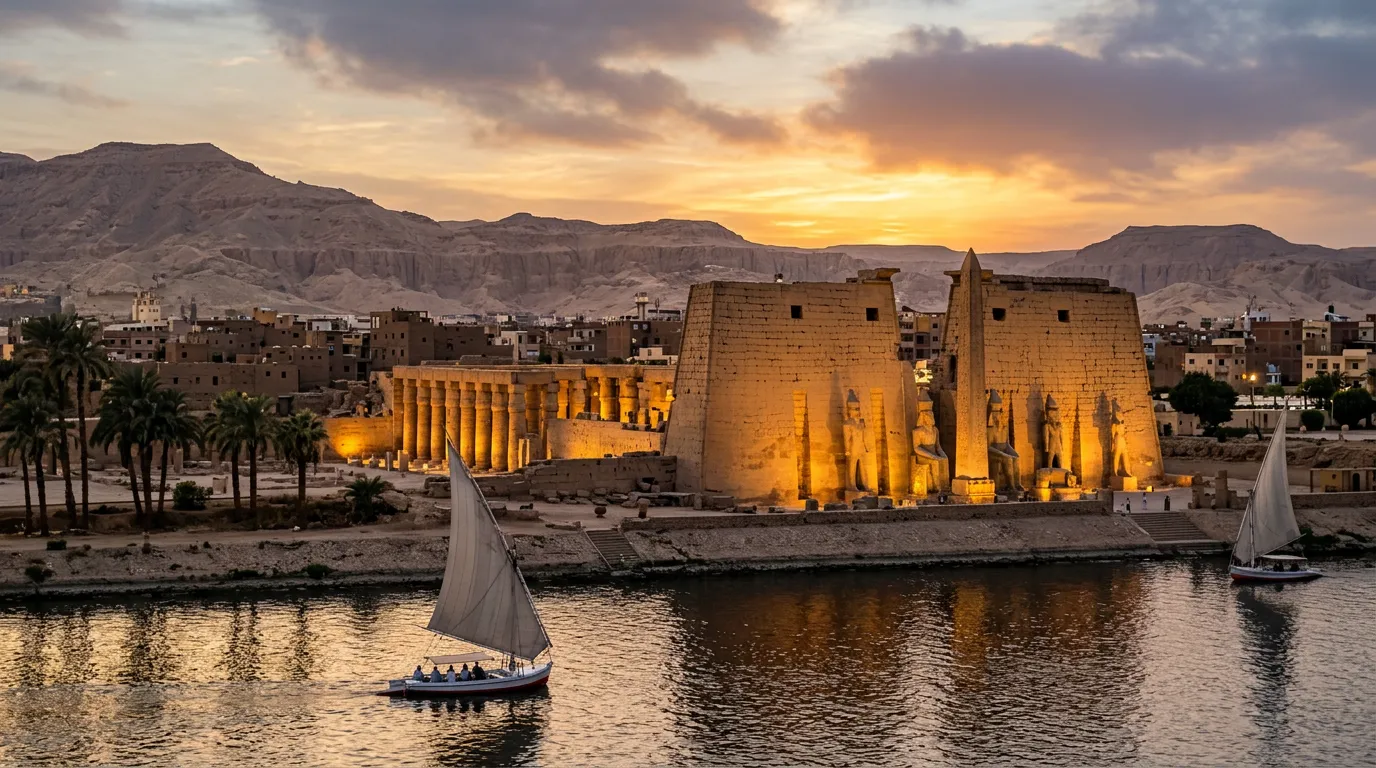
A traditional wooden sailing boat ride at sunset is the defining Luxor experience that no temple ticket can replicate. The light on the West Bank mountains turns gold then pink while the water goes glassy. This is not overrated — it genuinely delivers every single evening.
ICONICNeighbourhoods
East Bank – Karnak Temple Complex Area
The spiritual epicenter of ancient Thebes. Monumental columns, towering obelisks, and the Great Hypostyle Hall create an overwhelming sense of scale that no photograph fully captures.
Must do: Walk the Great Hypostyle Hall at sunrise before crowds arrive. Attend the Sound and Light Show at night for dramatic illumination of the columns. Photograph the Sacred Lake reflections during golden hour.
ICONIC · PHOTO · GOLDEN HOUR · NIGHT SHOOT · BOOK AHEAD · CROWD WARNING
West Bank – Valley of the Kings & Deir el-Bahari
A sun-scorched desert valley hiding the tombs of pharaohs beneath barren limestone hills. The landscape itself feels otherworldly — austere, silent, and deeply powerful.
Must do: Visit the tombs of Seti I and Nefertari (separate tickets, expensive, absolutely worth it). Explore Hatshepsut's temple at Deir el-Bahari at first opening. Hire a bicycle in the West Bank village area and ride between sites at your own pace.
ICONIC · PHOTO · SUNRISE · PERMIT NEEDED · HARD HIKE · BUDGET
Luxor Temple & Corniche Promenade
The beating heart of modern Luxor where a living city wraps around a 3,400-year-old temple. At night, the illuminated columns against the dark sky are one of Egypt's most magical urban scenes.
Must do: Visit Luxor Temple after dark when the floodlighting is spectacular and crowds thin out. Walk the restored Avenue of Sphinxes connecting Luxor Temple to Karnak. Sip tea at a Corniche cafe and watch feluccas on the Nile at sunset.
ICONIC · NIGHT SHOOT · BLUE HOUR · EASY WALK · PHOTO · NEXTPIC
West Bank – Gurna & the Colossi of Memnon
A quieter, more local side of the West Bank where traditional mudbrick villages (partially relocated) sit among lesser-visited nobles' tombs. The twin Colossi statues stand alone in green fields — surreal and photogenic.
Must do: Photograph the Colossi of Memnon at sunrise with hot air balloons floating behind them. Explore the Tombs of the Nobles — far less crowded than the Valley of the Kings with vivid daily-life paintings. Visit the Ramesseum for its fallen colossus that inspired Shelley's Ozymandias.
PHOTO · SUNRISE · HIDDEN GEM · FREE · EASY WALK · GOLDEN HOUR
Luxor Souq (Sharia al-Souq)
A compact, chaotic market street running parallel to the Corniche. It transitions from tourist alabaster shops near the temple to a genuine local market selling spices, fabric, and street food deeper in.
Must do: Walk past the tourist zone into the deeper local market for real hibiscus tea, spices, and Egyptian cotton at local prices. Try fresh sugarcane juice from the stand-up carts. Bargain for alabaster but know that most pieces are mass-produced resin.
BUDGET · EASY WALK · PHOTO · TRANSIT-FRIENDLY
West Bank – Medinet Habu
The most underrated major temple in Luxor. Ramesses III's mortuary temple retains vivid original paint on its carvings and sees a fraction of Karnak's visitors. It feels like discovering something secret.
Must do: Study the preserved original colors on the ceiling and column carvings — some of the best surviving polychrome in Egypt. Photograph the massive first pylon depicting battle scenes. Combine with a walk to the nearby Valley of the Queens.
HIDDEN GEM · PHOTO · GOLDEN HOUR · NEXTPIC
Nile Islands & Felucca Zone
Banana Island and the stretch of Nile south of town offer a genuine escape from temple fatigue. Lush green against desert hills, birdsong, and the quiet lap of water — a totally different Luxor experience.
Must do: Take a sunset felucca ride — negotiate 200-300 EGP for an hour and insist on sailing, not motoring. Visit Banana Island for a walk through plantation groves and fresh fruit. Photograph the West Bank cliff faces from the water during golden hour.
SUNSET · FAMILY · PHOTO · BUDGET · EASY WALK
Day Trips
Valley of the Kings & West Bank Full Circuit
Travel: 5 km across the Nile / 15 min by local ferry + taxi
Dendara Temple (Temple of Hathor)
Travel: 75 km north / 1.5 hr by private car or taxi
Abydos (Temple of Seti I)
Travel: 165 km north / 2.5 hr by private car
Esna Temple (Temple of Khnum)
Travel: 55 km south / 1 hr by taxi or minibus
Nile Felucca to Banana Island (Gezira el-Moz)
Travel: 5 km upstream / 30–45 min by felucca
El-Kab & Elkab Rock Tombs
Travel: 80 km south / 1.5 hr by private car
Qena City & Local Life Experience
Travel: 60 km north / 1 hr by train or minibus
Scenic Routes
Nile Corniche Promenade – East Bank
Walking
Route: Luxor Temple to Winter Palace Hotel and beyond toward Karnak
ICONIC · PHOTO · GOLDEN HOUR · BLUE HOUR · EASY WALK · FREE · NEXTPIC
Avenue of Sphinxes – Luxor Temple to Karnak
Walking
Route: Luxor Temple entrance to Karnak Temple first pylon
ICONIC · PHOTO · NIGHT SHOOT · SUNRISE · EASY WALK · FREE · NEXTPIC
West Bank Valley Road – Colossi to Valley of the Kings
Driving
Route: Colossi of Memnon to Valley of the Kings via Hatshepsut Temple turnoff
ICONIC · PHOTO · GOLDEN HOUR · CROWD WARNING
Theban Hills Sunrise Hike – Valley of the Kings Ridge
Hiking
Route: Hatshepsut Temple area to peak of Al-Qurn (the Theban Peak) and back
HIDDEN GEM · PHOTO · SUNRISE · HARD HIKE · FREE · NEXTPIC
Felucca Sail – East Bank to Banana Island
Cycling
Route: Luxor Corniche dock to Banana Island (Gezira el-Mozh) and return
PHOTO · SUNSET · GOLDEN HOUR · BUDGET · FAMILY
West Bank Village Cycling Loop
Cycling
Route: Local ferry landing (West Bank) looping through Gurna villages to Medinet Habu and back
HIDDEN GEM · PHOTO · BUDGET · EASY WALK · TRANSIT-FRIENDLY
Street Art
Luxor's street art scene is small but uniquely layered atop 3,500 years of visual storytelling. The city doesn't have a traditional Western-style graffiti or mural culture, but several notable projects have emerged in recent years. The most significant is the ongoing transformation of walls in the West Bank village of Gurna (Al-Qurna), where Egyptian and international artists have painted murals on homes and public walls, blending pharaonic motifs with contemporary themes. On the East Bank, scattered murals appear near the Corniche, around Luxor Temple's perimeter streets, and in the alleyways of the souk. Much of the visual culture here is vernacular folk art — Hajj paintings on house facades documenting pilgrimages to Mecca — which are arguably Egypt's most authentic form of street art and deserve serious attention from photographers.
Gurna Village (West Bank)
The relocated and partially demolished village of Old Gurna and surrounding New Gurna areas feature striking murals painted on residential walls. Some were part of organized art projects aiming to preserve the cultural identity of families displaced from the Theban necropolis area. Pharaonic-inspired designs sit alongside modern Egyptian street art. The visual contrast of painted concrete homes against the Theban hills is extraordinary.
New Gurna and Old Gurna road, West Bank, accessible via local ferry then taxi or bicycle
ICONIC · PHOTO · GOLDEN HOUR · NEXTPIC · HIDDEN GEM
West Bank Hajj Paintings
Scattered across homes on the West Bank, traditional Hajj paintings are folk murals painted on house facades to celebrate a family member's pilgrimage to Mecca. These feature boats, planes, the Kaaba, camels, and Quranic calligraphy in vivid blues, greens, and yellows. They are a living tradition dating back generations and represent Egypt's most genuine indigenous street art form. Some homes near the ferry landing and along the road to Valley of the Kings have particularly well-preserved examples.
Residential streets between West Bank ferry landing and the Colossi of Memnon road
ICONIC · PHOTO · HIDDEN GEM · FREE · NEXTPIC
Luxor Corniche Walls
The Corniche road running along the Nile on the East Bank features intermittent murals and painted walls, some government-commissioned with pharaonic themes, others more spontaneous. Quality varies widely. The best sections are between Luxor Temple and the Winter Palace Hotel, where painted barriers and low walls depict stylized ancient Egyptian scenes. These are touristy but photograph well at sunset with the Nile behind you.
Corniche El Nile, between Luxor Temple and Sofitel Winter Palace
PHOTO · SUNSET · GOLDEN HOUR · EASY WALK · FREE
Luxor Souk Alleyways
The narrow lanes behind Luxor Temple leading into the tourist souk contain sporadic murals, hand-painted shop signage that doubles as folk art, and occasional stencil work. Nothing is curated or mapped — discovery is the point. The visual density of Arabic calligraphy signs, painted doorways, and the occasional political or cultural mural makes this a rewarding wander for street photographers even if dedicated street art is sparse.
Alleyways east and south of Luxor Temple, centered around Sharia al-Souk
PHOTO · EASY WALK · FREE · HIDDEN GEM
Train Station District Walls
The area around Luxor Train Station has some painted walls and murals, mostly government-sponsored beautification projects with pharaonic motifs. Not destination-worthy on their own, but if you're arriving or departing by train, the colorful walls near the station entrance and along the approach road are worth a quick photo stop. Quality is municipal-grade but the colors pop in morning light. [ASSUMPTION]
Sharia al-Mahatta, near Luxor Railway Station entrance
BUDGET · FREE · TRANSIT-FRIENDLY · EASY WALK
Culture & History
Luxor sits on the site of ancient Thebes, the religious capital of pharaonic Egypt and the most concentrated repository of monumental architecture on Earth. For over two thousand years it served as the spiritual heart of Egyptian civilization, a role that still echoes in the daily life, craft traditions, and deep local pride of its residents. Few cities anywhere carry such a dense layering of continuous human meaning — Pharaonic, Coptic, Islamic, and modern — compressed into one walkable landscape.
Eat & Drink
Luxor's food scene is rooted in Upper Egyptian traditions that differ noticeably from Cairo's cosmopolitan dining. Expect hearty stews, fresh river fish from the Nile, wood-fired flatbreads pulled from communal ovens, and an abundance of legume-based dishes like ful medames and koshari. Spicing tends to be simpler than in the Delta, with cumin, coriander, and dill doing the heavy lifting, and meals are often built around communal plates shared family-style.
Sofra Restaurant & Cafe ★★★★★
Traditional Upper Egyptian dishes: molokhia with rabbit, stuffed pigeon, fattah with lamb, and homemade kunafa for dessert
East Bank, 90 Mohamed Farid Street near Luxor Temple
Restaurant
Al-Sahaby Lane Restaurant ★★★★★
Grilled Nile perch, tagine with okra, mixed meze platters, fresh sugarcane juice
East Bank, off Khalid Ibn El-Walid Street, near Luxor Temple corniche
Restaurant
Gerda's Garden ★★★★
Vegetarian-friendly Egyptian and international plates: baba ganoush, lentil soup, falafel platters, stuffed vine leaves, seasonal vegetable tagines
West Bank, near the Colossi of Memnon, Gezira village area
Restaurant · vegetarian_restaurant
Nile Valley Hotel Restaurant ★★★★
Grilled kofta, chicken shawarma plates, Egyptian salads, and solid no-frills ful with tahini
East Bank, Gezira Street near the train station
Restaurant
Al Moudira Restaurant ★★★
Organic salads, roasted vegetable couscous, lentil dishes, and vegan-friendly meze spreads
West Bank, Al Moudira Hotel, Daba'iya village [ASSUMPTION]
Restaurant · vegan_restaurant
Aboudi Bookshop Cafe
Strong Turkish coffee served alongside Egyptology books and maps. A cultural landmark for travelers planning their itinerary over a cup.
East Bank, Tourist Bazaar area near Luxor Temple
Coffee · cafe
Chez Omar Cafe
Fresh mango juice, hibiscus tea (karkade), and shisha in a relaxed garden courtyard on the quieter West Bank
West Bank, Ramla village near Medinet Habu
Coffee · cafe
Marsam Hotel Terrace Cafe
Simple tea and coffee on a terrace overlooking the Theban Hills, frequented by archaeologists and long-term visitors
West Bank, near the Antiquities Inspectorate office
Coffee · cafe
Metropolitan Cafe
Espresso-style coffee, fresh juices, and light snacks in a modern air-conditioned setting, rare for Luxor
East Bank, Corniche el-Nil near the Winter Palace
Coffee · cafe
Luxor's Corniche Aish Baladi Bakeries
Fresh aish baladi (whole wheat flatbread) pulled from wood-fired ovens, sold by the kilo. The bread Luxor runs on.
East Bank, multiple stalls along the Corniche and side streets near the train station
Bakery · bakery
El Hussein Bakery
Feteer meshaltet (flaky layered pastry) served sweet with honey or savory with cheese and egg. Also fresh croissants and simple breakfast plates.
East Bank, Television Street area [ASSUMPTION]
Bakery · bakery · breakfast_restaurant
West Bank Village Bakeries
Rustic baladi bread and sometimes seasonal kahk (date-filled cookies) baked in communal clay ovens
West Bank, scattered through Gezira and Gurna villages
Bakery · bakery
Sofra Restaurant & Cafe (Vegetarian Options)
Lentil soup, baba ganoush, tahini salad, ful medames, koshari, and an exceptional molokhia that can be ordered without meat
East Bank, 90 Mohamed Farid Street
Vegetarian · vegetarian_restaurant
Gerda's Garden (Vegan Options)
Roasted aubergine dishes, fresh salads from garden produce, hummus, falafel, and rice-stuffed vegetables. Vegan plates available on request.
West Bank, Gezira village near Colossi of Memnon
Vegetarian · vegan_restaurant
Street Cart Ful and Taamiya
Ful medames (stewed fava beans) and taamiya (Egyptian falafel made from fava beans, not chickpeas), served in fresh aish baladi with pickled vegetables
East Bank, carts near the train station and along Sharia al-Mahatta
Vegetarian · vegetarian_restaurant · vegan_restaurant
Shopping
Luxor's shopping scene is dominated by alabaster workshops, papyrus art, and a deeply rooted haggling culture centered around the tourist corridor between Luxor Temple and the train station. Shoppers who love handmade stone crafts, antique-style jewelry, and direct-from-artisan purchasing will find Luxor more rewarding than Cairo for certain specialty items.
Souq al-Luxor (Luxor Souk)
Mixed
Alabaster vessels, cotton galabiyas, handmade leather sandals, essential oils in ornate bottles, spice blends for gifting, scarves. The deeper you walk from the temple end, the more local and less tourist-oriented the stalls become.
Market · ICONIC · PHOTO · BUDGET · CROWD WARNING
Gurna Village Alabaster Workshops
Craft
Watching alabaster carved and polished on-site, buying direct from the families who quarry and shape the stone. Canopic jar replicas, vases, scarab figures, and bowls. Quality is noticeably higher than souk stalls.
Market · HIDDEN GEM · WORKSHOP SPOT · PHOTO
Habou Market (Tuesday Market)
Mixed
Local textiles, secondhand clothing, household goods, cheap cotton fabrics by the meter, plastic sandals, and an authentic non-tourist market atmosphere. Not curated but genuinely fascinating.
Market · HIDDEN GEM · PHOTO · BUDGET · SEASONAL
Banana Island Craft Stalls
Craft
Small handmade baskets, woven palm-leaf goods, simple pottery. The draw is the felucca ride and setting rather than exceptional merchandise.
Market · EASY WALK · BUDGET
Sharia al-Mahatta (Station Street) Corridor
The main tourist shopping artery running from the train station toward Luxor Temple. Mix of souvenir shops, perfume stores, papyrus galleries, and jewelry shops. Heavily tourist-oriented with persistent touts.
Aboudi Bookshop for genuinely good Egyptology books and maps. Several reputable essential oil shops selling frankincense, lotus, and sandalwood blends. Gold and silver cartouche jewelry shops cluster near the Corniche end — compare at least three before buying.
District · ICONIC · CROWD WARNING
Corniche el-Nil (Nile Corniche)
The riverfront promenade has a string of upmarket shops, hotel boutiques, and galleries selling higher-end papyrus art, jewelry, and antiquity reproductions. Less haggling pressure, slightly higher base prices, air-conditioned.
Fair Trade Center Luxor for verified fair-trade crafts. Hotel gift shops at Sofitel Winter Palace and Steigenberger Nile Palace carry curated, fixed-price items that can serve as a price benchmark before you enter the souk. Several galleries sell hand-painted papyrus using traditional methods.
District · EASY WALK · TRANSIT-FRIENDLY
West Bank Artisan Road (Gurna to Medinet Habu)
Scattered family-run workshops and small storefronts along the road connecting major archaeological sites. Alabaster, pottery, and painted reproductions dominate. Feels more authentic than East Bank tourist shops.
Mohamed Ahmed Alabaster Factory and similar multi-generational workshops. Small pottery studios near Deir el-Medina selling reproductions inspired by the artisan village. Hand-painted tomb scene reproductions on limestone fragments.
District · HIDDEN GEM · WORKSHOP SPOT
Photo Spots
Luxor sits at roughly 25.7 degrees north latitude, giving it intense overhead sun from April through September and more photographer-friendly low-angle light from October through March. Winter (Dec–Feb) is peak season for good reason: sunrise around 6:20–6:40am, sunset around 5:00–5:20pm, with golden hours that last a solid 45 minutes and produce warm, directional light perfect for carved stone reliefs. Summer light is brutal between 9am and 4pm — plan all outdoor shooting for the first and last two hours of daylight. Haze from agricultural burning (Oct–Nov) can soften distant shots of the Theban hills but creates moody atmospheric layers. The Nile orientation in Luxor runs roughly north-south, meaning East Bank sites catch morning light on their faces and West Bank temples and tombs are best in afternoon. Rain is essentially nonexistent — maybe two days per year — so weather is never a planning factor. Gear-wise, bring the widest lens you own for temple interiors (16mm or wider on full frame) and a fast prime (f/1.8 or f/2.8) for tomb photography where no flash is allowed and tripods are banned. A 70–200mm telephoto earns its weight for compressing columns at Karnak, isolating carved details high on walls, and shooting other hot air balloons from your basket. A circular polarizer is essential for cutting glare off polished stone and deepening blue skies against sandstone — this is the single most useful filter in Luxor. Dust is constant: bring a rocket blower, keep rear caps on lenses when swapping, and avoid changing lenses in open desert wind. In post-processing, the warm sandstone tones respond beautifully to split-toning with warm highlights and cool shadows. Recover shadow detail aggressively — the dynamic range between sunlit stone and deep tomb corridors is extreme. Shoot RAW without exception.
Karnak Temple — Great Hypostyle Hall
134 massive columns in rows, with shafts of low-angle light piercing between them. Shoot from the central nave looking toward the obelisk of Hatshepsut. The columns dwarf human figures — include a subject for scale. Wide-angle from below creates towering verticals. Late afternoon light rakes horizontally across the carved reliefs, making hieroglyphs pop with dimensional shadow.
Valley of the Kings — Tomb Interiors
Vivid 3,000-year-old painted walls and ceilings inside royal tombs. The colors — deep blues, ochre yellows, rich reds — are astonishingly preserved. Tomb of Ramesses VI (KV9) has the most spectacular astronomical ceiling. Tomb of Seti I is the most detailed but costs extra. Tight corridors create dramatic framing with descending passageways.
Hot Air Balloon Over West Bank at Sunrise
Aerial view of the Theban Necropolis, Hatshepsut Temple, patchwork sugar cane fields, and the Nile — all in golden sunrise light. Dozens of balloons launch simultaneously, so you can photograph other balloons as foreground elements against the mountains. The Colossi of Memnon from above is a unique perspective. Shoot both wide establishing shots and telephoto compressions of balloons against the cliffs.
Luxor Temple — Night Illumination
The temple is spectacularly lit after dark with warm amber and white uplighting. The colonnade of Amenhotep III glows against a deep blue hour sky. The mosque of Abu Haggag, built on top of the temple, creates a unique layers-of-history composition. The Avenue of Sphinxes leading north toward Karnak is now restored and lit — shoot the receding line of sphinxes with the temple pylon behind.
Colossi of Memnon at Sunrise
Two 18-meter seated statues of Amenhotep III facing east across flat farmland toward the Nile. At sunrise they catch the first warm light on their faces while the Theban hills behind remain in cool shadow — excellent color contrast. The recently restored smaller colossi behind them add depth. Sugar cane fields or flooded irrigation channels in the foreground (seasonal) add layering options.
Ramesseum — Fallen Colossus
The shattered remains of what was once the largest freestanding statue in Egypt — the fallen colossus of Ramesses II. Massive granite fragments scattered across the ground create a haunting Ozymandias scene. The standing Osiride pillars in the second court frame beautifully. Far fewer visitors than Karnak or Valley of the Kings, giving you freedom to compose without crowds. The Theban cliffs rise directly behind for dramatic backdrops.
West Bank Village of Gurna — Street Photography
The painted mud-brick houses of old and new Gurna villages on the West Bank offer some of the best street photography in Upper Egypt. Brightly painted facades in turquoise, yellow, and pink. Donkey carts on dusty lanes. Farmers loading sugar cane. Children playing in alleyways. The backdrop of the Theban hills gives everything a cinematic desert-village quality that feels timeless.
Felucca on the Nile — Sunset Crossing
Charter a felucca (traditional sailboat) for the golden hour crossing. The white lateen sail against sunset skies is the definitive Luxor image. Shoot the sail from below with warm sky behind. Photograph other feluccas silhouetted on the water. The West Bank mountains turn purple and pink at dusk. Banana Island is a common short route — the lush green palms contrast with the amber water surface.
Suggested Itinerary
Nightlife
Luxor is a conservative Upper Egyptian city, and its nightlife is extremely limited compared to Cairo, Hurghada, or Sharm El Sheikh. There is no club scene, no late-night bar district, and alcohol service is almost entirely confined to upscale hotel properties catering to foreign tourists. The evening atmosphere revolves around the illuminated Corniche promenade, shisha cafes, and hotel rooftop bars with Nile views — things wind down early, usually by midnight.
Sofitel Winter Palace Bar
Colonial-era grandeur with dark wood paneling, ceiling fans, and leather armchairs where Agatha Christie once sipped gin — it feels like drinking inside a period film set.
Open to non-guests. Serves beer, wine, spirits, and cocktails. Smart casual expected — no shorts or flip-flops. Closes around 11pm-midnight. The garden terrace is the best seat on a cool evening. Stella beer around 80-100 EGP, cocktails 150-250 EGP.
Hilton Luxor Resort Lounge Bar
Modern five-star lobby bar with floor-to-ceiling Nile views, low lighting, and the slightly antiseptic calm of an international hotel — but the panorama compensates.
Open to non-guests. Full cocktail menu plus imported wines. Dress code is resort smart casual. Can stay open until midnight or later depending on occupancy. Occasionally has a pianist or oud player on weekends.
Steigenberger Nile Palace Rooftop Bar
Open-air rooftop with direct sightlines to the West Bank mountains — at sunset the cliff face turns amber while you nurse an overpriced Sakara Gold.
Best visited at sunset or just after. Beer and basic cocktails available. No dress code enforced beyond covered shoulders. Closes around 11pm. Mosquito coils appear at dusk — bring repellent anyway.
Al Moudira Hotel Lounge
A candlelit courtyard in a hand-built boutique palace surrounded by sugar cane fields — genuinely atmospheric and unlike anything else in Luxor, though getting there after dark requires a taxi.
Reservation strongly recommended as it is a small boutique hotel. Wine and beer served to guests and diners. Dinner service ends around 10pm and drinks continue for a short while after. A taxi from the East Bank runs 100-150 EGP each way. [ASSUMPTION] Non-guest access may require advance arrangement — call ahead.
Snobs Bar (Sonesta St. George)
The closest thing Luxor has to a nightlife spot — a dim, slightly worn hotel bar where tour guides, Egyptologists, and tourists mix over cold Stella and loud Arabic pop on the TV.
More relaxed dress code than the Winter Palace. Beer around 60-80 EGP. Can stay open until midnight or 1am if there are enough drinkers. No cover charge. The adjacent Nile-view terrace is the better option in warm months.
Nile Terrace Cafe (Mercure Karnak)
A breezy poolside terrace overlooking the Nile where package tourists gather for after-dinner beers — relaxed, forgettable decor, but the warm night air and felucca lights on the river do the work.
Open to non-guests. Serves beer and basic spirits. Service can be very slow. Usually closes by 11pm. Good fallback when other hotel bars feel too formal.
Corniche Shisha Cafes
Rows of plastic chairs facing the Nile, sweet apple-tobacco smoke, strong tea, and the sound of backgammon dice — this is where actual Luxor evening life happens, entirely alcohol-free.
No alcohol served. Shisha runs 20-40 EGP, tea 10-15 EGP. Open until midnight or later. Predominantly male clientele, though mixed tourist groups are welcome and unbothered. Best stretch is between Luxor Temple and the local ferry dock. No reservation, just sit down.
Emo Hotel Rooftop
A budget-traveler gathering spot on a basic rooftop with cheap beers, fairy lights, and backpackers swapping West Bank hiking stories — the polar opposite of the five-star hotel bars.
Beer around 40-60 EGP. No dress code whatsoever. Atmosphere depends entirely on who is staying — some nights its lively, others its empty. Usually wraps up by 11pm-midnight. [ASSUMPTION] Alcohol availability may be intermittent depending on hotel management changes.
Build your own Itinerary from this guide
Pick the places you care about — attractions, photo spots, map markers — and we'll lay out a day-by-day starting point. Yours to edit; guide updates never touch it.