Essentials
Currency, language, transit & safety — tap to expand.
Currency — Peruvian Sol (PEN), symbol S/. Roughly S/3.7 = 1 USD, S/4.0 = 1 EUR [ASSUMPTION: rates fluctuate]
Cash vs card — Cash is king in Aguas Calientes and on the mountain — bring Soles. Cards accepted at hotels and bigger restaurants but often add fees. ATMs exist in Aguas Calientes (Cusco has more reliable ones — withdraw there). Tipping: round up or 10% at sit-down restaurants; tip your guide and porters generously (they earn little).
Budget — Budget: S/150-200 (~$40-55) / mid-range: S/350-500 (~$95-135) / luxury: S/1500+ (~$400+). Note: the Machu Picchu day itself is expensive regardless — entry + train + bus stack up fast.
Language — Spanish is official and dominant. Quechua is widely spoken in the Cusco/Sacred Valley region, especially by older and rural Andean communities.
Language barrier — English is decent in tourist-facing spots (guides, hotels, train staff) but thin elsewhere. Basic Spanish goes a long way and earns goodwill.
Getting around — There are no roads to Machu Picchu — you reach Aguas Calientes (the base town) by train, then a bus or steep walk up to the ruins. Book train and entry tickets well ahead; they sell out, especially in high season. From Cusco, budget a full day each way unless you overnight in Aguas Calientes.
Safety — Altitude is the real risk — Cusco sits ~3,400m; acclimatise there 1-2 days before heading up. Machu Picchu itself is lower (~2,430m), easier on the lungs. Stone steps get slippery in rain — proper shoes matter. Timed entry slots are strictly enforced; you must exit within your window. Watch footing near unfenced drops for photos. Petty theft is more a Cusco/train-station concern than the site itself.
Highlights
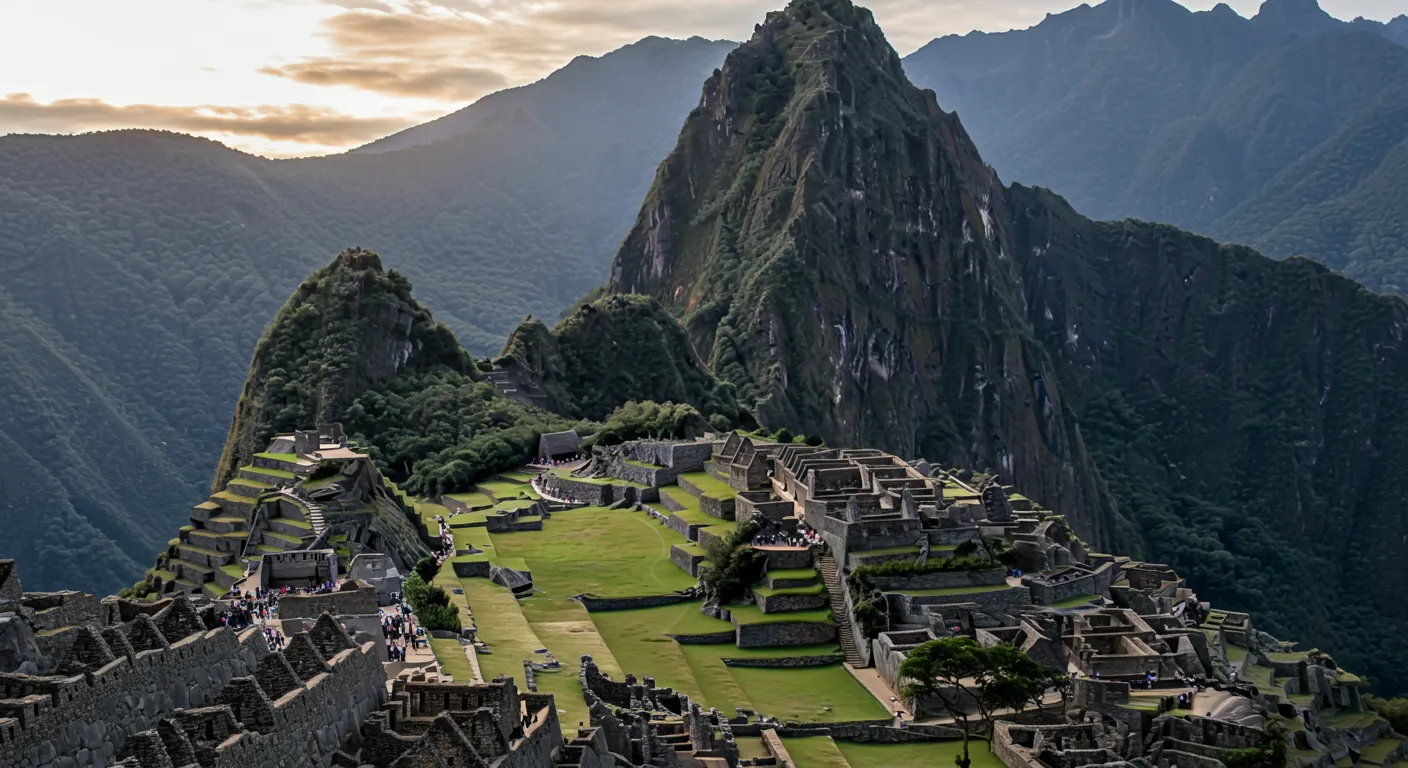
Machu Picchu isn't a city you wander into — it's a 15th-century Inca citadel perched on a saddle between two peaks, reached only by train, foot, or trek. The theatrical reveal (mist parting to expose terraces above the Urubamba gorge) is the payoff for a genuinely involved journey. Nothing about the logistics is casual, and that friction is exactly what keeps the experience feeling earned.
Aguas Calientes is your basecamp, not the site
The town below (officially Machu Picchu Pueblo) is where you sleep, eat, and catch the shuttle bus. Book the 25-minute Consettur bus up the switchbacks in advance — the alternative is a 90-minute uphill hike. First buses leave around 5:30am; queue by 5:00am for sunrise entries.
BOOK AHEAD · TRANSIT-FRIENDLY
Timed circuits and mandatory guides
Since 2024 entry is split into Circuits 1, 2, and 3, each with sub-routes. Circuit 2 (routes 2A/2B) gives the classic postcard view. Guides are now required for first entry — hire one at the gate or pre-book. You cannot backtrack, so choose your circuit around the shot you want.
BOOK AHEAD · PHOTO · PERMIT NEEDED
The Huayna Picchu vs Machu Picchu Mountain choice
Two add-on peaks sell out weeks ahead. Huayna Picchu (the iconic sugarloaf behind the ruins) is steep, exposed, and capped at 400/day — book on the official gov.pe portal the moment your dates open. Machu Picchu Mountain is longer but less vertigo-inducing with wider trail.
BOOK AHEAD · HARD HIKE · PHOTO
Entry reality for most travellers
Peru is visa-free for up to 90 days for US, UK, EU, Canada, Australia, and most nationalities. You get a stamp on arrival; keep the entry record. Machu Picchu tickets themselves require your passport number at purchase — the name on the ticket must match your passport at the gate.
Connectivity and payment setup
Claro and Bitel have the best coverage in the Sacred Valley; buy a SIM in Cusco (Jorge Chávez airport or JCC stores) with passport, or use an eSIM before arrival. Signal at the site itself is spotty — download offline maps in maps.me or Google Maps offline. Yape is the dominant local payment app but needs a Peruvian bank account; carry soles cash in Aguas Calientes as cards are inconsistent.
PLUGIN TIP
Altitude and etiquette
Acclimatise in Cusco (3,400m) or the lower Sacred Valley (Ollantaytambo, 2,800m) for two days before — Machu Picchu itself is a relatively gentle 2,430m. Coca tea and mate de coca are standard local remedies, offered freely. Don't touch or climb on stonework, drones are banned, and no large backpacks (over 40x35x20cm) are allowed inside.
PERMIT NEEDED
The IncaRail vs PeruRail unlock
Both operators run from Ollantaytambo and Poroy. Book the earliest morning train to beat day-trippers arriving from Cusco around 10am. [ASSUMPTION] Vistadome-class panoramic cars cost more but the glass-roof views through the gorge are worth it for photographers. Stay a night in Aguas Calientes to be first at the gate — day trips from Cusco waste hours in transit.
CROWD WARNING · BOOK AHEAD
When to Go
May and September are the sweet spot — dry, walkable trails with slightly thinner crowds than the July-August peak, and clear morning light for that classic citadel shot before clouds build. April and October offer green landscapes and moody mist for photography if you accept some rain risk. Avoid February entirely if you plan to hike the Inca Trail, as it closes.
Dry Season
The reliable window of sunny days, clear mornings, and firm trails. This is when the Inca Trail is at its best and the classic sunrise citadel shot is most achievable. It also brings the year's biggest crowds and highest prices.
Best for hiking and clear photography, but book permits and lodges months ahead.
Wet Season
Heavy afternoon rain and landslide risk define these months, peaking in January and February. The upside is dramatically thinner crowds, lower prices, and vibrant green ruins. Trains occasionally face disruptions.
Cheapest and quietest, but pack for rain and expect some obscured views.
Green Season
The tail of the rains leaves the surrounding cloud forest at its lushest and greenest. Mist drifts through the ruins for atmospheric photography while crowds stay modest. A rewarding shoulder for those who accept weather uncertainty.
Excellent for moody, misty photography with fewer people around.
Inca Trail Closure
The classic Inca Trail closes for the entire month of February for maintenance and safety during peak rains. The citadel itself and alternate treks like Salkantay remain open but muddy. [ASSUMPTION] Exact reopening is March 1 each year.
Do not plan the Inca Trail in February — choose an alternate route or another month.
Where to Stay
Machu Picchu lodging splits between Aguas Calientes (the base town, officially Machu Picchu Pueblo) and the one property literally at the ruins' gate. Prices run high for what you get — you're paying for proximity to a bucket-list site with limited buildable land, not luxury infrastructure. Book early for June–August and shoulder seasons around Peruvian holidays; last-minute rooms in Aguas Calientes exist but the good-value ones vanish fast.
Belmond Sanctuary Lodge
Machu Picchu citadel gate
Hotel
ICONIC · SUNRISE · PHOTO · BOOK AHEAD
Sumaq Machu Picchu Hotel
Aguas Calientes riverside
Hotel
CENTRAL · VIEWS · BOOK AHEAD
Inkaterra Machu Picchu Pueblo Hotel
Aguas Calientes edge, near rail station
Boutique Hotel
UNIQUE · VIEWS · BOOK AHEAD
El MaPi by Inkaterra
central Aguas Calientes
Hotel
CENTRAL · VALUE · TRANSIT-FRIENDLY
Tierra Viva Machu Picchu
Aguas Calientes near hot springs
Boutique Hotel
VALUE · CENTRAL
Supertramp Hostel Machu Picchu
Aguas Calientes hillside
Hostel
BUDGET · SOCIAL · HARD HIKE
Ecopackers / Local Guesthouses
central Aguas Calientes
Guesthouse
BUDGET · CENTRAL
Inkaterra Casitas (Garden Villa Suites)
Aguas Calientes cloud forest
Villa
UNIQUE · SPLURGE · VIEWS · BOOK AHEAD
Top Attractions
№ 1 · Essential
The Citadel and Classic Postcard Viewpoint
★ ICONIC · PHOTO · SUNRISE · BOOK AHEAD · CROWD WARNING · PERMIT NEEDED
The iconic terraced ruins with Huayna Picchu rising behind — this is the shot everyone comes for, and it genuinely lives up to the hype. The classic view is from the upper agricultural terraces near the Guardhouse. Arrive early or the foreground fills with crowds.
Tip: The Circuit 1 upper route delivers the postcard angle. Walk up toward the Guardhouse first, before descending into the ruins, so you get the clear frame before tour groups arrive.
Best: First entry slot 6:00 AM for soft light and thinner crowds; morning mist often clears by 8-9 AM.
Fees: Circuit tickets from ~150 PEN for foreign adults [ASSUMPTION]
Huayna Picchu Summit Hike
The steep peak in the classic photos — a short but genuinely intimidating climb up narrow Inca stairs with drop-offs. The reward is a bird's-eye view straight down onto the citadel. Not for those with vertigo, but incredible for the fit and brave.
HARD HIKESun Gate (Inti Punku)
The historic entrance where the Inca Trail arrives, offering a distant, elevated view of the whole site. It's a moderate uphill walk from the citadel — worth it if you skipped the trail and want the trekker's first-glimpse perspective. Slightly overrated if you're short on time and energy.
EASY WALKInca Bridge (Puente Inca)
A short trail to a dramatic stone bridge built into a sheer cliff face, part of the original Inca defensive path. It's a quick, flat detour most day-trippers skip, so it stays quiet. You can't cross it — a gate stops you — but the cliffside engineering is striking.
EASY WALKNeighbourhoods
The Citadel (Llaqta of Machu Picchu)
The reason you came: terraces, temples, and stone masonry stacked against a saddle of cloud forest between Huayna Picchu and Machu Picchu Mountain. Feels monumental and improbable in equal measure.
Must do: Walk Circuit 2 for the classic terrace-to-city panorama; visit the Temple of the Sun and Intihuatana stone; shoot from the upper agricultural terraces near the Guardhouse for the postcard frame.
ICONIC · PHOTO · BOOK AHEAD · PERMIT NEEDED · SUNRISE · CROWD WARNING
Huayna Picchu Peak
The pointed mountain looming behind the citadel in every famous photo. Climbing it flips the perspective — you look down onto the ruins from a dizzying, near-vertical vantage.
Must do: Book the timed Huayna Picchu ticket well ahead; climb the exposed stone stairs to the summit terraces; photograph the citadel from above with the Urubamba river bend below.
HARD HIKE · PHOTO · BOOK AHEAD · PERMIT NEEDED · CROWD WARNING
Aguas Calientes (Machu Picchu Pueblo)
The gateway town crammed into a river gorge below the ruins — part logistics hub, part tourist strip. Rushing water, train tracks through the centre, and rows of restaurants and hostels.
Must do: Soak in the namesake thermal baths after a hike; stock up on water and snacks before your citadel entry; grab an early breakfast to catch the first bus up.
TRANSIT-FRIENDLY · RAINY DAY · BOOK AHEAD · CROWD WARNING
Machu Picchu Mountain (Montaña)
The taller, less crowded peak opposite Huayna Picchu. A longer but wider, safer climb rewarding you with the broadest sweeping view of the whole valley system.
Must do: Take the graded stone path to the summit for a 360-degree valley panorama; shoot the citadel as a tiny detail against the vast landscape.
HARD HIKE · PHOTO · PERMIT NEEDED · HIDDEN GEM
Sun Gate (Inti Punku)
The original Inca Trail entrance point above the citadel, where trekkers get their first reveal of Machu Picchu at dawn. Quiet, elevated, and atmospheric.
Must do: Walk the gentle uphill trail from the citadel for the framed 'arrival' view; time it for early morning light before the mountain clouds build.
EASY WALK · SUNRISE · PHOTO · GOLDEN HOUR · PERMIT NEEDED
Inca Bridge (Puente Inka)
A short, flat side trail to a dramatic cliff-hugging Inca stonework path and a removable log bridge over a sheer drop. A quick, underrated detour most crowds skip.
Must do: Follow the level path to the viewpoint; photograph the vertigo-inducing ledge trail carved into the cliff face.
HIDDEN GEM · EASY WALK · PHOTO · FREE
Day Trips
Huayna Picchu
Travel: On-site / 45-60 min climb each way
Aguas Calientes (Machu Picchu Pueblo)
Travel: 8 km / 25 min by bus, or 90 min walk downhill
Sun Gate (Inti Punku)
Travel: On-site / 60-75 min hike each way
Ollantaytambo
Travel: ~40 km / 1.5-2 hr by train
Machu Picchu Mountain (Montaña)
Travel: On-site / 90 min climb each way
Inca Bridge (Puente Inca)
Travel: On-site / 20-30 min walk each way
Scenic Routes
Classic Inca Trail
Hiking
Route: KM82 Piscacucho to Machu Picchu via Sun Gate
ICONIC · HARD HIKE · PERMIT NEEDED · BOOK AHEAD · SUNRISE
Salkantay Trek
Hiking
Route: Mollepata to Aguas Calientes
HARD HIKE · PHOTO · BUDGET · SEASONAL
Huayna Picchu Summit Trail
Hiking
Route: Machu Picchu citadel to Huayna Picchu peak and back
PHOTO · HARD HIKE · PERMIT NEEDED · BOOK AHEAD · CROWD WARNING
Machu Picchu Mountain (Montaña) Trail
Hiking
Route: Citadel to Montaña summit and back
PHOTO · HARD HIKE · PERMIT NEEDED · BOOK AHEAD
Sun Gate (Inti Punku) Walk
Walking
Route: Citadel to Inti Punku and back
EASY WALK · PHOTO · GOLDEN HOUR · ICONIC
Inca Bridge (Puente Inca) Walk
Walking
Route: Citadel to Inca Bridge overlook and back
HIDDEN GEM · EASY WALK · PHOTO · FREE
Culture & History
Machu Picchu is the most iconic surviving expression of Inca civilization — a 15th-century royal estate built for the emperor Pachacuti, engineered into a mountain saddle without mortar or iron tools. Its significance is not just archaeological but living: the surrounding Quechua communities are direct cultural heirs of the Inca, keeping language, weaving, agriculture, and Andean spirituality alive today.
Eat & Drink
The food scene near Machu Picchu centers on Aguas Calientes (Machu Picchu Pueblo), the gateway town below the ruins. Don't expect fine dining at the citadel itself, where options are limited to one overpriced buffet. The real eating happens in the valley towns, where Andean staples like quinoa, alpaca, trout from the Urubamba, and cuy (guinea pig) meet Peru's broader culinary confidence. Expect inflated tourist pricing in Aguas Calientes; you pay a premium for the captive location.
Indio Feliz ★★★★★
trout in ginger sauce, French-Peruvian three-course menu
Aguas Calientes, Calle Lloque Yupanqui 4
Restaurant
Tinkuy Buffet at Sanctuary Lodge ★★★★★
buffet lunch beside the citadel entrance
Machu Picchu citadel entrance
Restaurant
The Tree House Restaurant ★★★★
alpaca tenderloin, Andean-fusion tasting plates
Aguas Calientes, Calle Huanacaure 105
Restaurant · vegetarian_restaurant
Mapacho Craft Beer & Peruvian Cuisine ★★★★
lomo saltado, local craft beer flights
Aguas Calientes, Av. Imperio de los Incas 614
Restaurant
Full House Peru ★★★
wood-fired pizza, quinoa soup, veggie curries
Aguas Calientes, Av. Pachacutec
Restaurant · vegan_restaurant
The Point Café
Peruvian single-origin espresso, mountain views
Aguas Calientes, near Plaza Manco Capac
Coffee · cafe
Café Inkaterra
organic coffee grown on-site, terrace overlooking the river
Aguas Calientes, Inkaterra Machu Picchu Pueblo Hotel
Coffee · cafe
Chullos Coffee
flat whites, banana bread
Aguas Calientes, Av. Pachacutec
Coffee · cafe
Apu Salkantay Café
coca tea, altitude-friendly herbal infusions
Aguas Calientes, near the market
Coffee · cafe
French Bakery Machu Picchu
croissants, empanadas, fresh baguettes
Aguas Calientes, near Av. Imperio de los Incas
Bakery · bakery
Panadería La Boulangerie de Paris
morning pastries, egg breakfasts, coffee
Aguas Calientes, Av. Pachacutec
Bakery · bakery · breakfast_restaurant
Local Market Bakery Stalls
pan chuta, sweet Andean breads
Aguas Calientes artisan market
Bakery · bakery
Full House Peru
vegan curries, quinoa bowls, veggie pizza
Aguas Calientes, Av. Pachacutec
Vegetarian · vegan_restaurant
The Tree House Restaurant
grilled vegetable plates, quinoa risotto
Aguas Calientes, Calle Huanacaure 105
Vegetarian · vegetarian_restaurant
Govinda Aguas Calientes
budget vegetarian set menu, lentil stews
Aguas Calientes, near the plaza
Vegetarian · vegetarian_restaurant · vegan_restaurant
Shopping
Shopping around Machu Picchu means Aguas Calientes (Machu Picchu Pueblo), the base town, where a large artisan market dominates — plus the higher-quality craft options you should really save for Cusco or the Sacred Valley. This is a place for textile lovers, but savvy shoppers will buy selectively here and hold out for better sources nearby.
Mercado Artesanal de Aguas Calientes
Craft
Alpaca-blend hats, gloves, scarves, and Machu Picchu-motif textiles you can grab quickly before boarding the train. A convenient catch-all rather than a source of the finest goods.
Market · CROWD WARNING · TRANSIT-FRIENDLY · BARGAIN
Mercado San Pedro (Cusco)
Mixed
Genuine alpaca textiles, woven blankets, ceramics, and coca-leaf products at a fraction of Aguas Calientes prices. The go-to for serious craft buying on the Machu Picchu route.
Market · ICONIC · BUDGET · PHOTO · BARGAIN
Avenida Pachacutec, Aguas Calientes
The main uphill street of the base town, lined with tourist-focused shops, small craft stalls, and pharmacies. Convenient but pricey and largely generic.
Alpaca knitwear, silver-tone jewelry, and last-minute gifts. Look for shops selling locally sourced honey and herbal teas rather than mass-printed T-shirts.
District · LOCAL
Calle del Medio & San Blas (Cusco)
Cusco's artisan quarter — cobblestone streets with higher-end galleries, independent textile cooperatives, and workshops. Where quality and provenance actually matter.
Center for Traditional Textiles of Cusco (fair-trade, certified alpaca weavings), silver jewelry ateliers, and locally made ceramics from the Pisac tradition.
District · LOCAL · PHOTO
Photo Spots
Machu Picchu sits at roughly 13° south latitude, so day length barely shifts across the year — sunrise hovers near 5:45–6:15am and sunset near 5:30–6:00pm every month. What changes dramatically is not the clock but the sky. The dry season (May–September) delivers clean, crisp mornings and reliable clear reveals — this is prime shooting, though it's also the most crowded and coldest at dawn. The wet season (November–March) brings thick morning fog that often shrouds the citadel until 8–9am, then burns off into the most atmospheric, moody light of the year; if you're patient, cloud-and-ruins reveals are worth the gamble. April and October are transitional sweet spots: greener terraces, fewer crowds, decent light odds. Whatever the month, the light window that matters is the first two hours after gates open at 6am, before harsh overhead sun flattens the terraces. Gear-wise, plan for the tripod ban inside the sanctuary — everything on-site is handheld, so a stabilized body and a fast-ish standard zoom (24–70mm equiv) covering wides and portraits is your workhorse, backed by a 70–200mm equiv for Sun Gate compression, Inca Bridge, and terrace details. A circular polarizer is genuinely useful for cutting glare off wet stone and deepening the sky over green ridges. Push ISO 400–800 without fear during foggy mornings; modern sensors handle it and the diffuse light keeps contrast manageable. Save all tripod, long-exposure, and astro work for Aguas Calientes, where rules are relaxed. In editing, resist crushing the greens — the terraces and cloud forest carry the frame; lift shadows gently to hold stonework texture, use dehaze sparingly on foggy shots (heavy dehaze looks fake on real mist), and warm the morning white balance slightly to counter the cool high-altitude cast.
Guardhouse (Casa del Guardián) Classic Overlook
The postcard view — full citadel with Huayna Picchu towering behind, agricultural terraces in foreground. The single most recognizable angle on Earth; get here first to shoot before crowds and clouds.
Sun Gate (Inti Punku)
Elevated distant view down onto the whole citadel with Huayna Picchu behind — the arrival shot Inca Trail hikers get. Compressed telephoto layers of ridgelines. Fewer people than the Guardhouse.
Huayna Picchu Summit
Vertigo-inducing top-down view of the entire citadel spread out like a map far below, wrapped by the Urubamba River bend. The reverse-angle that most visitors never get.
Terraces from the Lower Agricultural Sector
Repeating stone terrace lines as strong leading-line graphics, with llamas frequently grazing for scale and foreground interest. A cleaner, more abstract composition than the wide overlook.
Temple of the Sun & Curved Wall Detail
The finest Inca stonework on site — the curved semicircular wall and precision-fitted masonry. Tight architectural detail shots emphasizing the impossibly seamless joints.
Inca Bridge (Puente Inca) Trail Viewpoint
A vertiginous stone trail clinging to a sheer cliff face with a removable-log 'drawbridge' section — a dramatic, rarely-photographed defensive engineering shot. Almost no crowds.
Rio Urubamba & Ruins from Aguas Calientes Road
Blue-hour and night context shots — the rushing Urubamba River, the switchback road, and forested peaks. Long-exposure water and, on clear nights, dense Southern Hemisphere star fields with minimal light pollution.
Suggested Itinerary
Nightlife
Machu Picchu itself is an archaeological site that closes in late afternoon, so all nightlife happens in Aguas Calientes (Machu Picchu Pueblo), the valley town below. It's a compact, tourist-heavy strip of pisco-sour bars and pizza-oven restaurants that peaks between 8pm and midnight, driven by hikers refuelling after Inca Trail days and travellers on early-train schedules. Don't expect a serious club scene — most people are asleep by 11pm to catch dawn buses, and the town is exhausted rather than wild.
Mapacho Craft Beer & Peruvian Cuisine
A warm, wood-heavy room where Sacred Valley craft beers pour beside coca-leaf cocktails and the Vilcanota River rushes past outside.
No cover, no dress code. Try the local Cusquena craft taps and the coca sour. Fills with post-hike crowds from 7pm; good early evening spot before an early train. [ASSUMPTION] hours vary seasonally.
The Tree House Bar
A cosy upstairs perch with candlelight and Andean textiles, aimed squarely at couples winding down after the ruins.
Pisco sours and passion-fruit cocktails are the draw. Small room, so it feels intimate rather than lively. Closes earlier than the strip bars. [ASSUMPTION] no reservations needed.
Chullpi / La Boheme-style lounges on the strip
Interchangeable happy-hour bars with 2-for-1 pisco sour boards and touts waving laminated menus at anyone walking past.
Happy hour is the whole business model — often 2-for-1 until 9pm. Fine for cheap drinks, low on atmosphere. No cover.
Indio Feliz Bistro-Bar
A quirky French-Peruvian restaurant with a nautical-cluttered bar corner where the owner's personality fills the room.
Primarily a restaurant but the bar and wine list stand alone. Booking recommended for dinner. Warm service, genuinely good food. Closes when the kitchen does.
Wasicha Pub
A backpacker pub with cheap beer, football on the TV, and the closest thing Aguas Calientes has to a rowdy late crowd.
No cover, no dress code. Best late-night option if the strip has gone quiet. Loud when a big hostel group rolls in. [ASSUMPTION] closes around midnight.
Full House Bar
A small dance-floor bar that only comes alive on weekend nights when guides and seasonal workers stay out; otherwise it's a near-empty room with reggaeton on the speakers.
As close to a club as the town gets. No real cover. Don't expect much midweek or in low season. Manage expectations.
Build your own Itinerary from this guide
Pick the places you care about — attractions, photo spots, map markers — and we'll lay out a day-by-day starting point. Yours to edit; guide updates never touch it.
Premium section
Special Interest
This part of the guide is included with a NextTripLabs account. Sign in to read it here — full guide unlocks and itineraries are available in the NextTripLabs app.
Premium section
ISKCON Centers
This part of the guide is included with a NextTripLabs account. Sign in to read it here — full guide unlocks and itineraries are available in the NextTripLabs app.
Premium section
Record Stores
This part of the guide is included with a NextTripLabs account. Sign in to read it here — full guide unlocks and itineraries are available in the NextTripLabs app.
Premium section
Walkability Scores
This part of the guide is included with a NextTripLabs account. Sign in to read it here — full guide unlocks and itineraries are available in the NextTripLabs app.
Premium section
unesco world heritage sites
This part of the guide is included with a NextTripLabs account. Sign in to read it here — full guide unlocks and itineraries are available in the NextTripLabs app.
Premium section
Hidden Gems and Off the Beaten Path
This part of the guide is included with a NextTripLabs account. Sign in to read it here — full guide unlocks and itineraries are available in the NextTripLabs app.
Premium section
Sustainability Guide
This part of the guide is included with a NextTripLabs account. Sign in to read it here — full guide unlocks and itineraries are available in the NextTripLabs app.