Essentials
Currency, language, transit & safety — tap to expand.
Currency — Malaysian Ringgit (RM / MYR). Roughly 1 USD = RM 4.50, 1 EUR = RM 4.90. Notes come in RM1, RM5, RM10, RM20, RM50, RM100.
Cash vs card — Cash is still king at hawker stalls, night markets, and local shops. Cards widely accepted at malls, hotels, and chain restaurants. GrabPay and Touch n Go eWallet are used everywhere — worth loading up. ATMs are plentiful in cities (Maybank, CIMB have lowest foreign fees). Tipping is not expected or culturally required — some upscale restaurants add 10% service charge automatically. Rounding up small amounts is appreciated but optional.
Budget — Budget: RM80-120/day (~$18-27 USD) — dorm beds, hawker food, public transit. Mid-range: RM250-450/day (~$55-100 USD) — 3-star hotel, mix of street food and restaurants, Grab rides. Luxury: RM800+/day (~$180+ USD) — boutique or 5-star hotels, fine dining, private tours. Food is where Malaysia punches way above its weight — world-class meals for RM8-15.
Language — Bahasa Malaysia (Malay) is the official language. Mandarin, Cantonese, Hokkien, and Tamil widely spoken by respective communities. Sabah and Sarawak have dozens of indigenous languages.
Language barrier — English proficiency is genuinely good, especially in KL, Penang, and tourist areas. Most signage is bilingual. You can navigate the entire country in English with very few issues. Rural Borneo and east coast Peninsular states may require more gesturing.
Getting around — Grab (Southeast Asia's Uber) is your best friend — cheap, reliable, air-conditioned, and eliminates haggling. Within KL, the train network is solid. For intercity travel, budget airlines (AirAsia) are absurdly cheap if booked early. Buses are comfortable and affordable for Peninsular routes. Borneo requires more flights.
Safety — Malaysia is generally very safe for travelers. Petty theft (bag snatching from motorcycles) is the main real risk — carry bags on your non-road side, especially in KL and JB. Food hygiene at hawker stalls is remarkably good; busy stalls with high turnover are safest. Tap water is treated but locals drink filtered or bottled — follow their lead. Dengue fever is present year-round; use repellent especially at dawn and dusk. Be aware of strong currents on east coast beaches. Avoid political demonstrations (rare but occasionally happen in KL). Borneo jungle treks require proper guides — never freelance. Drug penalties are extremely severe including mandatory death penalty for trafficking. Religious sites require modest dress (headscarves provided at mosques). Monkeys at Batu Caves and tourist sites will grab food and bags — secure everything.
Highlights
Malaysia is Southeast Asia's great cultural layering — Malay, Chinese, Indian, and indigenous traditions colliding in a country where a world-class hawker stall sits next to a Petronas-funded skyscraper. It moves between hyper-modern KL and deep Borneo jungle faster than almost any country on Earth, and the food alone justifies the trip.
Malaysia's Three-Culture Engine
Malay, Chinese, and Indian communities each maintain distinct food traditions, festivals, and neighborhoods. In Penang's Georgetown, you can eat Hokkien prawn mee for breakfast, nasi kandar for lunch, and banana leaf rice for dinner — all within walking distance. Festivals like Thaipusam (Batu Caves), Chinese New Year (nationwide), and Hari Raya Aidilfitri each transform the country. Understanding this tri-cultural dynamic is essential context for everything from food choices to temple visits.
ICONIC · EASY WALK
Visa-Free for Most, But Check Borneo Rules
Citizens of 160+ countries get 90-day visa-free entry. Since January 2024, Malaysia requires the Malaysia Digital Arrival Card (MDAC) to be filled out online within 3 days before arrival — free, takes 5 minutes, do it before you fly. Important: Sabah and Sarawak on Borneo have their own immigration controls. Your passport gets stamped again when crossing from Peninsular Malaysia, and your allowed stay may differ. Carry your passport even on domestic flights to Borneo.
BOOK AHEAD
SIM Cards and Connectivity Setup
Get a Hotlink (Maxis), Digi, or CelcomDigi tourist SIM at any airport arrival hall — expect 15-30 GB for around RM15-35. CelcomDigi generally has the best rural and Borneo coverage. Free airport WiFi is decent but slow. GrabPay and Touch 'n Go eWallet are the two dominant payment apps — load Touch 'n Go first as it works for toll roads, transit, parking, and most hawker stalls. Google Maps works well nationwide; download offline maps for Borneo interior travel.
BUDGET · TRANSIT-FRIENDLY
Mosque and Temple Etiquette
Malaysia is a Muslim-majority country with a moderate but observant culture. Remove shoes before entering any mosque or temple. Women need to cover shoulders and knees at mosques — most major ones like Masjid Negara in KL and Masjid Selat Melaka provide free robes. Avoid eating openly during Ramadan daytime in conservative areas (east coast especially). When visiting Hindu or Chinese temples, same shoe rule applies. Point with your thumb, not your index finger — it is considered rude.
ICONIC
The Grab App Is Your Swiss Army Knife
Grab handles ride-hailing, food delivery, and payments across Malaysia. It is cheaper and more reliable than taxis in every city. In KL, a Grab from KLIA to city center costs roughly RM75-100 vs metered taxis at RM100-130. GrabFood also unlocks hawker stalls that are otherwise hard to find. Download and set up Grab with a local payment method before you leave the airport.
BUDGET · TRANSIT-FRIENDLY · PLUGIN TIP
Eat Where the Locals Queue
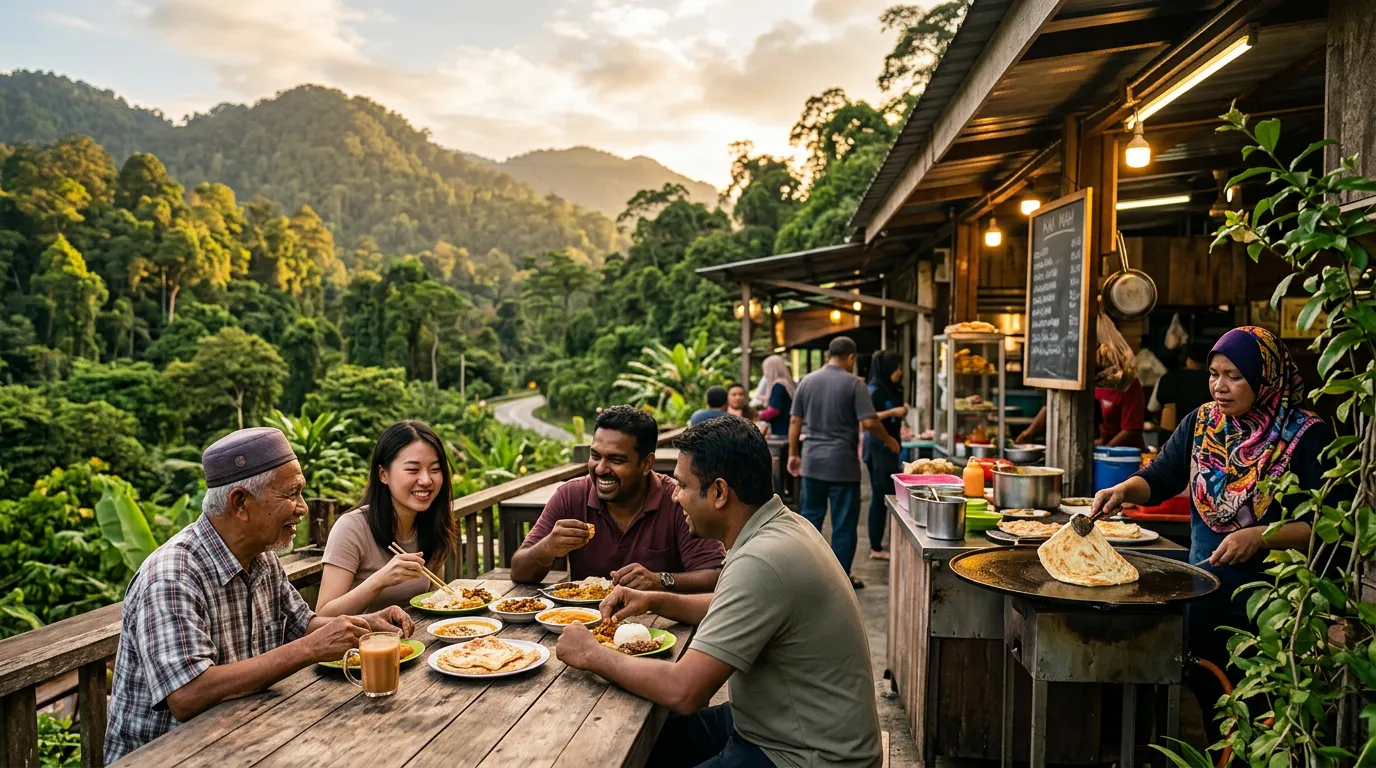
Malaysian food is the country's single greatest asset and the hawker stall system is the delivery mechanism. Nasi lemak, char kway teow, roti canai, laksa — these are not restaurant dishes, they are street dishes. The best versions are at specific stalls with specific reputations: Ali Nasi Lemak Daeng in KL, Siam Road char kway teow in Penang, Selvam's banana leaf in Brickfields. Locals eat with their right hand for Malay food — left hand is considered unclean. Most hawker meals cost RM5-15.
ICONIC · BUDGET · HIDDEN GEM
Borneo Is a Separate Trip, Not a Day Add-On
Sabah and Sarawak deserve minimum 5-7 days each. Climbing Mount Kinabalu requires booking months ahead through Sutera Sanctuary Lodges — the permit and guide are mandatory and limited to 135 climbers per day. Danum Valley and Mulu Caves need advance lodge reservations. Flights from KL to Kota Kinabalu or Kuching are cheap on AirAsia if booked early (RM80-200 one way). Do not try to squeeze Borneo into a Peninsular itinerary as an afterthought.
BOOK AHEAD · HARD HIKE · PERMIT NEEDED
When to Go
June through August is the sweet spot — east coast islands are pristine, Borneo wildlife viewing peaks, and KL street food scenes are in full swing without Chinese New Year or Hari Raya surges. For photographers, early morning golden hour at George Town or the Petronas Towers is best in July when haze risk is still low and skies clear after brief overnight showers. The trade-off is higher prices and booked-out dive permits, so plan at least 8 weeks ahead.
Northeast Monsoon
The dominant wet season for Peninsular Malaysia's east coast, driven by moisture-laden winds from the South China Sea. Brings heavy, sustained rainfall that closes island resorts and makes coastal roads dangerous. The west coast remains relatively dry and functional.
East coast islands are completely closed; focus travel on KL, Penang, Ipoh, Langkawi, and Borneo instead.
Southwest Monsoon Dry Season
Counterintuitively, the southwest monsoon brings dry weather to the east coast while delivering mild afternoon rain to the west coast. This is Malaysia's prime travel season — islands are open, seas are calm, visibility for diving peaks, and wildlife is active in Borneo.
Best window for island hopping, diving at Sipadan, and jungle trekking; book Sipadan permits and popular island resorts 2–3 months ahead.
Inter-Monsoon Transition Spring
A transitional period with unpredictable weather patterns as monsoon winds shift direction. Characterized by extreme humidity, sudden thunderstorms, and dramatic cloud formations. The east coast dries out and resorts reopen with soft-opening prices.
Great for budget island stays before peak season and for photographers who love storm-light over cityscapes.
Potential Haze Season
Transboundary haze from agricultural burning in Sumatra and Kalimantan can blanket parts of Malaysia. Severity varies dramatically year to year — some years are clear, others see API readings above 200 (unhealthy). Impacts visibility, air quality, and outdoor activities. [ASSUMPTION: timing and severity vary annually]
Check real-time API readings before booking outdoor-focused itineraries; have indoor backup plans and N95 masks.
Chinese New Year Period
A moveable 15-day celebration that transforms Malaysia's Chinese communities. George Town, Melaka, and KL's Chinatown erupt in color with lion dances, temple ceremonies, open houses, and extraordinary festive food. Dates shift between late January and mid-February based on the lunar calendar.
Book accommodation 6–8 weeks ahead; domestic flights and buses sell out; incredible for cultural photography but expect peak pricing.
Ramadan and Hari Raya Period
Ramadan's dates shift yearly across the Gregorian calendar. During fasting month, Ramadan bazaars appear nationwide offering extraordinary street food from late afternoon. Hari Raya Aidilfitri marks the end of Ramadan with a massive domestic travel surge as families return to kampungs. [ASSUMPTION: approximate Gregorian months, shifts annually]
Ramadan bazaars are a must for food lovers; book all transport and accommodation well ahead of Hari Raya as the entire country moves.
Where to Stay
Malaysia offers extraordinary value across every budget tier, from world-class luxury resorts at a fraction of what you would pay in Singapore or Hong Kong to genuinely excellent hostels under $10 a night. Kuala Lumpur is the sweet spot for urban stays, Langkawi and Penang dominate the resort and boutique scenes, and Borneo delivers once-in-a-lifetime jungle lodges. Book direct for local boutique properties (often 10-15% cheaper), but use Agoda for chain hotels as it consistently beats Booking.com in Southeast Asia.
Four Seasons Resort Langkawi
Tanjung Rhu, Langkawi
Resort
ICONIC · PHOTO · SUNSET · BOOK AHEAD
The Datai Langkawi
Datai Bay, Langkawi
Resort
ICONIC · HIDDEN GEM · PHOTO · BOOK AHEAD
Cheong Fatt Tze - The Blue Mansion
George Town, Penang
Boutique Hotel
ICONIC · PHOTO · NEXTPIC · BOOK AHEAD
Travelodge Bukit Bintang
Bukit Bintang, Kuala Lumpur
Hotel
CENTRAL · BUDGET · TRANSIT-FRIENDLY
BackHome Hostel
Chinatown, Kuala Lumpur
Hostel
BUDGET · CENTRAL · TRANSIT-FRIENDLY · FREE
Reggae Mansion
Chinatown, Kuala Lumpur
Hostel
BUDGET · NIGHT SHOOT · PHOTO
Borneo Rainforest Lodge
Danum Valley, Sabah, Borneo
Resort
ICONIC · HIDDEN GEM · SUNRISE · PHOTO · BOOK AHEAD · PERMIT NEEDED
Japamala Resort by Samadhi
Tioman Island, Pahang
Resort
HIDDEN GEM · PHOTO · SUNSET · SEASONAL · BOOK AHEAD
Top Attractions
№ 1 · Essential
Cameron Highlands Tea Plantations
★ ICONIC · PHOTO · GOLDEN HOUR · EASY WALK · FREE
Rolling emerald hills of BOH tea plantations create one of Malaysia's most photogenic landscapes. The combination of cool mountain air, misty mornings, and perfectly manicured tea rows makes this a genuine highlight. Worth at least two days to explore the various estates and mossy forests.
Tip: Visit BOH Sungei Palas estate first thing at opening (9am) before tour buses arrive around 10:30am. Walk past the cafe viewing deck and follow the trail downhill into the tea rows for unobstructed photos without railings.
Best: Early morning 7-9am for mist rolling through the valleys, or late afternoon 4-5pm for golden light on the tea rows. Dry season Feb-Apr offers clearest skies.
Fees: Free entry to BOH estates. Guided tours from RM15-40
George Town Street Art and Heritage Zone
Penang's UNESCO-listed core is a living gallery where Ernest Zacharevic's famous wire-frame and painted murals blend with crumbling shophouses, clan jetties, and hawker stalls. It genuinely rewards slow exploration on foot. Some murals are fading and over-photographed, but the overall neighborhood atmosphere remains authentically compelling.
ICONICSipadan Island
Consistently ranked among the world's top five dive sites, Sipadan's sheer underwater wall drops 600 meters and hosts tornado-like formations of barracuda and jackfish, green turtles, and reef sharks. This is not hype — it delivers every time. Permits are strictly limited to 120 divers per day.
ICONICBatu Caves
The 272 rainbow-painted steps leading to the massive limestone cave temple are undeniably dramatic and deeply photogenic. During Thaipusam festival it is extraordinary, but even on regular days the scale impresses. Be warned: macaques are aggressive and will snatch food, bags, and sunglasses.
ICONICDay Trips
Batu Caves from Kuala Lumpur
Travel: 13 km / 30 min by KTM Komuter train from KL Sentral
Malacca (Melaka) from Kuala Lumpur
Travel: 150 km / 2 hr by express bus from TBS terminal
Cameron Highlands from Kuala Lumpur
Travel: 200 km / 3.5 hr by bus from TBS terminal
Firefly Tour at Kuala Selangor from Kuala Lumpur
Travel: 65 km / 1.5 hr by car or Grab
Ipoh from Kuala Lumpur
Travel: 200 km / 2.5 hr by ETS train from KL Sentral
Taman Negara National Park from Kuala Lumpur
Travel: 250 km / 3.5 hr by bus to Kuala Tahan (or 4 hr bus + 3 hr riverboat via Kuala Tembeling)
Penang (Georgetown) from Kuala Lumpur
Travel: 350 km / 4.5 hr by ETS train or 1 hr flight
Scenic Routes
Cameron Highlands Loop Drive
Driving
Route: Tapah (Route 59) to Brinchang via Tanah Rata
ICONIC · PHOTO · GOLDEN HOUR · SEASONAL · FAMILY
Langkawi Sky Trail & SkyBridge Walk
Walking
Route: SkyCab upper station to SkyBridge viewpoint
ICONIC · NEXTPIC · PHOTO · BOOK AHEAD · CROWD WARNING · FAMILY
Kinabalu Park Summit Trail
Hiking
Route: Timpohon Gate (1866m) to Low's Peak summit (4095m)
ICONIC · SUNRISE · HARD HIKE · PERMIT NEEDED · BOOK AHEAD · NEXTPIC
Penang Hill Heritage Trail via Jeep Track
Walking
Route: Penang Hill upper station to Botanical Gardens (downhill)
EASY WALK · PHOTO · GOLDEN HOUR · FAMILY · HIDDEN GEM
East-West Highway (Route 4) Crossing
Driving
Route: Gerik (Perak) to Jeli (Kelantan)
HIDDEN GEM · PHOTO · SUNRISE · SEASONAL
George Town Heritage Walk
Walking
Route: Fort Cornwallis to Acheen Street Malay Mosque via Armenian Street
ICONIC · EASY WALK · PHOTO · FREE · TRANSIT-FRIENDLY · NEXTPIC
Street Art
Malaysia has one of Southeast Asia's most vibrant street art scenes, centered in George Town, Penang, where a 2012 public art project by Lithuanian artist Ernest Zacharevic sparked a national movement. His interactive wire-frame sculptures and painted murals turned the UNESCO Heritage Zone into an open-air gallery that redefined how Malaysians engage with public art. The scene has since expanded to Ipoh, Kuala Lumpur, and Melaka, each city developing its own character. Penang remains the undisputed epicenter, with hundreds of murals across its heritage core, while KL's back alleys in Chinatown and the Zhongshan Building creative hub offer grittier, more contemporary work.
Lebuh Armenian - Kids on Bicycle
Ernest Zacharevic's most famous mural, depicting two children on a real bicycle mounted to the wall. This single artwork arguably launched Malaysia's entire street art tourism movement. The mural has faded and been restored multiple times since 2012. Arrive early or expect a queue of tourists waiting for their turn to pose.
Lebuh Armenian, near intersection with Lebuh Acheh, George Town, Penang
ICONIC · PHOTO · CROWD WARNING · NEXTPIC · EASY WALK
Lebuh Ah Quee - Boy on Chair & Little Girl in Blue
A tight cluster of Zacharevic's interactive murals including the famous Boy on Chair reaching up and Little Girl in Blue. This stretch also features dozens of iron rod caricature sculptures by local collective Sculpture At Work, depicting scenes from Penang's multicultural heritage. The contrast between painted murals and wire sculptures makes this one of the most photographically diverse streets in Southeast Asia.
Lebuh Ah Quee at Lebuh Canon, George Town, Penang
ICONIC · PHOTO · EASY WALK · FREE
Kwai Chai Hong, Kuala Lumpur
A restored back alley in KL's Chinatown transformed into an atmospheric art lane with rotating large-scale murals depicting 1960s Chinese immigrant life. The narrow alley creates dramatic light shafts in the afternoon. Surrounded by excellent cafes and bars. The murals rotate roughly every 12-18 months, so each visit offers something new. Far more curated and Instagram-ready than Penang's organic sprawl.
Lorong Panggung, off Petaling Street, Chinatown, Kuala Lumpur
PHOTO · HIDDEN GEM · NEXTPIC · TRANSIT-FRIENDLY · FREE
Mural Art Lane, Ipoh Old Town
Ipoh has quietly built a street art scene that rivals Penang without the crowds. Lithuanian artist Ernest Zacharevic also left works here, but the real draw is local artist Hue Kee's large-scale nostalgic murals depicting old Ipoh coffee shop culture and tin mining heritage. The art is concentrated along narrow lanes between Jalan Masjid and Jalan Market, interweaving with some of Malaysia's best white coffee shops.
Mural Art Lane off Jalan Masjid, Ipoh Old Town, Perak
HIDDEN GEM · PHOTO · EASY WALK · FREE · GOLDEN HOUR
Melaka River Art Walk
Both banks of the Melaka River between Jalan Kampung Hulu and Jalan Kampung Pantai feature colorful murals reflecting the city's Peranakan, Portuguese, and Malay heritage. The art quality varies widely but the riverside setting adds atmosphere, especially during blue hour when murals are illuminated. Less spontaneous than Penang, more of a municipal beautification project, but some genuinely striking pieces exist among the tourist-oriented work.
Melaka River banks between Jalan Kampung Hulu and Jalan Kampung Pantai, Melaka
PHOTO · BLUE HOUR · SUNSET · EASY WALK · FAMILY
Culture & History
Malaysia is a rare cultural convergence point where Malay, Chinese, Indian, and indigenous Orang Asli traditions coexist within a single nation, shaped by centuries of maritime trade, colonial rule by the Portuguese, Dutch, and British, and a post-independence identity that remains actively negotiated. Its cultural richness comes not from homogeneity but from layered plurality — the same street can hold a mosque, a Chinese temple, and a Hindu shrine, and Malaysians navigate this daily with a blend of pride, pragmatism, and food-obsessed camaraderie.
Eat & Drink
Malaysia is one of the greatest eating countries on Earth, full stop. The collision of Malay, Chinese, Indian, Peranakan, and indigenous Bornean cuisines creates a street-food landscape so deep that many Malaysians eat out for every single meal. From predawn roti canai at a mamak stall to post-midnight nasi lemak from a roadside vendor, the variety, affordability, and sheer intensity of flavor here is world-class. Hawker centers and kopitiams are the backbone of daily life, and the best meals often cost under RM10.
Dewakan ★★★★★
Tasting menus built around foraged Malaysian ingredients like wild ferns, fermented durian, and jungle herbs. Chef Darren Teoh redefines what Malaysian fine dining means.
KDU University College, Utropolis, Shah Alam
Restaurant · msw:dinner
Nasi Kandar Line Clear ★★★★★
Legendary Penang nasi kandar with rich, layered curry gravies poured over rice. The mutton curry, fried chicken, and squid are essential.
177 Jalan Penang, George Town, Penang
Restaurant · msw:lunch
Annalakshmi ★★★★
Generous South Indian vegetarian thali with dishes like rasam, sambar, paneer butter masala, and fresh chapati. The restaurant operates on a pay-what-you-wish model.
Temple of Fine Arts, 116 Jalan Berhala, Brickfields, Kuala Lumpur
Restaurant · vegetarian_restaurant
Soong Kee Beef Noodles ★★★★
Dry beef noodles tossed in dark soy with tender braised beef brisket and tripe. The chili paste is fiery and addictive.
Jalan Tun Tan Siew Sin, Chinatown, Kuala Lumpur
Restaurant · msw:lunch
Sala KL ★★★
Creative plant-based dishes using local produce, including jackfruit rendang, tempeh satay, and pandan coconut desserts. Fully vegan menu.
Jalan Mesui, Bukit Bintang, Kuala Lumpur
Restaurant · vegan_restaurant
VCR (Volatile Caffeine Roasters)
Pioneer of KL specialty coffee with single-origin pour-overs, excellent brunch food, and a photogenic industrial interior in a converted shophouse.
Jalan Galloway, Bukit Bintang, Kuala Lumpur
Coffee · cafe
Piu Piu Piu
Third-wave specialty coffee in a retro-styled George Town shophouse. Known for creative espresso drinks and single-origin options roasted in-house.
Lebuh Melayu, George Town, Penang
Coffee · cafe
Merchant's Lane
Atmospheric cafe hidden above a traditional Chinese medicine shop. Good coffee and fusion brunch dishes in a beautifully restored heritage space.
Jalan Petaling, Chinatown, Kuala Lumpur
Coffee · cafe
Three Little Birds Coffee
Bright, airy cafe with consistently well-pulled espresso, house-made granola bowls, and a friendly vibe popular with remote workers.
Jalan Sin Chew Kee, Bukit Bintang, Kuala Lumpur
Coffee · cafe
Lisette's Cafe & Bakery
French-trained pastry chef producing exceptional croissants, kouign-amann, and tarts. The pain au chocolat rivals what you find in Paris at a fraction of the price.
Plaza Damansara, Damansara Heights, Kuala Lumpur
Bakery · bakery
China House
George Town institution with one of the longest cake counters in Southeast Asia. Over 30 cakes daily including pandan layer cake, burnt cheesecake, and local kuih.
153 & 155 Lebuh Pantai, George Town, Penang
Bakery · bakery · breakfast_restaurant
Tommy Le Baker
Artisan sourdough and rustic European-style breads baked fresh daily. The sourdough loaves and ciabatta are standouts, along with seasonal fruit danishes.
Bangsar, Kuala Lumpur
Bakery · bakery
Dharma Realm Guan Yin Sagely Monastery Canteen
Enormous variety of Chinese Buddhist vegetarian dishes served buffet-style. Mock meats, stir-fried greens, tofu preparations, and hearty rice plates for under RM8.
161 Jalan Ampang, Kuala Lumpur
Vegetarian · vegetarian_restaurant
Simple Life Healthy Vegetarian
Modern vegetarian chain serving creative Malaysian dishes like vegetarian laksa, tom yam noodles, nasi lemak with plant-based rendang, and fresh juices.
Multiple locations including Pavilion KL, Mid Valley, and 1 Utama
Vegetarian · vegan_restaurant
Woodlands Vegetarian Restaurant
Authentic South Indian vegetarian thali, masala dosa, idli, and vadai. The banana leaf rice on weekends is a must-try with multiple curries and chutneys.
Jalan Scott, Brickfields, Kuala Lumpur
Vegetarian · vegetarian_restaurant · vegan_restaurant
Shopping
Malaysia is a shopper's paradise spanning duty-free electronics, Southeast Asian textiles, indigenous crafts, and some of the cheapest luxury mall shopping in the region. Bargain hunters, textile lovers, and anyone who enjoys chaotic night markets will be in heaven.
Petaling Street Market (Chinatown KL)
Night
Knockoff goods aside, genuinely good finds include Chinese calligraphy brushes, incense, jade jewelry, embroidered slippers, and traditional Chinese medicine supplies. Also a decent spot for cheap luggage and phone accessories.
Market · ICONIC · PHOTO · BUDGET · CROWD WARNING · NIGHT SHOOT
Central Market (Pasar Seni)
Craft
Batik fabrics and clothing, pewterware, wayang kulit shadow puppets, handwoven songket textiles, and Orang Asli indigenous crafts. The upper floor Annexe gallery often has local art exhibitions and workshops.
Market · ICONIC · EASY WALK · TRANSIT-FRIENDLY · WORKSHOP SPOT
Kota Kinabalu Sunday Market (Tamu)
Mixed
Kadazan-Dusun tribal bead necklaces, rattan baskets and woven mats, Borneo pearls, jungle honey, and hand-carved wooden items. One of the best places in Malaysia for indigenous Bornean crafts sold directly by makers.
Market · HIDDEN GEM · PHOTO · GOLDEN HOUR · SUNRISE · SEASONAL
Jonker Street Night Market
Night
Nyonya beaded shoes (kasut manek), vintage Peranakan tiles, antique porcelain, wooden clogs, and handmade Peranakan kebaya blouses. The antique shops flanking the night market are open daily and are the real treasures.
Market · ICONIC · PHOTO · NIGHT SHOOT · CROWD WARNING · EASY WALK
Bukit Bintang, Kuala Lumpur
KL's golden mile of shopping — everything from luxury megamalls to street-level bargain alleys within a 15-minute walk. This is where locals actually shop for fashion and electronics.
Pavilion KL for luxury brands at prices 10-20% below European retail. Sungei Wang Plaza for budget fashion and accessories beloved by local teens. Lot 10 for the Isetan Japanese department store. The back alleys between Jalan Bukit Bintang and Jalan Alor have small tailor shops offering custom suits in 48 hours.
District · ICONIC · TRANSIT-FRIENDLY · EASY WALK
Little India (Brickfields), Kuala Lumpur
Vibrant Indian commercial district with sari shops, gold jewelry stores, garland makers, and Bollywood music vendors. A sensory overload that feels transplanted from Chennai.
Sari shops along Jalan Tun Sambanthan sell pure silk saris at a fraction of Western boutique prices. Gold jewelry is sold by weight with low markups — many Malaysian Indians buy wedding gold here. Jasmine garlands and Indian cosmetics like kajal are dirt cheap.
District · HIDDEN GEM · PHOTO · BUDGET · TRANSIT-FRIENDLY
Armenian Street and George Town Heritage Zone, Penang
UNESCO heritage zone with a thriving scene of independent boutiques, art galleries, vintage shops, and craft studios housed in restored shophouses. The best district in Malaysia for curated, design-forward local products.
Hin Bus Depot weekend market for local artisan goods. Mano Plus for curated Malaysian design objects. Bon Ton for vintage Peranakan wares. Street art murals by Ernest Zacharevic are free to photograph. Small batik studios on Lebuh Armenian offer workshops.
District · HIDDEN GEM · PHOTO · WORKSHOP SPOT · EASY WALK
Photo Spots
Malaysia sits between 1 and 7 degrees north of the equator, so day length barely changes — expect roughly 12 hours of daylight year-round with sunrise between 6:00-7:15am and sunset between 6:40-7:25pm depending on coast and season. The key variable is not light timing but weather. The northeast monsoon (Nov-Mar) hammers the east coast of Peninsular Malaysia and Sabah's east coast with heavy rain and grey skies, while the west coast stays relatively dry. The southwest monsoon (May-Sep) is milder but brings afternoon thunderstorms almost daily to the interior highlands and KL. The inter-monsoon months of April and October often deliver the clearest skies nationwide. Haze from Indonesian agricultural burning can severely degrade visibility from July through October in some years, turning the sky into flat white soup — check the Air Pollution Index before planning landscape shoots. Morning light is generally more reliable than evening because convective clouds build through the afternoon across most of the country.
Petronas Twin Towers from KLCC Park
The twin towers reflected in the KLCC Park wading pool. The symmetry of the pool's edge creates a perfect mirror image. Shoot low from the water's edge with a wide-angle lens. The fountain show adds foreground energy. At blue hour the towers glow silver-white against a deep cobalt sky, and the reflection doubles the impact.
Batu Caves Staircase
The 272 rainbow-painted steps leading up to the limestone cave mouth with the 140-foot golden Murugan statue standing guard. Best composed from across the plaza to get the full staircase sweep with the statue on the left. Inside the cathedral cave, shafts of light pierce the ceiling holes around midday creating dramatic god-rays in the humid air.
George Town Street Art Walk
Ernest Zacharevic's famous interactive murals — Kids on Bicycle, Boy on Motorbike, Little Girl in Blue — plus dozens of wire-frame art installations. The murals interact with real objects like actual bicycles and chairs. Shoot people interacting with the art for scale and story. The weathered colonial shophouse walls create beautiful texture around each mural.
Mosque at Kota Kinabalu Waterfront (Masjid Bandaraya)
The white and gold City Mosque sitting on a man-made lagoon. At sunrise the mosque appears to float on glass-still water with Mount Kinabalu occasionally visible in the far background on clear mornings. The reflection is the shot. Compose from the south causeway to get the full mosque and its mirror image.
Cameron Highlands Tea Plantations — BOH Sungei Palas
Rolling emerald-green tea terraces cascading down hillsides with misty mountain ridges behind. The geometric rows of tea bushes create incredible leading lines. Include tea pickers in traditional hats for human scale when present (weekday mornings). Morning mist threading through the valleys is the hero shot.
Sipadan Island Drop-Off Wall
One of the world's top dive photography locations. The coral wall drops 600 meters straight down — shoot upward with snorkelers or divers silhouetted against the sun for dramatic scale. Barracuda tornados, green turtles, and whitetip reef sharks are reliable subjects. The visibility regularly exceeds 30 meters.
KL Tower Skybox at Night
A glass-floored skybox extending from the KL Tower observation deck at 300 meters. You stand on glass looking straight down at the glittering city grid below your feet. The Petronas Towers are visible at eye level from here, framed against the city sprawl — a different perspective than the ground-level pool reflection shot.
Langkawi Sunset at Tanjung Rhu Beach
Limestone karst islands silhouetted against the Andaman Sea sunset. The beach curves gently with tide pools reflecting the sky colors. At low tide, the sandbars extend hundreds of meters and create layered reflections. Far less crowded than Cenang Beach. Include the distinctive karst formations as anchoring shapes against the color explosion.
Suggested Itinerary
Nightlife
Malaysia's nightlife is a split personality: Kuala Lumpur runs hot with rooftop bars, mega-clubs, and speakeasies that don't empty until 3am, while Penang and Langkawi offer mellower scenes built around craft cocktails and live music. Outside these hubs, Malaysia is a Muslim-majority country where alcohol is available but not culturally central — many towns simply shut down after 10pm. KL's scene kicks off around 10:30pm on weekends, skews young-professional and expat-heavy in certain pockets, and is genuinely world-class for cocktail culture relative to its prices.
Heli Lounge Bar
A literal helipad on the 34th floor that converts into an open-air bar at night; wind in your hair, Petronas Towers glowing at eye level, drinks surprisingly mid-range for the view.
Opens at 6pm, helipad section weather-dependent — if it rains you're moved inside to the far less interesting indoor bar. No flip-flops or shorts strictly enforced for men. No cover charge. Best arrived at by 7pm for sunset seats. Cocktails RM35-55.
PS150
Hidden behind a dusty toy-shop facade in Chinatown, this speakeasy channels pre-war Malaya with pandan-infused cocktails, dim lighting, and bartenders who actually know their craft without the condescension.
Reservations strongly recommended on Friday and Saturday nights. Cocktails RM45-65. Five themed rooms inside. No sign — look for the old shophouse with toys in the window at 150 Petaling Street. Opens 5pm, closes 1am weekdays, 2am weekends.
Rum Bar
Changkat's rowdiest strip distilled into one sweaty, happy room — expats, backpackers, and KL locals mixing over absurdly generous rum pours while reggae and dancehall thump from tinny speakers.
No cover. Happy hour until 9pm with RM15 rum cocktails. Gets packed and spills onto the street after 11pm on Fridays. The whole Changkat strip is walkable and bar-hoppable. Cash preferred at some spots along this strip.
Zouk KL
KL's flagship superclub spread across multiple rooms — the main room thumps EDM with international DJs, while Phuture leans hip-hop and Velvet Underground goes deep house for the crowd that thinks the main room is too obvious.
Cover RM50-80 on weekends, sometimes includes one drink. Strict dress code: no slippers, no shorts, no sleeveless for men. Doesn't fill until midnight. Wednesday ladies' night is legendary and packed. International DJ nights can push cover to RM150+. Open until 3am, sometimes later.
Coley
A serious cocktail bar that feels like a well-lit living room — no gimmicks, no speakeasy theatrics, just technically brilliant drinks using Malaysian ingredients like calamansi, torch ginger, and local honey, served by bartenders who geek out if you ask questions.
Small space, maybe 30 seats. Walk-ins possible on weeknights, book ahead for weekends. Cocktails RM40-58. Opens 5pm, closes midnight Sun-Thu, 1am Fri-Sat. Located on the first floor above a row of shops on Jalan Maarof.
The Canteen by Chef Adu
A no-frills corner bar in a heritage shophouse where local blues and rock bands play loud sets to a mixed crowd of Penangites and in-the-know travelers; the kind of place where the guitarist knows half the audience by name.
No cover most nights. Live music Thursday through Saturday from around 9:30pm. Beer from RM12. Limited food menu — eat before you come. Small and gets crowded fast on weekends.
SkyBar
A pool-deck bar on the 33rd floor of Traders Hotel where the Petronas Towers fill the entire frame of your vision — unapologetically touristy but the view genuinely delivers, especially for photography.
Smart casual enforced. No reservations for bar seating but arrive by 6pm for a poolside spot at sunset. Cocktails RM45-70. Gets corporate-crowd heavy on weeknights. Closes at 1am. Not the place for a wild night — come for the view, leave for the party.
Beach Bar at Pelangi Beach Resort
Feet-in-sand drinking with cheap Tiger beers and fire spinners on weekends — Langkawi nightlife is mellow and beach-centric, and this strip of Cenang bars is the closest it gets to a scene.
Langkawi is duty-free so beer is RM5-8, cheapest in Malaysia. The whole Pantai Cenang strip has multiple beach bars — wander and pick your vibe. Things wind down by midnight. No dress code, come sandy.
Elysium Bar
A heritage-shophouse cocktail bar on Muntri Street with exposed brick, ceiling fans turning slowly overhead, and cocktails that lean tropical-botanical — Penang's answer to the KL speakeasy scene, minus the pretension.
No reservations needed most nights. Cocktails RM30-48. Good bartender knowledge of local spirits and arrak. Opens 6pm, closes midnight. Located in the UNESCO heritage zone so pair with a sunset street-food crawl beforehand.
Pisco Bar
Latin-themed and slightly chaotic, with salsa nights that actually draw dancers who know what they are doing mixed in with enthusiastic amateurs — the energy is high and the pisco sours are legit.
Salsa nights usually Wednesday and Saturday. No cover. Cocktails RM25-40. Gets loud and sweaty. The upstairs balcony overlooking Changkat is prime people-watching territory. Opens 5pm, closes 2am on weekends.
Build your own Itinerary from this guide
Pick the places you care about — attractions, photo spots, map markers — and we'll lay out a day-by-day starting point. Yours to edit; guide updates never touch it.