Essentials
Currency, language, transit & safety — tap to expand.
Currency — US Dollar (USD), symbol $. Already in USD so no exchange needed. 1 EUR ≈ $1.08–$1.12 as of mid-2025
Cash vs card — Card is king in Miami — tap-to-pay accepted nearly everywhere including food trucks and beach bars. Cash useful for small Cuban cafecitas at ventanitas, tips for valets, and some Little Havana vendors. ATMs widely available but avoid standalone ones on Ocean Drive that charge $5+ fees. Tipping is non-negotiable: 18–20% at restaurants, $1–2 per drink at bars, $2–5 per bag for bellhops, 15–20% for rideshares
Budget — Daily budget — budget: $80–120 (hostel, pizza slices, bus/free trolley, beach days) / mid-range: $200–350 (boutique hotel, sit-down meals, rideshares, one activity) / luxury: $500+ (beachfront resort, fine dining, boat charters, rooftop bars). Miami is genuinely expensive — food and drinks run 20–40% higher than most US cities
Language — English and Spanish are both widely spoken. Miami-Dade County is over 70% Hispanic — Spanish is the dominant language in neighborhoods like Little Havana, Hialeah, Doral, and Kendall. Many service workers are bilingual
Language barrier — Zero English barrier for travelers. You can get by entirely in English everywhere. Knowing basic Spanish opens doors to warmer interactions and better food recommendations in local neighborhoods, but it is never required
Getting around — Miami is a car city — full stop. Rideshares are the most practical option for most visitors. The free trolley system is underrated for neighborhood exploring. Public transit exists but is slow and limited. Renting a car makes sense if you are heading to the Keys, Everglades, or bouncing between spread-out neighborhoods. Parking in South Beach is $20–40/day and a headache
Safety — Miami is generally safe in tourist areas but stay street-smart. South Beach after 2 AM gets rowdy — petty theft and aggressive panhandling increase significantly on Ocean Drive late at night. Car break-ins are common citywide — never leave anything visible in a parked car, even in paid lots. Overtown and parts of Liberty City are best avoided after dark unless you know where you are going. Swim only at lifeguarded beaches — rip currents are real and kill tourists every year. Hydration is critical from May to October — heat exhaustion sneaks up fast. Hurricane season runs June through November; check forecasts and have a plan if one approaches. Mosquitoes are aggressive near the Everglades and at dusk anywhere — bring repellent
Highlights
Miami is less a single city than a mosaic of distinct neighborhoods stitched together by causeways, palm-lined boulevards, and a cultural gravity that pulls harder toward Havana and Bogotá than it does toward Atlanta or New York. The light here is different — golden, humid, saturated — and it shapes everything from the architecture to the pace of daily life. It is simultaneously a beach town, a global finance hub, a Latin American capital, and an art-world playground, and the trick to visiting well is accepting all of those identities at once.
The Latin-Caribbean cultural layer
Miami-Dade County is roughly 70% Hispanic or Latino. Spanish is not a novelty — it is the dominant language in many neighborhoods. In Little Havana, Hialeah, Doral, and large parts of Kendall, you will default to Spanish at restaurants, markets, and service counters. Cuban coffee culture is real infrastructure: ventanitas (walk-up coffee windows) like the one at Versailles on Calle Ocho serve cortaditos and coladas all day. Understanding this is not a cultural side quest; it is how the city actually operates.
ICONIC
Neighborhood identity matters more than 'Miami'
South Beach, Wynwood, Brickell, Coconut Grove, Little Haiti, the Design District, and Coral Gables are all dramatically different experiences. South Beach is the Art Deco tourist strip. Wynwood is street art and galleries. Brickell is glass-tower finance and nightlife. Coconut Grove is old-money bohemian. Little Haiti (now overlapping with the Little River arts district) is one of the most creatively interesting zones in the city. Plan by neighborhood, not by 'Miami.'
HIDDEN GEM · NEXTPIC
US entry and visa reality
Miami is a US port of entry. Visa Waiver Program (ESTA) covers 40 countries including most of Europe, Japan, Australia, and South Korea — apply at least 72 hours before travel at the official CBP site (esta.cbp.dhs.gov). Canadian citizens need a valid passport but no visa. Everyone else needs a B-1/B-2 visa. Miami International Airport (MIA) customs lines can be long; Global Entry or Mobile Passport Control (now CBP One app) saves significant time.
BOOK AHEAD
SIM cards and connectivity
T-Mobile and Mint Mobile offer the best prepaid options for visitors. Buy a T-Mobile Tourist Plan (available at MIA airport T-Mobile stores or Best Buy) for 3 weeks of data, calls, and texts for around $35–50. Alternatively, eSIM services like Airalo or Holafly work well for data-only needs. Free Wi-Fi is widespread at cafes and hotels. Apple Pay and Google Pay are accepted nearly everywhere; some ventanitas and small Cuban spots are still cash-only.
BUDGET · PLUGIN TIP
Tipping and social norms
Standard US tipping applies: 18–20% at sit-down restaurants, $1–2 per drink at bars, 15–20% for rideshares and taxis. Many Miami restaurants add an automatic 18–20% gratuity, especially in tourist areas like South Beach — check your bill before double-tipping. Miami is casual but appearance-conscious; nicer restaurants in Brickell and the Design District may have dress codes (no flip-flops, no tank tops for men). Nightclub door policies at places like LIV and E11EVEN are genuinely selective.
CROWD WARNING
The seasonal calendar changes everything
High season runs November through April — perfect weather, higher prices, booked-out restaurants. Art Basel week (early December) and Miami Music Week/Ultra (late March) transform the city into a global event with 2–3x hotel pricing. Summer (June–September) brings intense heat, afternoon thunderstorms, hurricane risk, and dramatically lower prices. Shoulder months (May and October) are the real unlock: warm water, fewer crowds, hotel rates drop 30–50%.
SEASONAL · BUDGET
The golden-hour and blue-hour advantage
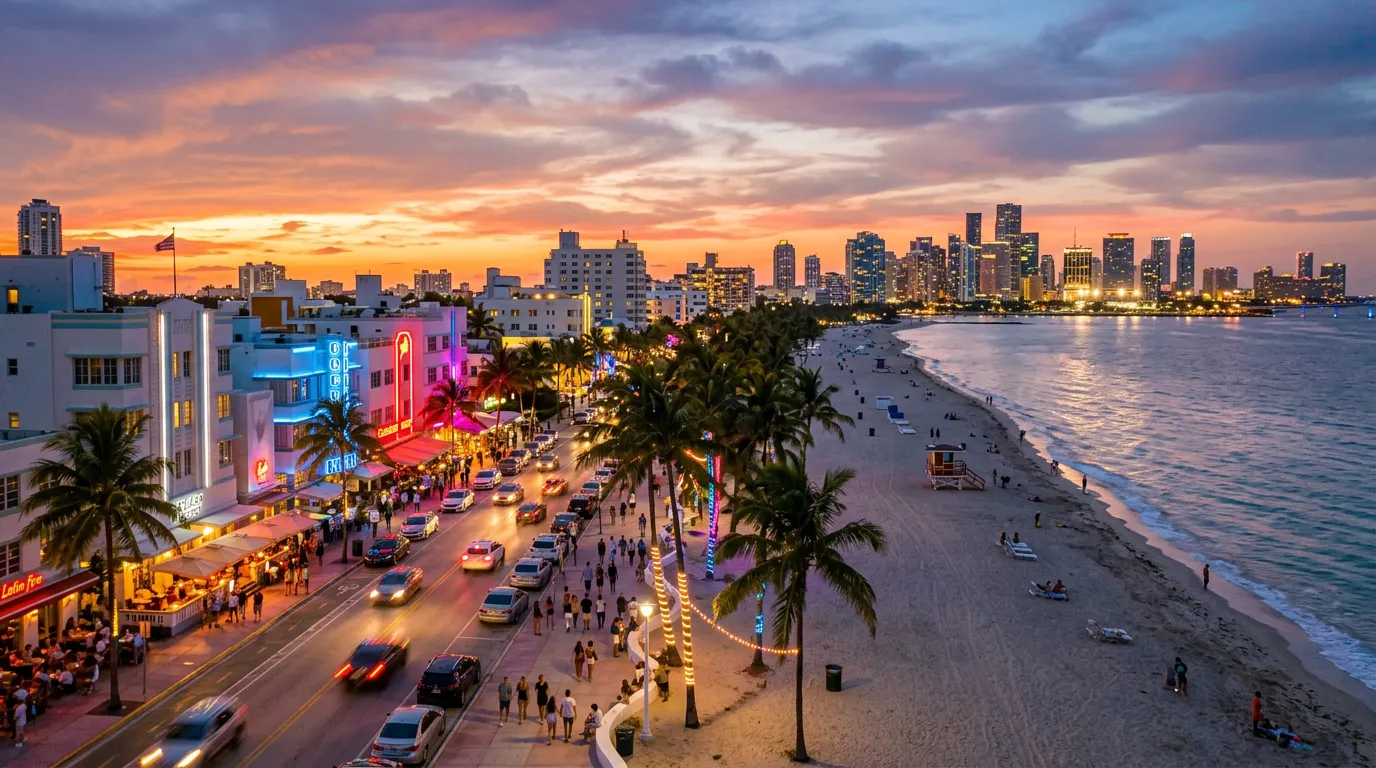
Miami's east-facing beaches mean sunrise over the ocean is the signature shot — be at South Pointe Park or Crandon Park by 6:15 AM for empty sand and perfect light. Sunset shooters should head west: the Venetian Causeway, the rooftop at Juvia in South Beach, or the waterfront at Bayfront Park all face west across Biscayne Bay. The pastel-colored Art Deco buildings on Ocean Drive photograph best in the soft light just after sunset during blue hour.
PHOTO · SUNRISE · BLUE HOUR · GOLDEN HOUR · NEXTPIC
When to Go
The sweet spot for walking, food, and photography is mid-November through mid-February. You get low humidity, golden-hour light that flatters Miami's pastel Art Deco facades, and the full restaurant scene firing on all cylinders. January offers the best balance of comfortable weather and slightly lower hotel rates than the December Art Basel spike.
Dry Season
Miami's marquee travel window. Low humidity, minimal rainfall, and temperatures between 15–29°C make outdoor exploration genuinely pleasant. This is when the city's cultural calendar fires on all cylinders.
Best for walking tours, outdoor dining, beach days, and Everglades wildlife photography as animals gather at shrinking water sources.
Wet Season
Defined by daily afternoon thunderstorms, oppressive humidity, and dramatically lower tourist numbers. Mornings are often clear and sunny before clouds build after lunch. The landscape turns lush and green.
Budget travelers benefit from 30–50% hotel discounts, but outdoor itineraries need morning-only scheduling.
Hurricane Season
Officially runs six months, but meaningful risk concentrates August through October. Miami has robust infrastructure for storms, but disruptions can cancel flights and close attractions with little notice.
Always book refundable rates and travel insurance during this window — flexibility is non-negotiable.
Art and Culture Season
Anchored by Art Basel Miami Beach in early December, this season includes major gallery openings in Wynwood, museum exhibitions at Pérez Art Museum, and performing arts programming across the city. The social calendar peaks.
Book hotels and restaurants 4–8 weeks ahead during Art Basel week; the rest of the season is more manageable but still busy.
Spring Break Season
South Beach becomes ground zero for college spring breakers in March. The city actively manages crowds with increased police presence and noise ordinances. April calms significantly after Easter.
Avoid South Beach in mid-March if you want a quiet trip; consider Key Biscayne or Coral Gables as calmer alternatives.
Mango Season
South Florida produces over 50 varieties of mango. Homestead and the Redland area host the International Mango Festival in July. Fruit stands along US-1 south sell varieties you will never find in a grocery store.
A unique culinary draw for food adventurers willing to brave the summer heat — combine with a visit to Fairchild Tropical Botanic Garden.
Where to Stay
Miami's accommodation scene is heavily seasonal — winter rates (December through April) can be double or triple summer prices, especially on South Beach. The best value often lies in neighborhoods like Wynwood, MiMo District, and Coral Gables rather than the oceanfront strip. Resort fees are rampant here, sometimes adding $40–$60 per night on top of quoted rates, so always confirm the all-in price before booking.
Faena Miami Beach
Mid-Beach
Resort
ICONIC · PHOTO · BOOK AHEAD
The Setai Miami Beach
South Beach
Hotel
ICONIC · PHOTO · BOOK AHEAD
Esmé Miami Beach
South Beach (Espanola Way)
Boutique Hotel
CENTRAL · PHOTO · HIDDEN GEM
Life House, Little Havana
Little Havana
Boutique Hotel
HIDDEN GEM · BUDGET · TRANSIT-FRIENDLY
Freehand Miami
Mid-Beach
Hostel
BUDGET · ICONIC · PHOTO
Generator Miami
Mid-Beach
Hostel
BUDGET · TRANSIT-FRIENDLY
The Biltmore Hotel
Coral Gables
Resort
ICONIC · PHOTO · BOOK AHEAD
Casa Claridge's at Faena
Mid-Beach
Boutique Hotel
HIDDEN GEM · FAMILY · PHOTO
Top Attractions
№ 1 · Essential
Vizcaya Museum and Gardens
★ ICONIC · PHOTO · GOLDEN HOUR · BOOK AHEAD
A stunning Italian Renaissance-style villa built in 1916 on Biscayne Bay with 10 acres of formal European gardens. This is genuinely one of the most photogenic spots in Miami and worth every minute. The waterfront barge and garden grottos are unforgettable.
Tip: Visit the gardens first thing in the morning when tour groups haven't arrived yet. The south terrace overlooking the bay and the stone barge are the hero shots. Bring a wide-angle lens.
Best: Weekday mornings right at 9:30 AM opening for soft light in the gardens and minimal crowds
Fees: $25 adults, $10 children 6-12, under 6 free
Everglades National Park (Shark Valley)
The Shark Valley entrance is the most accessible and rewarding way to experience the Everglades from Miami. A 15-mile paved loop trail with a 45-foot observation tower delivers guaranteed alligator sightings and vast sawgrass prairie views. Far better than the touristy airboat operations along US-41.
ICONICLittle Havana - Calle Ocho
The cultural heart of Miami's Cuban community along SW 8th Street. Domino Park, hand-rolled cigars, ventanitas serving cortaditos, and Versailles restaurant are the real draws. Some blocks feel touristy now, but the authentic energy is still there if you wander beyond the main strip.
ICONICBill Baggs Cape Florida State Park
At the southern tip of Key Biscayne, this park has the best actual beach in the Miami metro area — less crowded than South Beach with cleaner water and genuine natural beauty. The 1825 Cape Florida Lighthouse is the oldest standing structure in Miami-Dade County.
PHOTONeighbourhoods
South Beach (SoBe)
The iconic Art Deco playground where pastel buildings meet turquoise water. Equal parts fashion runway, open-air museum, and beach party — loud, photogenic, and unapologetically over-the-top.
Must do: Walk the Art Deco Historic District along Ocean Drive at golden hour for the best facade light. Photograph the lifeguard towers on the beach — each one is a unique color and shape. Eat at Joe's Stone Crab if it's in season (October–May), but skip the wait and do takeout next door.
ICONIC · PHOTO · GOLDEN HOUR · CROWD WARNING · TRANSIT-FRIENDLY · NEXTPIC
Wynwood
A former warehouse district reborn as Miami's creative engine. Every wall is a canvas, every corner a potential album cover. It's become commercialized, yes — but the murals are genuinely world-class and constantly rotating.
Must do: Explore Wynwood Walls (the curated outdoor gallery, free most days) then wander the surrounding blocks for even better street art. Grab a cafe con leche at Panther Coffee. Hit Zak the Baker for outstanding sourdough and pastries.
ICONIC · PHOTO · FREE · GOLDEN HOUR · CROWD WARNING · NEXTPIC
Little Havana
The cultural heartbeat of Miami's Cuban diaspora. Calle Ocho smells like cigars and cafecito, domino tiles clack in Maximo Gomez Park, and the energy is authentically neighborhood — not curated for tourists, though tourists are welcome.
Must do: Watch the old-timers play dominoes at Domino Park (Maximo Gomez Park). Order a ventanita coffee and croquetas from any walk-up window on Calle Ocho. Visit Ball & Chain for live salsa music in a beautifully restored 1935 venue.
ICONIC · HIDDEN GEM · PHOTO · BUDGET · EASY WALK · FREE
Design District
Miami's answer to a luxury open-air mall crossed with a contemporary art installation. Ultra-curated, immaculately clean, and dripping with high-end fashion — but the public art and architecture are genuinely impressive and completely free to experience.
Must do: See the Buckminster Fuller Fly's Eye Dome on NE 39th Street. Browse the Institute of Contemporary Art Miami (free admission, strong rotating exhibitions). Photograph the dramatic facades of the luxury flagships — the Dior and Louis Vuitton buildings are architectural statements.
PHOTO · FREE · EASY WALK · TRANSIT-FRIENDLY
Coconut Grove
Miami's oldest continuously inhabited neighborhood feels like a leafy, bohemian village that time forgot — until the recent wave of upscale development. Banyan trees, waterfront parks, and a slower pace that contrasts sharply with the rest of the city.
Must do: Explore Vizcaya Museum and Gardens, a stunning 1916 Italian Renaissance estate on the bay — book ahead and go early to avoid crowds. Walk the Coconut Grove Waterfront Park for sunset bay views. Eat at Lulu in the Grove for excellent brunch.
PHOTO · SUNSET · BOOK AHEAD · FAMILY · EASY WALK · GOLDEN HOUR
Brickell & Downtown
Miami's gleaming financial core — a forest of glass towers, rooftop bars, and waterfront promenades. It's corporate by day and cocktail-fueled by night. Not charming, but the skyline views and energy are undeniable.
Must do: Walk the Brickell Key promenade at blue hour for the best downtown skyline reflections. Ride the free Metromover for elevated city views — it loops through downtown and Brickell. Grab cocktails at Sugar rooftop bar at EAST Miami for panoramic bay views.
PHOTO · BLUE HOUR · NIGHT SHOOT · FREE · TRANSIT-FRIENDLY · NEXTPIC
Key Biscayne
A barrier island escape that feels worlds away from mainland Miami. Quieter beaches, genuine nature, and the photogenic Cape Florida Lighthouse at the island's southern tip. It's residential and sleepy — and that's exactly the point.
Must do: Visit Bill Baggs Cape Florida State Park for the lighthouse, pristine beach, and excellent Cuban food at Boater's Grill right on the sand. Kayak through the mangrove trails at Crandon Park. Photograph the old Stiltsville houses from the shoreline at sunset.
HIDDEN GEM · PHOTO · SUNSET · FAMILY · GOLDEN HOUR · SEASONAL
Day Trips
Everglades National Park
Travel: 65 km / 1 hr by car from downtown Miami
Key Largo and John Pennekamp Coral Reef State Park
Travel: 100 km / 1.25 hr by car via US-1
Biscayne National Park
Travel: 55 km / 45 min by car to Convoy Point visitor center
Fort Lauderdale and Las Olas Boulevard
Travel: 50 km / 40 min by car or Brightline train
Naples and Marco Island
Travel: 200 km / 2 hr by car via I-75 (Alligator Alley)
Lion Country Safari, Loxahatchee
Travel: 130 km / 1.5 hr by car via I-95 or Turnpike
Key West (if you commit to the drive)
Travel: 270 km / 3.5-4 hr by car via Overseas Highway
Scenic Routes
Rickenbacker Causeway to Key Biscayne
Driving
Route: Brickell to Bill Baggs Cape Florida State Park
ICONIC · PHOTO · GOLDEN HOUR · SUNSET · NEXTPIC
Ocean Drive Art Deco Walk
Walking
Route: 5th Street to 15th Street along Ocean Drive, South Beach
ICONIC · PHOTO · BLUE HOUR · NIGHT SHOOT · EASY WALK · FREE · CROWD WARNING
Overseas Highway to Key Largo (Upper Keys)
Driving
Route: Florida City to Key Largo (Mile Marker 106)
ICONIC · PHOTO · GOLDEN HOUR · FAMILY
Boardwalk Trail at Oleta River State Park
Hiking
Route: Park entrance loop through mangrove trails to bay overlook
HIDDEN GEM · PHOTO · EASY WALK · FAMILY · BUDGET
Venetian Causeway Cycling Route
Cycling
Route: Downtown Miami to Miami Beach via Venetian Islands
PHOTO · SUNSET · GOLDEN HOUR · NEXTPIC · FREE · EASY WALK
Miami Riverwalk
Walking
Route: Brickell Key to Jose Marti Park along the Miami River
HIDDEN GEM · PHOTO · BLUE HOUR · NIGHT SHOOT · FREE · EASY WALK · TRANSIT-FRIENDLY
Street Art
Miami is one of the most important street art cities in the world, anchored by the Wynwood Walls — a purpose-built outdoor museum that transformed a former warehouse district into a global destination for large-scale murals. What started with Tony Goldman's vision in 2009 has grown into an entire neighborhood blanketed in murals, plus vibrant scenes in Little Haiti, Little Havana, and the Design District. Every December, Art Basel Miami Beach brings a wave of new installations and fresh walls, meaning the scene constantly evolves. Beyond Wynwood, Miami's Latin and Caribbean cultural roots infuse the art with a distinct energy you won't find in Brooklyn or Berlin.
Wynwood Walls
The epicenter of Miami's street art scene. This curated outdoor gallery features massive murals by world-renowned artists on purpose-built walls within a gated compound. Adjacent Wynwood Doors offers additional pieces. The collection rotates with new commissions, especially around Art Basel each December. Free to enter most of the year, though special events may charge admission.
2520 NW 2nd Ave, Miami, FL 33127
ICONIC · PHOTO · NEXTPIC · FREE · CROWD WARNING
Greater Wynwood Outdoor Murals
Step outside the Walls compound and the entire neighborhood is an open-air gallery. NW 2nd Avenue from 22nd to 29th Street is densest, but side streets like NW 1st Court and NW 3rd Avenue hide spectacular full-building murals. Unlike the curated Walls, these pieces are raw, experimental, and constantly changing. Many warehouses have been converted to galleries with painted exteriors that rival the interiors.
NW 2nd Ave between NW 22nd St and NW 29th St
PHOTO · NEXTPIC · EASY WALK · FREE
Little Haiti / Little River
North of Wynwood, this rapidly changing neighborhood has become the next frontier for Miami street art. Murals here lean into Haitian heritage, Afro-Caribbean identity, and social justice themes. The vibe is grittier and more authentic than polished Wynwood. Several artist-run warehouses and studios have exterior murals that are exceptional but rarely posted on Instagram. The Little River area around NE 75th Street is developing a secondary cluster.
NE 2nd Ave and NE 54th St corridor, extending to NW 54th St near Buena Vista
HIDDEN GEM · PHOTO · FREE
Calle Ocho - Little Havana
SW 8th Street through Little Havana features murals that tell the Cuban-American story — exile, nostalgia, resilience, and celebration. The art here is culturally specific and deeply tied to the community rather than the global street art circuit. Domino Park and surrounding blocks have colorful walls, rooster motifs, and portraits of cultural icons. The style leans folk art and political expression rather than contemporary abstraction.
SW 8th St (Calle Ocho) between SW 12th Ave and SW 17th Ave
ICONIC · PHOTO · EASY WALK · FREE · TRANSIT-FRIENDLY
Miami Design District Installations
More curated public art than raw street art, but the Design District features rotating large-scale installations, sculptural works, and commissioned murals integrated into luxury retail architecture. Think Buckminster Fuller's Fly's Eye Dome and rotating gallery facades. It is a different flavor — corporate-funded, pristine, sometimes sterile — but the production value is staggering and it photographs beautifully.
NE 39th St to NE 42nd St, between N Miami Ave and NE 2nd Ave
PHOTO · BLUE HOUR · EASY WALK · FREE
Culture & History
Miami is the cultural crossroads of the Americas, shaped more by Havana, Port-au-Prince, and Bogotá than by any other U.S. city. Its identity was forged by successive waves of Caribbean and Latin American immigration, creating a bilingual metropolis where Spanish is often the first language and cultural expression draws from a hemisphere's worth of traditions. It is simultaneously a young city (incorporated in 1896) and an ancient landscape, with Tequesta indigenous heritage predating European contact by millennia.
Eat & Drink
Miami's food scene is a collision of Cuban, Haitian, Colombian, Peruvian, and Southern flavors shaped by generations of immigration and proximity to the Caribbean. You can eat a perfect ventanita cafecito and croqueta for two dollars, then sit down to a world-class omakase on the same afternoon. The city takes its Latin comfort food seriously, and the best versions are often found in strip malls and walk-up windows, not design hotels.
Joe's Stone Crab ★★★★★
Stone crab claws with mustard sauce, creamed spinach, key lime pie
South Beach, 11 Washington Ave, Miami Beach
Restaurant · msw:dinner
Versailles Restaurant ★★★★★
Cuban sandwich, ropa vieja, lechon asado, cafecito from the ventanita
Little Havana, 3555 SW 8th St
Restaurant · msw:lunch
Ariete ★★★★
Elevated Cuban-American dishes, coconut-braised short rib, seasonal vegetable tasting menu available
Coconut Grove, 3540 Main Hwy
Restaurant · vegetarian_restaurant · msw:dinner
La Camaronera Fish Market ★★★★
Pan con minuta (fried snapper sandwich), fried shrimp, whole fried yellowtail
Little Havana, 1952 W Flagler St
Restaurant · msw:lunch
Plant Miami ★★★
Fully plant-based fine dining, cashew cacio e pepe, truffle mushroom risotto, raw desserts
Allapattah, 105 NE 24th St (Sacred Space)
Restaurant · vegan_restaurant · msw:dinner
Cafe La Trova
Classic Cuban cafecito and cortadito served with live music and old Havana vibes, plus craft cocktails at night
Little Havana, 971 SW 8th St
Coffee · cafe
All Day
Specialty single-origin pourovers, excellent matcha latte, seasonal pastries from local bakers
Wynwood, 1035 N Miami Ave
Coffee · cafe
Panther Coffee
Locally roasted beans, signature iced latte, beans available for purchase to bring home
Wynwood, 2390 NW 2nd Ave
Coffee · cafe
Vice City Bean
Cortaditos, guava pastries, strong espresso drinks with Cuban flair at accessible prices
Brickell, 1657 N Miami Ave
Coffee · cafe
Zak the Baker
Naturally leavened sourdough, babka, challah, seasonal grain bowls and sandwiches on house bread
Wynwood, 405 NW 26th St
Bakery · bakery
Bachour Bakery
French-style pastries with Latin twists, croissants, guava and cheese Danish, stunning plated desserts
Coral Gables, 2020 Salzedo St
Bakery · bakery · breakfast_restaurant
Karla Bakery
Classic Cuban pastelitos (guava, guava and cheese, meat), croquetas, and Maria cookies
Little Havana, multiple locations including 264 SW 8th St
Bakery · bakery
Love Life Cafe
Organic plant-based bowls, raw wraps, house-made nut milks, tropical smoothies
Wynwood, 50 NW 24th St
Vegetarian · vegetarian_restaurant · vegan_restaurant
Plntz
Vegan comfort food, smash burgers made from plants, loaded fries, creative shakes
Miami Beach, 930 Lincoln Rd
Vegetarian · vegan_restaurant
Choices Cafe
Build-your-own grain bowls, massive salads, fresh juices, raw desserts
Coral Gables, 2895 SW 32nd Ave
Vegetarian · vegetarian_restaurant · vegan_restaurant
Shopping
Miami is a genuinely exciting shopping city where Latin American fashion, Caribbean craft traditions, and high-end American retail collide. Design-minded shoppers, vintage hunters, and anyone looking for Cuban and Haitian artisan goods will find things here you simply cannot get elsewhere in the US.
Lincoln Road Antique and Collectible Market
Antiques
Mid-century modern furniture finds, vintage jewelry, Art Deco-era collectibles, old Florida postcards and ephemera, and Cuban art prints. Quality varies but genuine finds exist.
Market · ICONIC · PHOTO · EASY WALK · SEASONAL
Coconut Grove Arts Festival Market (weekend pop-ups)
Craft
Original artwork, handmade jewelry from local designers, ceramics, and tropical-themed watercolors. The February festival is one of the top juried art shows in the country.
Market · HIDDEN GEM · BOOK AHEAD · SEASONAL
Little Haiti Caribbean Marketplace (Marche Haitien)
Mixed
Haitian steel drum art (recycled oil drums cut and hammered into sculptural wall pieces), hand-painted canvases in the naive tradition, voodoo flags (drapo Vodou) made with sequins and beads, handmade straw bags. This is genuinely unique to Miami.
Market · HIDDEN GEM · PHOTO · BUDGET · NEXTPIC
Española Way Weekend Market
Mixed
Handmade candles, local artisan soaps, tropical-scented perfume oils, small-batch Miami-branded streetwear, and local artist prints. More curated and less junk than Ocean Drive tourist shops.
Market · EASY WALK · PHOTO · FREE
Wynwood Arts District
Former warehouse district now packed with galleries, independent boutiques, and streetwear shops. The vibe is urban-creative with strong street art DNA. This is where Miami's design identity lives right now.
The Wynwood Walls gift shop has exclusive artist collaboration prints. BASE (streetwear). Shinola (watches and leather goods). Numerous small galleries sell affordable prints from $50–$300 by artists whose murals are on the walls outside. Brooklyn-style vintage shops cluster on NW 2nd Avenue. Art Basel week in December transforms the entire district.
District · ICONIC · PHOTO · NEXTPIC
Design District
Open-air luxury shopping district with museum-quality architecture. This is Miami's answer to Rodeo Drive but with more interesting buildings and public art installations. Serious luxury shoppers and architecture photographers both benefit.
Flagship stores for Louis Vuitton (with a building designed by local architects), Dior, Prada, Celine. The Institute of Contemporary Art (ICA) gift shop has design-forward items at non-luxury prices. Luminaire carries high-end furniture and home design. Worth visiting even if you are not buying — the architecture and public art are free.
District · ICONIC · PHOTO · FREE
Calle Ocho (SW 8th Street) in Little Havana
The commercial heart of Miami's Cuban community. Shopping here is about cigars, guayabera shirts, religious goods, and Latin music. Authenticity varies wildly — some shops cater to tourists, others serve locals.
Guayabera World for properly made traditional shirts ($40–$150). Sosa Family Cigars and El Titan de Bronze for hand-rolled cigars you can watch being made. Botanicas selling Santeria candles, oils, and beads as genuine religious supplies (buy respectfully). DOS records for rare Latin vinyl. Skip the mass-produced maracas and fake domino sets at the tourist traps near the Domino Park end.
District · ICONIC · HIDDEN GEM · PHOTO
Photo Spots
Miami sits at 25.7 degrees north latitude, so light angles are more tropical than most US cities. In summer (Jun-Aug), sunrise is around 5:30-5:45am and sunset 8:00-8:15pm, giving extremely long golden hours but brutal midday overhead sun from roughly 11am-3pm. Winter (Dec-Feb) sunrise is 6:55-7:10am and sunset 5:30-5:50pm, with lower-angle sun all day that is far more flattering for architecture and street photography. The rainy season (Jun-Oct) brings dramatic afternoon thunderstorms that typically build between 2-5pm — the 30 minutes after a storm clears produce extraordinary skies with deep color and dramatic clouds. December through April is the dry season with consistent blue skies and lower humidity, which means sharper long-distance shots and cleaner skyline images. Miami faces east, so oceanside sunrise shots are abundant but true over-water sunset shots require positioning on the bay side (west-facing waterfronts like Brickell Key or South Pointe). The city is close enough to the tropics that blue hour is relatively short — roughly 20-25 minutes versus 35-40 minutes at northern latitudes.
South Pointe Park Pier
The classic Miami Beach skyline shot with the cruise ship channel in the foreground. Stand at the pier tip facing north for the full row of Art Deco and modern towers along South Beach. At sunset the buildings catch warm side-light and the water goes gold. At blue hour, the city lights pop against deep blue sky with reflections in Government Cut. Cruise ships passing within 200 feet make dramatic foreground subjects.
Ocean Drive Art Deco Row
The pastel-colored Art Deco hotels (Colony, Cavalier, Carlyle, Breakwater) lined up along Ocean Drive between 6th and 13th streets. Shoot from the west sidewalk facing east in the morning when the facades are front-lit by direct sun. The neon signs are the real prize — shoot after dark when each building glows in a different color. A 35mm or 50mm lens isolates individual buildings with their vintage signage. Classic cars parked out front complete the composition.
Brickell Key Waterfront — Skyline Panorama
The Brickell financial district skyline reflected in Biscayne Bay. Walk the paved path around Brickell Key island for a 270-degree panorama: downtown towers to the north, Brickell canyon to the west, Key Biscayne bridge to the south. The west-facing vantage catches sunset light painting the glass towers orange and pink. Post-sunset reflections in calm bay water are extraordinary.
Wynwood Walls and Surrounding Streets
World-class street art murals covering entire building facades. The official Wynwood Walls courtyard has curated pieces but the surrounding streets (NW 2nd Ave, NW 25th-27th St) are equally photogenic and less crowded. Shoot portraits against the murals — the saturated colors make incredible backdrops. Overcast days actually work best here because direct sun creates harsh contrast on the painted walls. Look for alleys between NW 25th and 26th for raw, less Instagram-famous pieces.
Rickenbacker Causeway — Bear Cut Bridge Overlook
Elevated causeway view looking back at the entire downtown Miami and Brickell skyline across turquoise shallow water. The shallow flats glow an unreal Caribbean blue-green in morning light. This is the widest unobstructed skyline angle available. Kite surfers in Hobie Beach below add dynamic foreground elements. A telephoto (100-200mm) compresses the skyline beautifully from this distance.
Stiltsville — View from Biscayne National Park Waters
Seven surviving wooden houses standing on stilts a mile offshore in Biscayne Bay — utterly surreal and unique to Miami. The structures against open sky and shallow turquoise water are unlike anything else in the US. Best accessed by kayak, paddleboard, or boat charter from Key Biscayne. The houses are not open to the public but photographing them from the water is permitted and spectacular. Wide-angle for environmental context, telephoto for isolating individual structures.
Vizcaya Museum and Gardens
Italian Renaissance-style villa and formal gardens on Biscayne Bay. The stone barge breakwater in the bay is wildly photogenic. Interior courtyards have beautiful diffused light through arched colonnades. The gardens feature grottos, sculptures, and reflecting pools. Overcast days make the lush garden greens pop. Sunrise from the waterfront terrace looking east across the bay is stunning when the estate is closed to visitors — the exterior grounds along the seawall are partially visible from the adjacent David T. Kennedy Park.
79th Street Causeway — Pelican Harbor Marina
A lesser-known waterfront with unobstructed views of the Miami skyline from the north, framed by mangroves and pelicans. The marina has weathered docks, stacked lobster traps, and working fishing boats — real Miami, not the glamour version. Brown pelicans dive-bomb for fish at dawn, making for excellent wildlife-action shots. The skyline at this distance is compressed beautifully with a 200mm lens.
Suggested Itinerary
Nightlife
Miami's nightlife is a legitimate cultural force, not just a tourist gimmick. The engine starts late — dinner at 10pm, clubs filling after midnight, with some venues pushing past 5am on weekends. The scene splits between the bottle-service megaclubs of South Beach, the gritty-cool bars of Wynwood, the Latin-infused energy of Little Havana and Brickell, and the low-key neighborhood spots in Coconut Grove and the Design District. It is simultaneously tourist-heavy and fiercely local depending on where you go.
LIV
The sweat-drenched cathedral of Miami mega-clubbing — massive LED walls, A-list DJ residencies, and tables where champagne sparklers signal five-figure tabs while the dance floor throbs with 1,000 bodies.
Cover $40-80+ for general admission, often higher for special events. Strict dress code: no shorts, sneakers, or sandals for men. Table reservations strongly recommended on weekends with minimum spend starting around $1,500. Best nights are Friday and Saturday. Guest list helps but does not guarantee entry. Arrive before midnight or expect a long wait.
E11EVEN
A 24/7 ultraclub-meets-cabaret that feels like Vegas crash-landed in downtown Miami — aerial performers, hip-hop and EDM on rotation, and a crowd that genuinely does not know what time zone they are in.
Open 24 hours, 7 days a week. Cover typically $20-50 but can spike for special events. Table minimums $1,000+ on weekends. Dress code enforced: collared shirts preferred for men, no athletic wear. The after-hours crowd (3am-7am) is its own surreal experience. Credit card required at door.
Ball & Chain
A resurrected 1935 jazz club where salsa bands blow the roof off a packed dance floor of Cuban abuelas, young couples, and tourists all moving together under vintage chandeliers.
Live salsa, Latin jazz, and son cubano most nights. No cover for the main bar area; the back patio stage sometimes has a small cover ($5-15) for special acts. Mojitos and Cuban cocktails are the move. Weekends get packed after 10pm. No dress code but people dress up a bit. Great spot for photos.
Broken Shaker
A tropical courtyard bar hidden inside a hostel where serious bartenders serve inventive cocktails with house-made syrups and fresh herbs to a crowd that skews creative-class and genuinely interesting.
Cocktails $16-22. No reservations for the bar; first come first served. Gets crowded Thursday through Saturday after 9pm. Relaxed dress code. Strong on seasonal menus — ask the bartender what is new. Indoor and outdoor seating. Closes around 1am on weeknights, 2-3am weekends.
Gramps
A divey-on-purpose Wynwood bar with a backyard stage hosting drag shows, comedy nights, and DJ sets — the kind of place where you show up in a Hawaiian shirt and leave at 2am having made four new friends.
No cover most nights; small cover ($5-10) for special events. Cheap beer and well drinks by Miami standards. Known for excellent drag brunches and themed event nights (check their Instagram for schedules). Very LGBTQ+ friendly. Cash and card accepted. Casual dress.
The Anderson
A retro-kitsch neighborhood bar that feels like your cool aunt's 1970s living room — wood paneling, pool table, frozen drinks in plastic cups, and a crowd of locals who actually live in the neighborhood.
No cover. Known for strong frozen cocktails at reasonable prices ($8-14). Late-night food menu is solid. Open late most nights until 3am. Very casual — flip flops are fine. Good weeknight spot when you want to avoid the South Beach circus. Free parking lot.
Basement
A subterranean club with an actual bowling alley and ice skating rink attached — Studio 54 meets rec center, where the dance floor is tight, dark, and sweaty in the best way.
Cover varies $20-40; sometimes free with guest list before midnight. Bottle service available. Good sound system with house and techno-leaning bookings. Bowling and skating cost extra but make for a good warm-up. Dress code is smart casual. Best on Friday and Saturday nights.
Sweet Liberty
A neighborhood cocktail bar disguised as a South Beach hotspot — the bartenders have won national awards and it shows, but the crowd is approachable, the lighting is forgiving, and nobody is trying too hard.
Cocktails $16-20. No reservations for the bar; tables can be reserved for dinner. Multiple James Beard and Spirited Award winner. Happy hour deals available early evening. Gets busy after 10pm on weekends. Kitchen serves good food. Closes around 2-3am.
Do Not Sit On The Furniture
An intimate underground house and techno temple where the DJ booth is at floor level, the sound system is world-class, and the crowd actually came to dance rather than be seen.
Cover $10-30 depending on the night and DJ. No bottle service — this is a dance-first club. Lineup leans deep house, tech house, and techno with strong local and international bookings. Dress code is relaxed but no beach attire. Opens late, peaks around 2am, runs until 5am on weekends. Small venue so it fills fast.
Blackbird Ordinary
Brickell's best antidote to its own corporate personality — a dark, loud bar with craft cocktails, live DJs in a back courtyard, and a crowd of young professionals who have loosened their ties and are not going home anytime soon.
No cover most nights. Cocktails $12-18. Gets extremely packed Thursday through Saturday after 11pm. Outdoor courtyard has DJs spinning hip-hop and house. Indoor bar is good for conversation earlier in the evening. Casual dress code. Open until 5am.
Lagniappe
A wine-and-cheese garden with a backyard stage where jazz trios, folk acts, and indie bands play under string lights to a crowd sprawled on mismatched furniture — the most genuinely relaxed live music experience in Miami.
No cover charge. Wine and cheese boards are the specialty — choose your own from the display cases. Live music every night starting around 8-9pm. Come early for seating in the backyard. Very casual, neighborhood feel. Closes around midnight on weeknights, 1am weekends. Free parking.
Build your own Itinerary from this guide
Pick the places you care about — attractions, photo spots, map markers — and we'll lay out a day-by-day starting point. Yours to edit; guide updates never touch it.