Essentials
Currency, language, transit & safety — tap to expand.
Currency — Japanese Yen (JPY, ¥). Roughly ¥150 = $1 USD / ¥160 = €1 [ASSUMPTION — rates fluctuate, check before travel]
Cash vs card — Cards accepted at hotels, department stores, and larger restaurants, but Japan is still cash-friendly — carry ¥10,000 or so for small ramen shops, izakaya, temples, and vending machines. 7-Eleven ATMs accept foreign cards reliably and are everywhere. No tipping anywhere — it can cause confusion or mild offense.
Budget — budget: ¥8,000 / $53 — hostel or capsule, konbini meals, subway. mid-range: ¥18,000 / $120 — business hotel, sit-down meals, a few paid sights. luxury: ¥40,000+ / $265+ — high-end ryokan or hotel, kaiseki dining, taxis
Language — Japanese, spoken universally. Sapporo has no significant regional dialect barrier for visitors — standard Japanese works everywhere.
Language barrier — Lower English proficiency than Tokyo or Kyoto. Staff at major hotels, the airport, and tourist spots manage basics; smaller restaurants and taxis often don't. Signage in stations and on subways is bilingual. A translation app is genuinely useful here.
Getting around — Sapporo's grid layout and compact center make it easy. The subway covers most of what you need; walking downtown is fine. Skip renting a car unless you're heading out to Hokkaido's countryside — parking and winter driving aren't worth it for a city trip. From New Chitose Airport, the JR Rapid train is the practical choice into Sapporo Station (~37 min).
Safety — Sapporo is very safe, including for solo travelers and at night. The real risks are weather-driven: winter sidewalks turn to sheet ice — wear grippy footwear or buy stick-on ice cleats locally. Snowfall is heavy (Jan–Feb), so budget extra walking time. Susukino nightlife district is generally fine but avoid touts offering 'free' bar entry, which lead to inflated bills. Bears exist in Hokkaido's mountains — relevant only if you hike outside the city; carry a bell on trails. [ASSUMPTION] Standard earthquake preparedness applies, as with all of Japan.
Highlights
Sapporo feels like Japan with the volume turned down and the sky opened up — wide grid-planned streets (a rarity in Japan), Hokkaido's frontier spirit, and a food culture built for cold winters. It's a city that rewards slow eating and seasonal timing: powder-snow winters, lilac-scented springs, and cool escape-the-heat summers when the rest of Japan swelters.
Frontier city identity
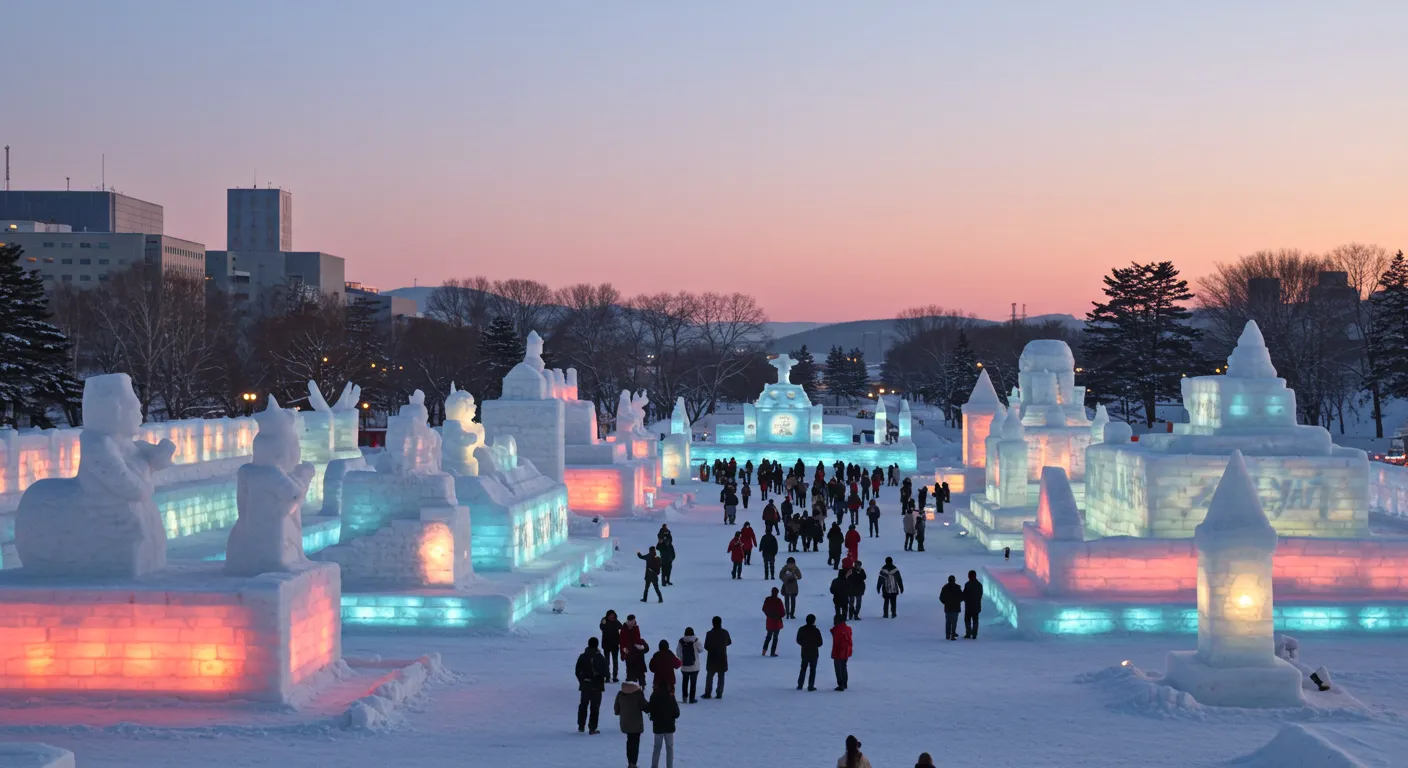
Sapporo was master-planned in the 1870s with American advisors, hence the numbered grid (e.g. addresses like 'North 5 West 2') and broad boulevards. Odori Park slices the centre east-west and hosts the Snow Festival in early February and Beer Garden in summer. This grid makes navigation far easier than Tokyo or Kyoto.
ICONIC · EASY WALK · SEASONAL
Food is the main attraction
Sapporo-style miso ramen (try Ramen Alley / Ganso Ramen Yokocho, but locals rate Menya Saimi higher), soup curry (Suage+ is a solid intro), Genghis Khan grilled lamb, and Hokkaido dairy/seafood. The Nijo Market is touristy and overpriced — go for atmosphere, buy seafood at Curb Market (Jogai Ichiba) instead.
ICONIC · CROWD WARNING
Entry and visa reality
Most Western passport holders (US, UK, EU, Canada, Australia) get 90 days visa-free on arrival. New Chitose Airport (CTS) is the entry point, ~40 min by JR Rapid Airport train to Sapporo Station. Fill the Visit Japan Web form online before arrival for faster immigration and customs QR codes. [ASSUMPTION] Verify your nationality's status before booking.
TRANSIT-FRIENDLY · BOOK AHEAD
Connectivity setup
Buy an eSIM before arrival — Ubigi, Airalo, or Sakura Mobile all work well on Hokkaido's networks (Docomo/SoftBank coverage). Download Google Maps offline tiles for Sapporo plus any day-trip areas (Otaru, Niseko) since rural signal drops. Navitime and Japan Travel by NAVITIME handle transit routing better than Google for local buses.
PLUGIN TIP
Payment and cash reality
Sapporo is more card- and IC-card-friendly than rural Hokkaido. Get a Suica or Kitaca (local IC card) or use Apple Pay Suica for subways and convenience stores. Carry some cash for small ramen shops, markets, and rural day trips where cards aren't accepted. 7-Bank ATMs inside 7-Eleven reliably accept foreign cards.
BUDGET · TRANSIT-FRIENDLY
Winter and photo logistics
For the Snow Festival (early Feb) book accommodation months ahead — prices triple. Blue hour hits the Odori snow sculptures and TV Tower beautifully around 16:30–17:00 in winter. Bring proper crampons/ice grips for shoes; sidewalks are lethal. Mt. Moiwa ropeway gives the best night city panorama.
BOOK AHEAD · BLUE HOUR · NIGHT SHOOT · SEASONAL · PHOTO
Local etiquette unlock
Hokkaido locals are notably relaxed but still expect quiet on transit, no eating while walking, and shoes off in ryokan/some restaurants. In ramen shops, slurping is fine and lingering is not — eat and free the seat. Onsen etiquette (wash fully before entering, no towels in water, tattoo policies vary) matters if you day-trip to Jozankei hot springs.
When to Go
Late September through mid-October is the single best window: crisp clear days, comfortable walking temps, peak food season, and autumn colour without the deep-winter cold. For pure spectacle, early February delivers the Snow Festival and reliable powder, but expect crowds and premium prices. June offers the most pleasant walking weather with long daylight.
Yuki Season
Hokkaido's legendary snow season blankets Sapporo in light, dry powder. The city hosts the Sapporo Snow Festival in early February and glows with winter illuminations. Ski resorts nearby reach peak conditions.
Best for snow photography and skiing, but book festival-week lodging months ahead.
Yukidoke Thaw
The snowmelt transition period when winter recedes and the city turns muddy and grey before spring greenery. Quiet and inexpensive, but visually flat.
Cheapest window with fewest crowds, but least photogenic conditions.
Sakura Window
Cherry blossoms arrive weeks later than mainland Japan, typically peaking in early May at Maruyama Park and Hokkaido Shrine. Far less crowded than Kyoto or Tokyo hanami spots.
Best for blossom photography without the mainland crush; timing shifts yearly [ASSUMPTION].
Ryoku Green Season
Lush green summer with mild, low-humidity weather since Hokkaido avoids the mainland rainy season. Beer gardens open in Odori Park and lavender fields bloom near Furano.
Best for comfortable walking and outdoor dining; expect crowds around Obon in August.
Koyo Autumn
Autumn foliage sweeps down from the mountains, peaking in Sapporo mid-to-late October. Crisp air, clear skies, and peak harvest food season make this a photographer's favourite.
Best overall window for photography, walking, and food; November turns cold and unpredictable.
Where to Stay
Sapporo offers strong value compared to Tokyo or Kyoto — you get more room and a better location for the money, especially outside the Snow Festival and summer peaks. The tightest concentration of good hotels sits around JR Sapporo Station and Odori, but prices swing hard by season: a room that's $80 in October can triple in early February. Book early for the Yuki Matsuri (Snow Festival, early February) and Golden Week or expect slim pickings at brutal rates.
JR Tower Hotel Nikko Sapporo
JR Sapporo Station
Hotel
ICONIC · TRANSIT-FRIENDLY · PHOTO
Cross Hotel Sapporo
Between Sapporo Station and Odori
Boutique Hotel
CENTRAL · PHOTO · BOOK AHEAD
Hotel Resol Trinity Sapporo
Odori / Chuo
Hotel
CENTRAL · VALUE
UNWIND HOTEL & BAR Sapporo
Near Sapporo Station
Boutique Hotel
CENTRAL · SEASONAL · VALUE
UNTAPPED HOSTEL
Kita-ku (north of the station)
Hostel
BUDGET · SOCIAL · HIDDEN GEM
Toyoko Inn Sapporo Susukino Kosaten
Susukino
Hotel
BUDGET · TRANSIT-FRIENDLY
Jozankei Tsuruga Resort Spa MORI NO UTA
Jozankei Onsen (mountain hot-spring town)
Resort
UNIQUE · SPLURGE · SEASONAL
Sapporo Serviced Apartments (self-catering studios)
Chuo / Odori
Apartment
FAMILY · VALUE · BUDGET
Top Attractions
№ 1 · Essential
Sapporo Clock Tower
★ ICONIC · CROWD WARNING · BLUE HOUR
Sapporo's most famous landmark and honestly one of Japan's most overrated 'must-sees.' It's a modest 1878 wooden building now dwarfed by surrounding office towers, and the photo everyone wants is hard to get without wires and glass in frame. Worth a five-minute look if you're passing, not a special trip.
Tip: There's an official raised photo platform across the street built specifically because the ground-level angle is disappointing — use it or skip it.
Best: Blue hour when the building is lit and the surrounding towers glow, hiding some of the visual clutter.
Fees: 200 yen to enter [ASSUMPTION]
Odori Park
A long green spine running through central Sapporo, anchored by the TV Tower at its east end. It genuinely changes with the seasons — home to the famous Snow Festival in February and beer gardens in summer — making it a reliable barometer of the city's mood. Free, central, and easy to loop into any day.
FREEFormer Hokkaido Government Office (Red Brick Building)
A handsome American-style neo-baroque red brick building from 1888 with a garden and pond out front. It photographs far better than the Clock Tower and offers a genuine sense of Hokkaido's frontier-era history. Note it has undergone renovation, so check current access before going.
FREEMount Moiwa Ropeway & Summit
The definitive Sapporo night view, reached by ropeway and a small cable car to the summit observation deck. On a clear evening the entire city grid spreads out below, framed by dark mountains. This is the one 'view' attraction that fully earns its ticket price.
ICONICNeighbourhoods
Susukino
Sapporo's dense entertainment and nightlife district, blazing with neon and packed with izakayas, ramen alleys, and bars. It's loud, unpretentious, and comes alive after dark.
Must do: Shoot the neon-soaked streets at blue hour, eat your way through Ramen Yokocho (Ramen Alley), and try Sapporo's soup curry at a local spot.
ICONIC · NIGHT SHOOT · BLUE HOUR · TRANSIT-FRIENDLY · CROWD WARNING
Odori / City Centre
The green spine of the city, a long park corridor bisecting downtown with the TV Tower at its eastern end. It's the civic heart and the venue for Sapporo's major festivals.
Must do: Climb or shoot the Sapporo TV Tower, walk the length of Odori Park, and time a visit for the Snow Festival (Feb) or Autumn Fest (Sep).
ICONIC · PHOTO · SEASONAL · TRANSIT-FRIENDLY · FAMILY · BLUE HOUR
Sapporo Station (Kita / North)
The transit and shopping powerhouse anchored by the massive JR Tower complex and connected underground malls. Modern, efficient, and a good rainy-day refuge.
Must do: Go up to the T38 observation deck for the widest city panorama, explore the Stellar Place and Paseo shopping, and use the underground passage to Odori when weather turns.
TRANSIT-FRIENDLY · RAINY DAY · PHOTO
Maruyama
A leafy, upscale residential area west of centre, home to Hokkaido Shrine, a large park, and quietly excellent cafes and restaurants. Calm and green, a contrast to downtown.
Must do: Photograph Hokkaido Shrine (especially cherry blossoms in early May), stroll Maruyama Park, and hunt the well-regarded independent bakeries and coffee shops nearby.
HIDDEN GEM · SEASONAL · GOLDEN HOUR · FAMILY · EASY WALK · TRANSIT-FRIENDLY
Nakajima Park Area
A serene park district south of Susukino with ponds, historic buildings, and seasonal foliage. It's a peaceful counterpoint that most visitors overlook.
Must do: Shoot autumn colour reflections in Kamokamo Pond, visit the historic Hoheikan building, and rent a rowboat in warmer months.
HIDDEN GEM · SEASONAL · GOLDEN HOUR · FREE · EASY WALK · TRANSIT-FRIENDLY
Moiwa / Fujino (Mount Moiwa)
The mountain fringe on the southwest edge of the city, offering Sapporo's premier night-view point. It feels like an escape from the urban grid.
Must do: Ride the ropeway and mini cable car to the Mount Moiwa summit for the night panorama, arrive before sunset to catch golden hour into blue hour, and bring a tripod.
PHOTO · SUNSET · BLUE HOUR · NIGHT SHOOT · BOOK AHEAD · SEASONAL
Nijo Market / Tanukikoji
The old-Sapporo food market and the covered Tanukikoji shopping arcade sit near each other, blending seafood stalls with a long retro shopping street. Gritty, functional, and full of texture.
Must do: Eat a fresh seafood kaisendon breakfast at Nijo Market, walk the full length of the Tanukikoji covered arcade, and browse for local snacks and souvenirs.
PHOTO · RAINY DAY · EASY WALK · TRANSIT-FRIENDLY · CROWD WARNING
Day Trips
Otaru
Travel: 40 km / 45 min by JR Hakodate Line rapid
Noboribetsu Onsen (Jigokudani / Hell Valley)
Travel: 110 km / 1.5 hr by JR limited express to Noboribetsu, then bus
Lake Toya & Mount Usu
Travel: 130 km / 2 hr by JR to Toya Station, then bus
Asahikawa & Asahiyama Zoo
Travel: 140 km / 1.5 hr by JR limited express Lilac/Kamui
Furano & Biei (Flower Fields)
Travel: 115 km / 2–2.5 hr by JR (transfer at Takikawa or bus tour)
Jozankei Onsen
Travel: 27 km / 60 min by direct Kappa Liner bus
Shakotan Peninsula (Cape Kamui)
Travel: 90 km / 2.5+ hr by train-plus-bus (car strongly advised)
Scenic Routes
Odori Park to Sapporo TV Tower Stroll
Walking
Route: Odori Park West End to Sapporo TV Tower
PHOTO · SEASONAL · EASY WALK · TRANSIT-FRIENDLY · ICONIC
Moerenuma Park Loop
Cycling
Route: Park entrance loop (rental bikes on-site)
PHOTO · GOLDEN HOUR · FAMILY · SEASONAL
Mount Moiwa Ropeway to Summit Walk
Walking
Route: Moiwa Ropeway lower station to summit observation deck
NIGHT SHOOT · BLUE HOUR · ICONIC · PHOTO · CROWD WARNING
Hokkaido Shrine to Maruyama Park Path
Walking
Route: Maruyama Park entrance to Hokkaido Shrine grounds
EASY WALK · SEASONAL · PHOTO · RAINY DAY · FREE
Otaru Coastal Drive
Driving
Route: Sapporo city center to Otaru Canal
PHOTO · BLUE HOUR · ICONIC · CROWD WARNING
Jozankei Onsen Gorge Route
Driving
Route: Sapporo center to Jozankei Onsen
SEASONAL · PHOTO · GOLDEN HOUR · HIDDEN GEM
Street Art
Sapporo is not a heavyweight street art city in the way Osaka or Tokyo's Koenji are, but it has a quietly growing scene concentrated in the entertainment and creative districts. Much of the visible work is commissioned murals on cafe and bar exteriors, shutter art in Susukino and Tanukikoji, and rotating installations tied to design events. Winter buries a lot of it under snow, so this is very much a warm-season pursuit. [ASSUMPTION] The scene is smaller and more polished than gritty, so set expectations toward curated murals rather than sprawling graffiti walls.
Tanukikoji Shopping Arcade
A long covered arcade with shutter art and mural work on side alleys and shop fronts. Covered, so it works as a rainy-day option. Best shot when shutters are down (early morning or after close) to see the full painted panels.
Tanukikoji, Chuo Ward, running east-west parallel to Odori
PHOTO · RAINY DAY · TRANSIT-FRIENDLY · EASY WALK
Susukino back streets
The nightlife district hides painted bar exteriors, neon-and-mural combos, and shutter art on narrow side lanes. This is your night shoot and blue hour location where murals meet Sapporo's dense neon.
Susukino, Chuo Ward, south of Susukino Station
PHOTO · NIGHT SHOOT · BLUE HOUR · TRANSIT-FRIENDLY
Odori and creative cafe district
Scattered commissioned murals on independent cafes, record shops, and small galleries around the Odori and Nishi blocks. Good for a slow wander rather than a fixed target. Quality varies but a few standout pieces reward the walk.
Nishi blocks around Odori Park, Chuo Ward
PHOTO · GOLDEN HOUR · EASY WALK · HIDDEN GEM
Nakajima Park area edges
Occasional mural work and public art near the park's northern approach and surrounding streets. Quieter, greener backdrops make for cleaner compositions than the busy arcade. Verify current pieces before committing.
Around Nakajima Koen Station, Chuo Ward
PHOTO · TRANSIT-FRIENDLY · EASY WALK
Culture & History
Sapporo is Japan's youngest major city, planned from scratch in the 1870s on a grid inspired by American cities and shaped by foreign advisors during Hokkaido's frontier colonization. That planned-frontier identity — beer, snow, wide streets, and hardy self-reliance — sits atop the far older culture of the Ainu, Hokkaido's Indigenous people, whose presence the modern city long erased and is only now beginning to acknowledge. The result is a city that feels distinctly un-Japanese to many first-time visitors: open, cold-climate, and quietly negotiating its layered past.
Eat & Drink
Sapporo eats like a city built for cold winters and big appetites. This is the birthplace of miso ramen, a heartier, fattier bowl than its Tokyo cousins, engineered to fight off Hokkaido's chill. The island's dairy and produce are genuinely world-class, so butter, corn, potatoes, and seafood show up richer and sweeter than you'd expect. Add Genghis Khan (jingisukan) grilled lamb and a soup curry scene that exists almost nowhere else in Japan, and you have a food identity that's distinct even by Japanese standards.
Ramen Shingen ★★★★★
thick miso ramen with rich pork broth
Susukino, Minami 6-jo
Restaurant
Soup Curry GARAKU ★★★★★
Hokkaido-style soup curry with chicken and vegetables
Central Sapporo, Minami 3-jo Nishi
Restaurant
Rojiura Curry SAMURAI ★★★★
vegetable-forward soup curry, big local veg portions
Multiple; Maruyama branch is calmest
Restaurant · vegetarian_restaurant
Sapporo Beer Garden (Genghis Khan Hall) ★★★★
all-you-can-eat jingisukan grilled lamb
Higashi-ku, former brewery grounds
Restaurant
Nijo Market seafood counters ★★★
uni, crab, and salmon roe donburi
Chuo-ku, Nijo Market
Restaurant
Morihico
roastery-cafe with quiet wood interiors, single-origin pours
Maruyama
Coffee · cafe
Barista Art Cafe
espresso and latte art, small-batch beans
Central Sapporo
Coffee · cafe
Miyakoshiya Coffee
old-school Japanese kissaten pour-over
Odori area
Coffee · cafe
Fuglen Sapporo
Nordic-style light roasts and clean brews
Chuo-ku
Coffee · cafe
Kinotoya Bake
baked cheese tarts, Hokkaido dairy sweets
JR Sapporo Station area
Bakery · bakery
Boulangerie Coron
crusty French-style loaves and croissants
Maruyama
Bakery · bakery · breakfast_restaurant
Donguri
chikuwa-pan (bread stuffed with fish cake) and cheap savory buns
Multiple central locations
Bakery · bakery
Rojiura Curry SAMURAI
vegetable soup curry, adjustable to meat-free
Maruyama and others
Vegetarian · vegetarian_restaurant
Ippin Chinese Vegan (Shojin-style)
plant-based Chinese and Buddhist-inspired dishes
Chuo-ku
Vegetarian · vegan_restaurant
Saido-inspired veg cafe
vegan bowls, salads, plant-based sweets
Central Sapporo
Vegetarian · vegetarian_restaurant · vegan_restaurant
Shopping
Sapporo's shopping is a mix of covered arcades built for brutal winters, department-store food halls, and craft goods tied to Hokkaido's dairy, wood, and Indigenous Ainu heritage. It rewards shoppers who want regional specialties over generic Japan souvenirs — and who don't mind that most of the good stuff is indoors.
Nijo Market
Mixed
Primarily seafood, but the peripheral stalls carry dried goods, seaweed, kelp (konbu), and packaged Hokkaido pantry items that travel well as non-perishable gifts.
Market · ICONIC · PHOTO · CROWD WARNING · TRANSIT-FRIENDLY
Sapporo Tanukikoji Shopping Arcade
Mixed
Independent shops mixed with chains — good for regional snacks, drugstore cosmetics, secondhand and vintage clothing, and quirky local goods rather than a single specialty.
Market · RAINY DAY · EASY WALK · TRANSIT-FRIENDLY · BUDGET
Odori and Ekimae Underground (Sapporo Station area)
Dense cluster of department stores and underground shopping passages connecting Sapporo Station, Odori, and Susukino — climate-controlled and heavily chain-oriented.
Daimaru and Stellar Place department stores for their basement depachika (packaged Hokkaido confections make excellent gifts), plus large branches of Bic Camera and Uniqlo. The underground walkways are your best route in winter.
District · TRANSIT-FRIENDLY · RAINY DAY
Susukino
Entertainment and nightlife district that shifts to shopping-adjacent browsing — Don Quijote megastore, drugstores, and late-night retail.
The multi-floor Don Quijote is the go-to for last-minute snacks, cosmetics, and cheap Hokkaido-branded goods under one roof. [ASSUMPTION] Best treated as a convenience stop rather than a destination.
District · NIGHT SHOOT · BUDGET · TRANSIT-FRIENDLY
Photo Spots
Sapporo sits at ~43°N with dramatic seasonal light swings — plan your shooting hours accordingly. In deep winter (Dec–Feb) the sun sets absurdly early, around 4:00–4:20pm, which means blue hour arrives by 4:40pm and you can be shooting city night views before dinner; snow acts as a giant reflector, filling shadows and boosting the whole scene's luminance, but overcast skies are frequent and flatten contrast. Late October delivers the region's best deciduous color and low, raking golden light by mid-afternoon. Summer flips everything: sunrise near 4:00am and sunset past 7:00pm give long working days, lush green, and true blue hour that lingers to nearly 8pm — great for the TV Tower and Moiwa, but the pre-dawn window at Nakajima Park requires an early alarm. Weather here is genuinely changeable; build in buffer days and treat rainy nights in Susukino as a gift rather than a washout. Gear-wise, Sapporo rewards a two-lens kit: a wide (16–35mm) for the parks, red-brick symmetry, and neon alleys, plus a short telephoto (70–200mm) for compressing the TV Tower against buildings and isolating city clusters from Moiwa. Bring a sturdy tripod for the night-view spots — it's the difference between a snapshot and a portfolio frame — and a fast prime (35mm f/1.4) for handheld Susukino work where tripods aren't practical. Winter shooters must pack lens cloths, spare batteries kept warm in an inside pocket (cold kills them fast), and let gear acclimate in a sealed bag to avoid condensation when moving indoors. A polarizer earns its place for autumn foliage saturation and pond reflections. In editing, lean into Sapporo's cool tonality — protect the deep blues of dusk snow rather than warming them out, recover neon highlights carefully in Susukino, and for winter scenes push whites without clipping so snow reads clean and bright rather than gray.
Sapporo Clock Tower (Tokei-dai)
The 1878 wooden colonial clock tower framed against modern glass towers — the contrast of old wood against steel is the shot. Shoot from the elevated platform across the street (there's a raised viewing deck built for exactly this) to lift the tower above street clutter.
Sapporo TV Tower & Odori Park
The red TV tower anchoring the long axis of Odori Park. In winter, this is the epicenter of the Snow Festival's illuminated ice sculptures; year-round the park's straight lines lead the eye to the tower. Shoot down the park's length with the tower dead center.
Former Hokkaido Government Office (Red Brick Office)
Neo-baroque red brick building reflected in the front pond with a foreground of gardens. The symmetrical facade mirrored in still water is the signature frame. Ginkgo trees flank it — spectacular gold in late October.
Mt. Moiwa Ropeway Summit
One of Japan's certified 'new three major night views' — the entire Sapporo grid glittering below with the illuminated city fanning toward the mountains. The whole city sprawls at your feet; long lenses isolate downtown clusters, wide grabs the full sweep.
Hokkaido University Ginkgo Avenue & Poplar Avenue
A 380m tunnel of ginkgo trees blazing gold in autumn, plus the historic Poplar Avenue. Backlit leaves glow like stained glass. Low-angle shots down the tunnel with figures for scale. In winter the bare avenues make stark minimalist compositions in snow.
Nakajima Park (Nakajima Koen)
A calm pond with the Hoheikan (a white Meiji-era guesthouse) and a Japanese garden. Autumn reflections and winter snow both work. Far fewer photographers than the central icons — a quiet productive spot for reflections and seasonal color.
Susukino Neon District
Hokkaido's biggest entertainment district — dense stacked neon signage, the iconic Nikka whisky billboard, wet-street reflections after rain or snowmelt. Classic Japanese cyberpunk-street vibe. Shoot up narrow alleys for layered signage; use puddles for mirror reflections.
Suggested Itinerary
Nightlife
Sapporo's nightlife concentrates almost entirely in Susukino, one of Japan's three great entertainment districts and the largest north of Tokyo. Things build slowly from around 7pm, hit full swing after 9pm, and the neon-and-izakaya energy runs well past midnight — the small bars, snack bars, and live houses dominate over the club scene. It's a genuinely local district first, with a heavy after-work salaryman and hospitality-worker crowd, though the ramen alleys and beer halls draw plenty of tourists too.
Bar Yamazaki
A long-running old-school cocktail bar where a veteran bartender in a white jacket builds precise, quiet drinks under low light; conversation stays hushed and the craft is the point.
Table charge typically applies (a few hundred yen per person). Smart casual expected. No reservation usually needed for small groups. House strength is classic cocktails and whisky. [ASSUMPTION] Exact charge varies.
Sapporo Beer Garden (Kaitakushikan / Garden Grill)
A converted red-brick brewery hall where you drink fresh-poured Sapporo Classic beside cast-iron Genghis Khan grills sizzling with lamb; loud, communal, unapologetically touristy but genuinely fun.
Book ahead for the all-you-can-eat/drink jingisukan plans, especially weekends. Closes earlier than Susukino bars (last orders around 9-9:30pm). Reachable by Toho subway line to Higashi-kuyakusho-mae plus a walk.
The Booty (or Susukino live houses generally)
A sweaty basement live house where local rock and punk bands cycle through short sets to a crowd that actually came to listen; cheap, unpretentious, and loud.
Live houses charge an entry fee (ticket) plus a one-drink minimum, commonly 2,000-3,000 yen combined. Best nights are weekends when band bills are fuller. [ASSUMPTION] Check the venue's schedule as programming rotates.
Habana
A tiny standing-and-stool salsa/latin bar where the owner spins records and regulars end up dancing in a space meant for far fewer people; strangers get talking fast.
Small charge or drink minimum common in Susukino snack-style bars. No dress code. Best late (after 11pm). English limited but welcoming. [ASSUMPTION] Details vary — call ahead if traveling far.
King Xmhu
Sapporo's long-standing dance club with an Egyptian-themed room, big-room house and hip-hop nights, and a mixed young local crowd that fills the floor after 1am.
Cover typically 1,500-3,000 yen, often including a drink; women's nights and event nights cheaper. Bring photo ID (passport). Peaks Friday/Saturday very late. Smart casual — no beach sandals or gym wear.
TK6 (The Kitchen 6)
A dependable expat-and-local pub with imported beers on tap, sports on screens, and English-speaking staff; the easy landing spot when izakaya menus feel intimidating.
No cover. Casual dress. Good for solo travelers and meeting people. Standard pub closing, generally around 1-2am. [ASSUMPTION] Hours seasonal.
Nikka Bar / whisky bars off Tanukikoji
Narrow wood-lined counter bars pouring Hokkaido and Japanese whiskies and local wines to a quieter, thirty-plus crowd escaping the Susukino chaos a few blocks north.
Seat/table charge common. Reservations wise for couples on weekends. Ask staff for Yoichi and Yamazaki pours. Dress smart casual.
Ramen Yokocho (Ganso Ramen Yokocho)
A cramped, steamy alley of counter ramen stalls that becomes the unofficial last stop of any Susukino night — miso ramen at 2am with a beer, elbow to elbow with drunk salarymen.
Not a bar but the definitive nightlife capstone. Cash-friendly. Many stalls open very late. Expect queues on weekends. Order the Sapporo-style miso ramen.
Build your own Itinerary from this guide
Pick the places you care about — attractions, photo spots, map markers — and we'll lay out a day-by-day starting point. Yours to edit; guide updates never touch it.
Premium section
Special Interest
This part of the guide is included with a NextTripLabs account. Sign in to read it here — full guide unlocks and itineraries are available in the NextTripLabs app.
Premium section
ISKCON Centers
This part of the guide is included with a NextTripLabs account. Sign in to read it here — full guide unlocks and itineraries are available in the NextTripLabs app.
Premium section
Record Stores
This part of the guide is included with a NextTripLabs account. Sign in to read it here — full guide unlocks and itineraries are available in the NextTripLabs app.
Premium section
Walkability Scores
This part of the guide is included with a NextTripLabs account. Sign in to read it here — full guide unlocks and itineraries are available in the NextTripLabs app.
Premium section
Hidden Gems and Off the Beaten Path
This part of the guide is included with a NextTripLabs account. Sign in to read it here — full guide unlocks and itineraries are available in the NextTripLabs app.
Premium section
Sustainability Guide
This part of the guide is included with a NextTripLabs account. Sign in to read it here — full guide unlocks and itineraries are available in the NextTripLabs app.