Essentials
Currency, language, transit & safety — tap to expand.
Currency — Euro (EUR, €). As of mid-2025, roughly 1 EUR = 1.08-1.12 USD. Coins come in annoying denominations — keep a pocket for 1 and 2 euro coins, you will need them for lockers, parking meters, and public toilets.
Cash vs card — Cards (Visa, Mastercard) accepted at most restaurants, hotels, and shops in Venice, Verona, and Padua. Smaller towns, market stalls, bacari (wine bars), and family-run trattorias often prefer or require cash. ATMs (bancomat) are everywhere in cities but scarce in hill towns — withdraw before heading to the Euganean Hills or Prosecco country. Tipping is not expected but appreciated: round up or leave 1-2 EUR at casual spots, 5-10% at upscale restaurants if service charge (coperto/servizio) is not already included. Check the bill first.
Budget — Daily budget per person: Budget traveler 60-90 EUR ($65-100) using hostels, pizza al taglio, and regional trains. Mid-range 130-200 EUR ($140-220) with 3-star hotels, sit-down trattorias, and vaporetto passes. Luxury 350+ EUR ($380+) for 4-5 star hotels, water taxis, fine dining. Venice inflates all categories by 30-50% compared to the mainland Veneto.
Language — Italian is the official language. Venetian dialect (Veneto) is still widely spoken among locals, especially in smaller towns and among older generations. You will hear 'ciao' used constantly for both hello and goodbye.
Language barrier — English is functional in Venice's tourist core, major hotels, and train stations. In Verona and Padua, hotel and restaurant staff usually speak some English. Outside the big three cities — in the Prosecco hills, Asolo, Bassano del Grappa, smaller Dolomite foothills — English drops off fast. A few Italian phrases go a very long way and locals genuinely appreciate the effort.
Getting around — The Veneto is well connected by regional trains (Trenitalia Regionale and Italo for high-speed). Venice-Padua is 25 min, Padua-Vicenza 15 min, Vicenza-Verona 30 min. Trains are the backbone and genuinely the best way to move between cities. Inside Venice, it is walking plus vaporetti. For the Prosecco hills, Lake Garda's western shore, and Dolomite foothill towns, you need a car or organized day trip — buses exist but are infrequent.
Safety — The Veneto is very safe by global standards. Your real risks are practical, not violent. Pickpocketing is concentrated in Venice — especially on crowded vaporetti (Line 1), around San Marco, Rialto Bridge, and at train stations. Use a front pocket or crossbody bag. Watch for acqua alta (high water flooding) in Venice from October to March — check the city's official tide forecast app and bring waterproof shoes. Venice's narrow calli (alleys) and bridges have no railings in many places — watch children carefully and watch your step at night, especially after a spritz or two. Mosquitoes can be aggressive near canals and lagoon areas in summer — bring repellent. Sunstroke is a genuine concern July-August in Verona's Arena or walking Venice with no shade. The tap water is safe and excellent throughout the region. Emergency number is 112 (works for police, ambulance, fire).
Highlights
The Veneto is where Italy's grandeur meets its everyday pleasures — a region that contains Venice, Verona, and the Dolomites yet still feels deeply local once you step off the main tourist tracks. It moves between Byzantine mosaics and Palladian villas, prosecco hills and Adriatic lagoons, giving you centuries of layered culture within a two-hour drive. This is not a single-city destination; it rewards the traveller who rents a car or hops regional trains to connect wildly different landscapes.
The Aperitivo Belt: Veneto's Social Engine
Aperitivo culture here predates the rest of Italy's adoption of it. In Venice, it's called an ombra — a small glass of wine at a bacaro (cicchetti bar) starting around 5:30pm. In Padova, students flood Piazza delle Erbe and Piazza dei Signori for Spritz Aperol, which was literally invented in the Veneto. In Verona, locals drink Soave or Valpolicella by the glass. Participating in this ritual is how you meet people and eat affordably. Cicchetti (small bites on bread or toothpicks) run EUR 1.50–3 each. Do a giro d'ombra — a bacaro crawl — rather than one formal dinner.
ICONIC · BUDGET · HIDDEN GEM
Veneto's Regional Identity Is Not Just Venice
Venetians, Veronese, Paduans, and Bellunesi each have distinct dialects and food identities. Treviso claims radicchio and tiramisù. Verona has pastissada de caval (horse meat stew). The mountains around Belluno eat polenta and game. Calling everything Venetian will get polite but firm correction. The region was the Venetian Republic for a thousand years, so there is enormous local pride. Learn the word terraferma — it is how Venetians distinguish the mainland Veneto from the lagoon city.
ICONIC
Schengen Entry and Practical Visa Reality
The Veneto falls under Italy's Schengen zone rules: 90 days visa-free for US, UK, Canadian, Australian, and most other Western passport holders. Starting 2025, the EU ETIAS pre-authorization (EUR 7, valid 3 years) will be required for visa-exempt travellers — check etias.com status before booking [ASSUMPTION on exact rollout timing]. Venice's Marco Polo Airport (VCE) and Verona's Catullo Airport (VRN) are your main entry points; Treviso's Canova Airport (TSF) handles Ryanair budget flights.
PLUGIN TIP
SIM Cards, Payments, and Staying Connected
Buy a TIM Tourist SIM or Vodafone Holiday SIM at the airport or any tabaccheria for EUR 15–20 with solid 4G/5G coverage across the region, including most Dolomite valleys. Iliad offers cheaper monthly plans (EUR 7.99–9.99) if staying longer. Contactless payments via card or Apple Pay/Google Pay work almost everywhere in cities, but carry EUR 20–30 cash for mountain rifugi, small bacari, and market vendors. Download offline maps in Google Maps or Organic Maps — cell signal drops in some Alpine passes and lagoon islands.
PLUGIN TIP
Church Dress Codes and Quiet Hours Are Real
Covered shoulders and knees are enforced at major churches including St. Mark's Basilica, Basilica di Sant'Antonio in Padova, and Verona's Duomo. Guards will turn you away. Carry a light scarf. Riposo (afternoon rest) from roughly 12:30–3:30pm is still observed in smaller towns — shops close, streets empty. This is not laziness; adjust your schedule to it. Dinner before 7:30pm marks you as a tourist; 8pm is standard, 8:30–9pm is local.
ICONIC
The Trenitalia Regionale Unlock
Forget expensive Frecciarossa high-speed trains for intra-Veneto travel. Trenitalia Regionale trains connect Venice–Padova (26 min, EUR 4.60), Padova–Vicenza (18 min, EUR 4.15), and Vicenza–Verona (30 min, EUR 5.50). No reservations needed — just tap your ticket at the green validator or use the Trenitalia app with QR codes. Weekend returns are even cheaper. For the Dolomites, take the train to Belluno or Calalzo then use Dolomiti Bus. Buy the Mi Muovo Dolomiti integrated pass for bus travel in mountain areas.
BUDGET · TRANSIT-FRIENDLY · PLUGIN TIP
Prosecco Hills and DOCG Wine Access
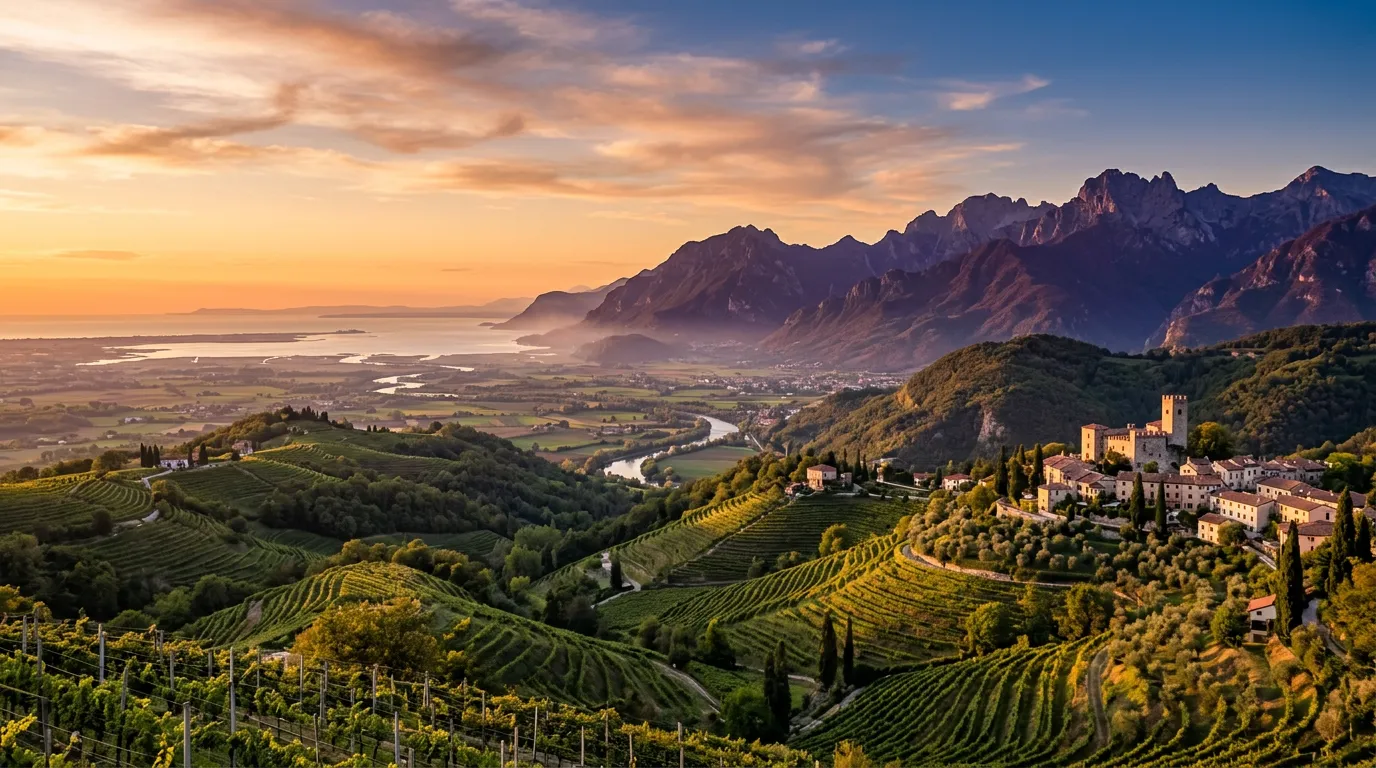
The Conegliano-Valdobbiadene Prosecco Superiore DOCG hills are a UNESCO World Heritage site since 2019 and dramatically less crowded than Tuscan wine regions. Most cantine (wineries) welcome walk-ins for tastings at EUR 5–15 for 3–4 pours, but calling ahead same-day is courteous. The Strada del Prosecco e Vini dei Colli runs 47km through the hills. Pair this with a stop in Asolo, one of Italy's most beautiful small towns. A car is essential here; no meaningful public transport serves the wine roads.
HIDDEN GEM · PHOTO · GOLDEN HOUR
When to Go
September through mid-October is the Veneto's sweet spot: summer heat breaks, vendemmia fills the Prosecco and Valpolicella hills with golden light and harvest energy, and Venice empties enough to photograph without tripod wars. For Dolomite photography, late June offers wildflower meadows and long golden hours with rifugi freshly open.
Nebbia Season
The Veneto's plains are notorious for thick, persistent fog (nebbia) that can last days. It blankets Padua, Treviso, and the Po Valley, creating an eerie beauty but limiting visibility. Venice in fog is one of Italy's most photogenic phenomena.
Plan indoor cultural visits on foggy days; Venice fog creates extraordinary photo opportunities but delays vaporetti.
Carnevale Season
Venice's Carnival runs for roughly two to three weeks before Lent, usually in February. Elaborate masks, historical costumes, and public spectacles fill the city. It is the single biggest cultural event in the Veneto calendar.
Book Venice hotels 3–6 months ahead; expect 3x normal prices and extreme crowds around San Marco.
Asparagus Season
White asparagus from Bassano del Grappa (DOP) is a culinary obsession. Restaurants across the Veneto build entire menus around it. The Bassano asparagus festival in April is a major local draw.
Plan a Bassano del Grappa day trip in April–May for the freshest asparagus and combine with grappa distillery visits.
Dolomite Summer
Mountain rifugi open, via ferrata routes become accessible, and high passes clear of snow. This is the only reliable window for high-altitude hiking in the Dolomites. Late June brings wildflowers; September brings golden larch forests.
Book popular rifugi like Locatelli and Lagazuoi by March; trails are busiest in late July and August.
Arena Opera Season
Verona's ancient Roman amphitheatre hosts open-air opera from mid-June through early September. Productions of Aida, Carmen, and Nabucco draw tens of thousands. The atmosphere under the stars is unforgettable.
Book tickets early for weekend performances; bring a cushion and arrive before sunset for the candle-lighting ritual.
Vendemmia Season
The grape harvest transforms Valpolicella, Soave, and the Prosecco hills (UNESCO site) into a hive of activity. Wineries open for tastings, villages host sagre (food festivals), and the landscape turns gold and amber.
Best time for wine-focused travel; book winery visits ahead as many small producers accept visitors by appointment only.
Dolomite Ski Season
Cortina d'Ampezzo and the wider Dolomiti Superski area offer world-class skiing across 1200km of connected pistes. The 2026 Winter Olympics will further boost Cortina's profile. January and February offer the most reliable snow.
Book Cortina accommodation months ahead for peak weeks; Sella Ronda circuit is less crowded on weekdays.
Where to Stay
The Veneto offers one of Italy's widest accommodation spectrums, from crumbling Venetian palazzos on the Grand Canal to agriturismo farmstays in the Prosecco hills and lakeside villas on Garda. Venice commands eye-watering premiums (especially during Biennale, Carnival, and summer), but the terraferma cities like Verona, Padua, and Treviso deliver far better value with easy train access. Booking direct often unlocks better cancellation terms and breakfast inclusions, especially at family-run properties outside Venice.
Aman Venice
San Polo, Venice
Hotel
ICONIC · BOOK AHEAD · PHOTO
Hotel Villa Cipriani
Asolo
Hotel
ICONIC · SUNSET · GOLDEN HOUR · PHOTO
Hotel Gabbia d'Oro
Centro Storico, Verona
Boutique Hotel
BOOK AHEAD · HIDDEN GEM · PHOTO
Hotel Belludi 37
Prato della Valle, Padua
Boutique Hotel
TRANSIT-FRIENDLY · BUDGET
We Crociferi
Cannaregio, Venice
Hostel
BUDGET · HIDDEN GEM · TRANSIT-FRIENDLY
Ostello di Verona
Veronetta, Verona
Hostel
BUDGET · SUNSET · PHOTO
Relais Villa Vittoria
Conegliano, Prosecco Hills
Villa
HIDDEN GEM · PHOTO · GOLDEN HOUR · NEXTPIC
Locanda San Vigilio
Punta San Vigilio, Lake Garda
Guesthouse
ICONIC · BOOK AHEAD · SUNSET · PHOTO · HIDDEN GEM
Top Attractions
№ 1 · Essential
Giotto's Scrovegni Chapel (Cappella degli Scrovegni)
★ ICONIC · BOOK AHEAD · PHOTO
Giotto's 1305 fresco cycle in Padua is one of the most important works of Western art, depicting the lives of Mary and Christ across luminous blue walls. This is not overrated — it genuinely rewrites your understanding of medieval painting. The 15-minute timed visit feels short but is deeply focused.
Tip: Book the evening slot when available — smaller groups and dramatic interior lighting make the frescoes glow. The mandatory 15-minute climate-control antechamber has a worthwhile introductory video.
Best: Evening slots or first morning entry for smallest crowds
Fees: 14 EUR including Musei Civici access
Prosecco Hills of Conegliano-Valdobbiadene
This UNESCO-listed landscape of steep vineyard-covered hills northwest of Treviso is stunningly photogenic and a working wine region. The winding Strada del Prosecco Superiore connects small producers where tastings cost a few euros or are free with purchase. Far more rewarding than drinking prosecco anywhere else in Italy.
ICONICBassano del Grappa and Ponte Vecchio
This elegant town at the foot of Monte Grappa centers on its iconic covered wooden bridge, designed by Palladio and rebuilt multiple times after floods and wars. The surrounding old town is genuinely charming without Venice-level crowds, and the grappa distilleries here are the real deal. A perfect half-day stop.
PHOTOPunta San Vigilio, Lake Garda
This tiny cypress-lined promontory on Garda's eastern shore is arguably the most beautiful single point on the entire lake. A Renaissance villa, ancient church, small pebble beach, and old harbor create an almost impossibly romantic scene. Far less visited than Sirmione or Malcesine despite being more photogenic.
HIDDEN GEMDay Trips
Venice (Venezia)
Travel: From Verona: 120 km / 1 hr 10 min by fast train. From Padua: 40 km / 25 min by train
Dolomites — Lago di Braies / Tre Cime
Travel: From Verona: 250 km / 3 hr by car. No practical direct train — car or organized tour required
Verona
Travel: From Venice: 120 km / 1 hr 10 min by train. From Padua: 80 km / 45 min by train
Prosecco Hills (Valdobbiadene — Conegliano)
Travel: From Venice: 70 km / 1 hr 15 min by car. Limited bus service — car strongly recommended
Padua (Padova)
Travel: From Venice: 40 km / 25 min by train. From Verona: 80 km / 45 min by train
Asolo and Possagno
Travel: From Venice: 75 km / 1 hr 15 min by car. Bus from Treviso possible but slow
Chioggia
Travel: From Venice: 50 km / 1 hr by bus or car. Also reachable by boat from Pellestrina
Scenic Routes
Strada delle 52 Gallerie (Road of 52 Tunnels)
Hiking
Route: Bocchetta Campiglia to Rifugio Achille Papa, Monte Pasubio
ICONIC · HARD HIKE · PHOTO · SEASONAL · NEXTPIC · FREE
Prosecco Hills Drive — Strada del Prosecco e Vini dei Colli
Driving
Route: Valdobbiadene to Conegliano
ICONIC · PHOTO · GOLDEN HOUR · SEASONAL · BUDGET
Tre Cime di Lavaredo Circuit
Hiking
Route: Rifugio Auronzo loop back to Rifugio Auronzo
ICONIC · PHOTO · SUNRISE · CROWD WARNING · NEXTPIC · FAMILY · SEASONAL
Passeggiata delle Mura — Padova City Wall Walk
Walking
Route: Porta Portello to Prato della Valle via the canal path
EASY WALK · HIDDEN GEM · PHOTO · FREE · TRANSIT-FRIENDLY
Grande Strada delle Dolomiti (Great Dolomites Road)
Driving
Route: Bolzano to Cortina d'Ampezzo (Veneto section from Passo Falzarego to Cortina)
ICONIC · PHOTO · GOLDEN HOUR · SEASONAL · FREE
Riviera del Brenta — Villa Walk and Cycle Path
Cycling
Route: Stra (Villa Pisani) to Mira along the Brenta Canal
EASY WALK · FAMILY · PHOTO · HIDDEN GEM · BUDGET · BOOK AHEAD
Street Art
The Veneto's street art scene is surprisingly vibrant, anchored by Padova's deeply rooted mural culture and spreading outward to smaller towns that have embraced urban art as a tool for neighborhood renewal. Padova is the undisputed capital, with entire districts transformed by large-scale murals from Italian and international artists. Verona has a growing scene concentrated in its industrial periphery, while Venice itself is famously hostile to graffiti (Banksy aside), though you'll find pockets on Giudecca and around the university area of Dorsoduro. The smaller towns of Cerea, Montagnana, and areas around Treviso have commissioned walls that reward detours. This is not Berlin or Shoreditch — the Veneto scene is more curated, more mural-focused, and deeply tied to community projects.
Arcella District, Padova
Padova's most diverse neighborhood has become an open-air gallery through the CHEAP and ArcellaBella projects. Massive multi-story murals cover residential buildings, tackling themes of immigration, community, and identity. The density is remarkable — you can see 15+ major works within a 20-minute walk. This is where Padova's art scene feels most alive and least curated for tourists.
Via Tiziano Aspetti to Via Jacopo Avanzo, Arcella, Padova
ICONIC · PHOTO · NEXTPIC · EASY WALK · TRANSIT-FRIENDLY · FREE
Tony Gallo's Padova Works
Tony Gallo is Padova's most famous street artist, and his whimsical blue-and-white figures have become unofficial symbols of the city. His largest work covers an entire building facade near the train station — elongated figures with tiny heads stacked in dreamlike compositions. Several other pieces are scattered through the center. These are genuinely iconic and photograph beautifully against Padova's warm-toned architecture.
Via Fra Paolo Sarpi 8 (main wall), with others near Piazza della Frutta and Via Altinate, Padova
ICONIC · PHOTO · GOLDEN HOUR · NEXTPIC · FREE · EASY WALK
ZIP Industrial Zone, Padova
Padova's industrial zone south of the center hosts warehouse-scale murals, many created during organized festivals. The scale here is enormous — entire factory walls become canvases. Less walkable than central locations and you'll want a bike or car, but the sheer size of the works makes for dramatic wide-angle photography. Some walls rotate with new festivals, so there's always something fresh.
Via della Navigazione Interna and surrounding industrial streets, ZIP Padova
PHOTO · GOLDEN HOUR · HIDDEN GEM · FREE
Veronetta Quarter, Verona
Verona's multicultural student neighborhood east of the Adige River has a growing collection of paste-ups, stencils, and commissioned murals. It lacks Padova's density, but the juxtaposition of street art against faded Venetian-era facades creates compelling contrasts. The area around Via XX Settembre and the former military buildings has the highest concentration. This is a neighborhood Verona tourists almost never visit.
Via XX Settembre to Vicolo Morette, Veronetta, Verona
HIDDEN GEM · PHOTO · FREE · EASY WALK
Banksy and Dorsoduro Walls, Venice
Venice aggressively removes graffiti, but Banksy's 2019 'Migrant Child' piece on the wall of a building along Rio di Ca' Foscari became an instant landmark and has been preserved behind plexiglass. Beyond this, the university area of Dorsoduro and parts of Giudecca island have small-scale stencils and paste-ups that appear and vanish quickly. Don't come expecting a street art district — this is guerrilla work in a city that actively fights it, which makes finding anything feel like a small victory.
Campo San Pantalon, Dorsoduro, Venice (Banksy wall on building facing the canal)
ICONIC · PHOTO · CROWD WARNING · FREE
Culture & History
The Veneto is a region whose cultural identity was forged by a thousand years of Venetian Republic sovereignty, creating a unique blend of Byzantine, Gothic, and Renaissance influences found nowhere else in Europe. Its cities — Venice, Padua, Verona, Vicenza, Treviso — each developed distinct artistic personalities while sharing a common civic pride rooted in commerce, diplomacy, and intellectual freedom. The region's cultural DNA is maritime and mercantile, shaped by trade routes that brought Eastern aesthetics into Western art and architecture.
Eat & Drink
The Veneto is one of Italy's most quietly extraordinary food regions, stretching from the lagoon kitchens of Venice to the alpine foothills of Belluno. Venice brings its iconic cicchetti bar culture, Verona delivers hearty risottos and horse-meat stews rooted in medieval tradition, and Padua and Treviso contribute radicchio-driven dishes and robust osteria cooking. The region's signature ingredients include vialone nano rice, white asparagus from Bassano, sopressa salami, baccala (salt cod), and the famous radicchio rosso di Treviso.
Alle Testiere ★★★★★
Tiny seafood-only menu: raw scampi, spaghetti with baby calamari, seasonal lagoon fish prepared with zero fuss and maximum skill
Castello, Calle del Mondo Novo 5801, Venice
Restaurant
Trattoria alla Madonna ★★★★
Classic Venetian seafood lunch: fritto misto, risotto di go (goby fish risotto), sarde in saor. Old-school service and honest prices near Rialto.
San Polo, Calle della Madonna 594, Venice
Restaurant
El Coq ★★★★★
Creative vegetable-forward tasting menus using Veneto terroir: Bassano asparagus, mountain herbs, radicchio preparations that will change your mind about the ingredient
Marano Vicentino, Via Roma 32, Vicenza province
Restaurant · vegetarian_restaurant
Osteria di Duomo ★★★★
Veronese classics done right: pastissada de caval (horse meat stew), bigoli con le sarde, risotto all'Amarone. Simple room, serious cooking.
Centro Storico, Via Duomo 7a, Verona
Restaurant
Radici Terra e Sapori ★★★
Fully plant-based menu rooted in Veneto produce: polenta with wild mushrooms, grilled radicchio plates, seasonal vegetable antipasti
Centro, Via Altinate 51, Padua
Restaurant · vegan_restaurant
Caffe Florian
Opened in 1720, oldest cafe in continuous operation in Italy. Ornate rooms, live orchestra on the piazza, espresso served on silver trays. You are paying for living history.
Piazza San Marco 57, Venice
Coffee · cafe
Torrefazione Cannaregio
Working roastery serving single-origin espresso in a no-frills neighborhood setting far from tourist Venice. Beans roasted on site.
Cannaregio, Fondamenta dei Ormesini, Venice
Coffee · cafe
Caffe Pedrocchi
Padua's neoclassical landmark cafe since 1831. Famous for its caffe Pedrocchi, an espresso with mint cream. Upstairs museum rooms are gorgeous.
Via VIII Febbraio 15, Padua
Coffee · cafe
Caffe Bontadi
Trentino-rooted roaster with a sleek Rovereto-area flagship and a newer Verona presence. Specialty-grade beans, pour-over options rare in Italy.
Via Leoncino 14, Verona [ASSUMPTION]
Coffee · cafe
Pasticceria Rizzardini
Operating since 1742. Fritole (Venetian carnival doughnuts), bussolai buranei (butter ring cookies), and seasonal pastries like pinza veneta.
San Polo, Campiello dei Meloni 1415, Venice
Bakery · bakery
Pasticceria Flego
Traditional Padovano breakfast: brioche col tuppo, crostate, focaccia veneta. Excellent cappuccino. The zaleti (cornmeal cookies with raisins) are the real find.
Via Luca Belludi 80, Padua
Bakery · bakery · breakfast_restaurant
Panificio Perbellini
Verona's pandoro heritage bakery. Year-round baked goods but the pandoro and offelle biscuits are the signatures. Bread is exceptional.
Via Cappello 10, Verona [ASSUMPTION]
Bakery · bakery
La Zucca
Famous pumpkin flan, seasonal vegetable plates, creative salads. The menu always has six to eight fully vegetarian mains alongside a few fish dishes.
Santa Croce, Ponte del Megio 1762, Venice
Vegetarian · vegetarian_restaurant
Osteria ai Pugni (vegetarian menu)
Traditional cicchetti bar with a surprisingly deep vegetarian and vegan cicchetti selection: grilled artichoke hearts, baccala-less polenta crostini, marinated peppers, arancini
Dorsoduro, Fondamenta Gherardini 2836, Venice
Vegetarian · vegan_restaurant
Sali e Tabacchi
Farm-to-table Paduan osteria with dedicated vegetarian and vegan sections on the menu. Radicchio tart, grilled seasonal greens, homemade pasta with vegetal ragu.
Via Marsala 31, Padua [ASSUMPTION]
Vegetarian · vegetarian_restaurant · vegan_restaurant
Shopping
The Veneto is one of Italy's richest shopping regions, spanning Murano glass and Venetian masks to Bassano del Grappa ceramics, Verona antiques, and luxury outlet malls drawing fashion hunters from across Europe. Craft-lovers, vintage seekers, and anyone who values artisan tradition over mass production will be in heaven here.
Mercatino dell'Antiquariato di Piazzola sul Brenta
Antiques
One of Italy's largest antique markets: vintage furniture, old prints and maps, silverware, Murano glass pieces from estate sales, mid-century Italian design objects, and retro jewelry.
Market · ICONIC · PHOTO · HIDDEN GEM · BUDGET
Mercato di Rialto
Mixed
Beyond the famous food stalls, the surrounding streets host vendors selling handmade leather goods, Venetian beads and jewelry, artisan paper, and old nautical prints. The market building itself is a photogenic iron-and-stone structure worth visiting for architecture alone.
Market · ICONIC · PHOTO · CROWD WARNING · SUNRISE
Mercato Antiquario di Verona
Antiques
Vintage Italian ceramics, antique books and prints, estate jewelry, old opera programs and posters from the Arena di Verona, Art Deco lamps and furniture.
Market · PHOTO · HIDDEN GEM · EASY WALK
Mercatino di Natale di Verona
Craft
Handcrafted Christmas ornaments, carved wooden figures from the Dolomite tradition, beeswax candles, wool scarves and felt hats, mulled wine accessories. One of Italy's most atmospheric Christmas markets.
Market · SEASONAL · PHOTO · FAMILY · CROWD WARNING
Murano Island, Venice
The global epicenter of artisan glassmaking since 1291. Dozens of fornaci (furnaces) and showrooms line the Fondamenta dei Vetrai. Ranges from museum-quality art glass to affordable small pieces.
Venini for high-end contemporary design glass. Davide Penso for extraordinary glass bead jewelry. Cesare Toffolo for goblets and sculptural work. Smaller studios along side canals offer pieces at 30-50% less than main-drag showrooms. Look for the Vetro Artistico Murano trademark to guarantee authentic origin.
District · ICONIC · PHOTO · BOOK AHEAD · TRANSIT-FRIENDLY
Noventa di Piave Designer Outlet and McArthurGlen Outlet
Large luxury outlet mall about 40 minutes from Venice with 150+ stores offering Italian and international designer brands at 30-70% off retail. Functional rather than charming, but genuinely good deals.
Bottega Veneta, Gucci, Prada, Furla, and Tod's all maintain outlet stores. The Bottega Veneta outlet is particularly well-stocked since the brand is headquartered in the Veneto. Furla bags here can be 50-60% off Venice boutique prices.
District · BUDGET · BOOK AHEAD
Via Mazzini and Centro Storico, Verona
Verona's elegant pedestrian shopping spine running from Piazza Bra to Piazza Erbe. A mix of Italian luxury brands, independent boutiques, and artisan shops in medieval and Renaissance buildings.
Salumeria Albertini for beautifully packaged regional goods. Libreria Antiquaria Perini for rare books. Several jewelers specializing in gold work around Piazza Erbe. Vintage clothing shops on the side streets off Corso Santa Anastasia offer curated Italian fashion at reasonable prices.
District · ICONIC · EASY WALK · PHOTO
Photo Spots
The Veneto spans from sea level in Venice to nearly 3,400m in the Dolomites, so light timing varies dramatically by elevation and orientation. Venice's low latitude relative to northern Europe means summer sunrises around 5:15-5:25am and sunsets near 8:45-9:00pm, with excellent long golden hours. Winter compresses daylight to roughly 8:30am-4:30pm but brings the famous nebbia (fog) that can create extraordinary atmospheric shots in Venice and the Prosecco hills — or completely kill visibility for mountain work. The Dolomites are only reliably accessible and photogenic from June through early October, with the best stable weather in September when autumn color begins. Spring (Apr-May) brings wildflowers to the foothills but unpredictable rain. Venice's acqua alta season peaks November through March and is increasingly less predictable — monitor the Centro Maree app for 48-hour tide forecasts. Gear-wise, bring a versatile zoom range: a 16-35mm for Venice's tight canals and Dolomite panoramas, a 24-70mm as a workhorse, and a 70-200mm for compressing Burano house rows and isolating mountain peaks. A circular polarizer is essential for managing reflections on canal water — use it to either enhance or eliminate reflections depending on the shot. For Venice specifically, a fast prime (35mm f/1.4 or 50mm f/1.4) handles the dark calli (alleyways) and moody night scenes without pushing ISO above 1600. A 3-stop graduated ND filter is critical for Dolomite sunrise and sunset when peak brightness vastly exceeds foreground shadow. In post-processing, Venice's color palette rewards warm white balance shifts (5800-6200K) and moderate vibrance boosts rather than heavy saturation, which makes the canal water look artificial. For the Dolomites, luminosity masking in Lightroom or Photoshop handles the extreme dynamic range between sunlit peaks and shadowed valleys far better than simple gradient filters.
Rialto Bridge at Dawn — Grand Canal View
The classic S-curve of the Grand Canal with the Rialto Bridge framing gondolas and water taxis. Shoot from the Fondamenta del Vin side (south bank, east of the bridge) to catch the first light hitting the bridge's white Istrian stone. The canal reflects warm tones beautifully before boat traffic churns the water. Wide-angle compression of the bridge arch with market vendors setting up below adds human scale.
Piazza San Marco — Acqua Alta Reflections
During acqua alta (high water flooding, typically Oct-Mar), Piazza San Marco becomes a mirror reflecting the Basilica, Campanile, and Procuratie. Even 3-5cm of water transforms the square into a surreal double image. Without flooding, shoot the Basilica's gold mosaics catching first light from the arcade shadows on the west side. The geometry of the arcade columns creates powerful leading lines.
Burano Island — Colored Houses Along Fondamenta di Cavanella
The candy-colored fishermen's houses lining the canals are the most photogenic streetscape in the Venetian lagoon. The best row is along Fondamenta di Cavanella and Via Galuppi where you get continuous blocks of saturated color with laundry lines, moored boats, and reflections in the still canal water. Overcast days actually produce better saturation than harsh sun, which blows out the pastel walls.
Ponte di Veja — Natural Stone Arch, Lessinia
A massive natural rock arch in the Lessinia Natural Park north of Verona — one of the largest in Europe. The arch frames the forest valley below. In autumn, the surrounding beech forest turns gold and copper, creating a natural frame. In winter, ice formations hang from the arch. This is a landscape photographer's spot that most Venice-focused visitors completely miss. The scale is dramatic — the arch spans roughly 40 meters.
Arena di Verona — Exterior and Piazza Bra at Blue Hour
The Roman amphitheater's exterior limestone glows warm pink at sunset and transitions to a deep blue-hour scene with the restaurant lights of Piazza Bra's Liston promenade creating bokeh warmth in the foreground. During summer opera season (Jun-Sep), you can hear the performance from outside while shooting. The arena's curved wall creates a powerful repeating pattern shot with a long lens from across the piazza.
Asolo — Hilltop Panorama from La Rocca
The medieval fortress atop Asolo gives a 360-degree panorama over the Prosecco hills, terracotta rooftops, and on clear days the Dolomites to the north. Known as the City of a Hundred Horizons. The layered hill composition — village roofs, cypress trees, vineyard rows, then mountain backdrop — is a textbook landscape scene. Morning mist in the valleys below is common in autumn and adds atmospheric depth.
Prato della Valle — Padua's Oval Canal at Night
One of Europe's largest squares, ringed by an elliptical canal lined with 78 statues. At night, the statues are lit from below and reflect in the still canal water, creating an eerie, cinematic symmetry. The oval geometry gives you strong compositional anchors from multiple angles. During Saturday morning markets, the square fills with stalls and local life for a completely different editorial-style shoot.
Tre Cime di Lavaredo — Rifugio Auronzo Viewpoint
The three towering dolomite peaks are arguably the most photographed mountain formation in the Alps. From the south side near Rifugio Auronzo, you get the classic triple-peak composition. The north side via the hiking loop gives the dramatic sheer north faces reflected in Lago dei Piani. Alpenglow on the peaks at sunrise and sunset turns the pale rock deep orange-pink for roughly 5-10 minutes.
Suggested Itinerary
Nightlife
Veneto nightlife revolves around the aperitivo ritual — spritz culture was born here, and the evening starts at 6pm with an Aperol Spritz or Select Spritz in hand. Venice, Padua, and Verona each have distinct scenes: Venice is intimate and tourist-heavy, Padua is university-driven and genuinely rowdy, and Verona sits somewhere between elegant and relaxed. Clubs are rare in Venice proper but exist on the Lido and mainland; Padua and the Jesolo coast carry the late-night energy.
Al Timon
A canalside wine bar where locals stand shoulder-to-shoulder on moored boats with cicchetti in one hand and a glass of Valpolicella in the other, ignoring tourists who wander past looking confused
No reservation, just show up by 7pm to get a canal-side spot. House wines by the glass from 3-4 EUR. Cash preferred. Cicchetti 1-2 EUR each. Closes around midnight. Thursday and Friday busiest.
Naranzaria
Upscale cocktails overlooking the Grand Canal near Rialto Bridge, polished but not pretentious, where well-dressed Venetians mix with in-the-know tourists over creative spritzes and raw fish plates
Reservations strongly recommended for canal-side tables at sunset. Cocktails 12-16 EUR. Dress smart casual. Kitchen closes around 10:30pm, bar stays open until midnight or later on weekends. Their signature spritz variations are worth trying.
Piccolo Mondo
Venice's only real nightclub is a tiny, sweaty, velvet-lined basement where an older crowd dances to 80s Italian pop alongside bewildered backpackers who stumbled in after midnight
Cover 10-15 EUR including one drink. Opens at 11pm, doesn't get going until 1am. Open Thursday to Saturday. Dress code is loosely enforced — no flip-flops or beachwear. Capacity is genuinely small, maybe 150 people. It's an experience, not a destination.
Fishmarket
A slick DJ bar steps from the Arena where the aperitivo crowd morphs into a proper late-night scene, all exposed brick and well-mixed Negronis, with the volume climbing as the night deepens
Aperitivo buffet included with drinks 6-9pm. After 10pm it becomes more of a bar-club hybrid with DJs. Cocktails 8-12 EUR. Gets packed Friday and Saturday. No cover. Open until 2am on weekends.
Osteria del Bugiardo
A standing-room wine bar on Verona's most photogenic street where locals crush in for Amarone by the glass and bruschetta, the noise level rising with every round until the medieval walls practically vibrate
Wines 3-8 EUR per glass, emphasis on local Veneto producers. Excellent Valpolicella and Soave selection. No reservations — it's a squeeze-in situation. Open until midnight most nights. The bruschette are some of the best cheap eating in town.
Padova Social Club
A grungy-chic bar near the university where philosophy students and young professionals argue over craft cocktails and the playlist swings from post-punk to Italian indie without warning
Cocktails 6-8 EUR, significantly cheaper than Venice equivalents. Live DJ sets on weekends. Open until 2am. No cover, no dress code. The university district around Via Barbarigo and Piazza dei Signori is the real nightlife heart of Padua.
Sotto l'Arco
A student pub packed to the ceiling every Thursday and Saturday where cheap spritz flows and the crowd spills out onto the street, making the whole block feel like an open-air party
Spritz from 2.50-3.50 EUR — possibly the cheapest in Veneto. Thursday is university night. Gets absolutely rammed by 10pm. Closes around 2am. No food to speak of. This is pure, unfiltered Paduan student nightlife.
Terrazza Bar al Ponte at Hotel Saturnia
A hidden rooftop terrace above San Marco's shopping street where you sip Bellinis invented just a few canals away, watching the sun set over terracotta rooftops in near-silence
Cocktails 15-20 EUR. Open to non-guests but seating is very limited — arrive by 6pm for sunset. Smart casual dress. Closes relatively early, around 11pm. Worth it once for the view. [ASSUMPTION] Seasonal opening — check availability in winter months.
Harry's Bar
The birthplace of the Bellini and the carpaccio, now more museum piece than bar, where you pay 22 EUR for a cocktail and sit elbow-to-elbow with tourists recreating Hemingway fantasies in a room the size of a living room
Bellini 22 EUR at the bar. Overpriced and tourist-heavy, but historically significant and worth one visit for the story. Sit at the bar downstairs, not the dining room upstairs. Smart dress expected. Closes around 11pm. No reservation needed for bar seating.
Marina Club
A massive beachfront club complex on the Adriatic where Italian club culture fully unfolds — proper sound systems, international DJs in summer, and crowds arriving at 1am to dance until sunrise on the sand
Summer season only, roughly June-September. Cover 15-25 EUR depending on the night and DJ. Gets going after 1am. Shuttle buses run from some Veneto cities in peak season. Dress code enforced — no beachwear ironically despite being on the beach. This is where Veneto goes clubbing.
Bacaro Jazz
A narrow cocktail bar with live jazz most nights crammed into an impossibly small space, the saxophonist practically sitting on your lap while you nurse a well-made martini and pretend you're in a Fellini film
Live music usually starts around 9:30-10pm. No cover charge but drinks are 10-14 EUR for cocktails. Standing room only most nights — arrive early for a seat. The cocktails are actually very good. Open until 1:30am. Their martini is the move.
Build your own Itinerary from this guide
Pick the places you care about — attractions, photo spots, map markers — and we'll lay out a day-by-day starting point. Yours to edit; guide updates never touch it.