Essentials
Currency, language, transit & safety — tap to expand.
Currency — Philippine Peso (PHP), symbol ₱. Roughly ₱56–58 = 1 USD, ₱61–63 = 1 EUR [ASSUMPTION: rates fluctuate, check before travel]
Cash vs card — Cash is king outside Manila, Cebu, and tourist hubs. Cards work at malls, hotels, and bigger restaurants but small eateries, sari-sari stores, tricycles, and island ferries are cash-only. ATMs are common in cities but often charge ₱250 per withdrawal and cap at ₱10,000–20,000 — withdraw the max to save on fees. Tipping is appreciated but not mandatory: round up or leave 10 percent where no service charge is added. Many restaurants add a 10 percent service charge already.
Budget — Budget: ₱1,500–2,500/day (~$27–45) — hostels, street food, public transit. Mid-range: ₱4,000–7,000/day (~$70–125) — private rooms, restaurants, some tours. Luxury: ₱12,000+/day (~$215+) — resorts, private boats, fine dining.
Language — Filipino (based on Tagalog) and English are both official. Filipino dominates Luzon and national media; regional languages like Cebuano dominate the Visayas and Mindanao. English is taught in schools nationwide.
Language barrier — Very low barrier — the Philippines is one of the most English-friendly countries in Asia. Signage, menus, and transit info are commonly in English, and most people in tourism, retail, and transport speak it well. You can travel comfortably with English alone.
Getting around — The Philippines is 7,000+ islands, so domestic flights and ferries do the heavy lifting between regions, while jeepneys, tricycles, and ride-hailing cover the ground locally. Manila traffic is brutal — budget far more time than distance suggests. Honest take: book domestic flights early (Cebu Pacific, AirAsia, PAL) and use Grab in cities to skip taxi haggling.
Safety — Generally safe for tourists in the main destinations (Palawan, Cebu, Bohol, Siargao, Boracay). Petty theft and pickpocketing happen in crowded Manila areas and on public transit — watch your bag. Skip unofficial street money changers and ATM scams; use bank ATMs inside malls. Government travel advisories warn against the western/central Mindanao mainland and Sulu archipelago due to kidnapping risk — these are far from typical tourist routes. Typhoon season (roughly June–November) brings cancelled ferries and flights, so build buffer days into island itineraries. Tap water is not reliably safe — drink bottled or filtered. Motorbike and tricycle accidents are a real risk; wear a helmet and don't ride at night on unlit rural roads.
Highlights
The Philippines is 7,641 islands' worth of distinct microcultures stitched together by warmth, Catholicism, and a shared love of karaoke. It feels different because hospitality here is structural — strangers will adopt you for a day, jeepneys double as rolling folk art, and the gap between Manila's chaos and a silent Palawan lagoon can be a single morning's flight. English fluency makes it unusually navigable for a region this remote-feeling.
Cultural identity: the bayanihan spirit and regionalism
The country isn't monolithic — Cebuano, Ilocano, Tagalog, and Hiligaynon regions differ in language, food, and pace. 'Bayanihan' (communal helping) is real and you'll feel it. Expect 'Filipino time' (events start late), and understand that 'po' and 'opo' added to sentences show respect to elders. Smiles often mask discomfort, so read context, not just words.
Entry & visa reality
Most nationalities (US, UK, EU, AU, Canada) get 30 days visa-free on arrival, extendable at any Bureau of Immigration office. You MUST show proof of onward/return travel or airlines may deny boarding. Register the eTravel pass online within 72 hours before arrival — it's free and mandatory. [ASSUMPTION] Visa-free terms vary by passport; verify yours.
BOOK AHEAD
Connectivity: SIMs and offline maps
Buy a Globe or Smart SIM at the airport (DITO is cheapest but weaker coverage rurally). SIM registration is legally required — bring your passport. Globe's coverage on tourist islands (Palawan, Siargao) is generally strongest. Download Google Maps offline tiles AND Maps.me before island-hopping; signal vanishes between islands. GCash is the dominant payment app but usually needs a local number to fully activate.
TRANSIT-FRIENDLY
Local customs and etiquette
Use 'mano po' (touching an elder's hand to your forehead) as a respectful greeting. Remove shoes entering homes. Karaoke is sacred — never refuse an invitation to sing, but never sing 'My Way' (genuinely associated with bar fights). Tipping ~10% is appreciated but not mandatory. Pointing with lips (a subtle mouth gesture) is normal directional language.
Practical setup: island-hopping logistics
Domestic flights on Cebu Pacific and Philippine Airlines are the backbone, but cancellations and weather delays are common — never book tight connections. Book inter-island ferries via the 12Go Asia app. Bring a waterproof dry bag and reef-safe sunscreen (some areas like Boracay ban non-reef-safe brands). Carry cash; ATMs on small islands run dry and cap withdrawals low.
BOOK AHEAD
Photography unlock: golden hour on the water
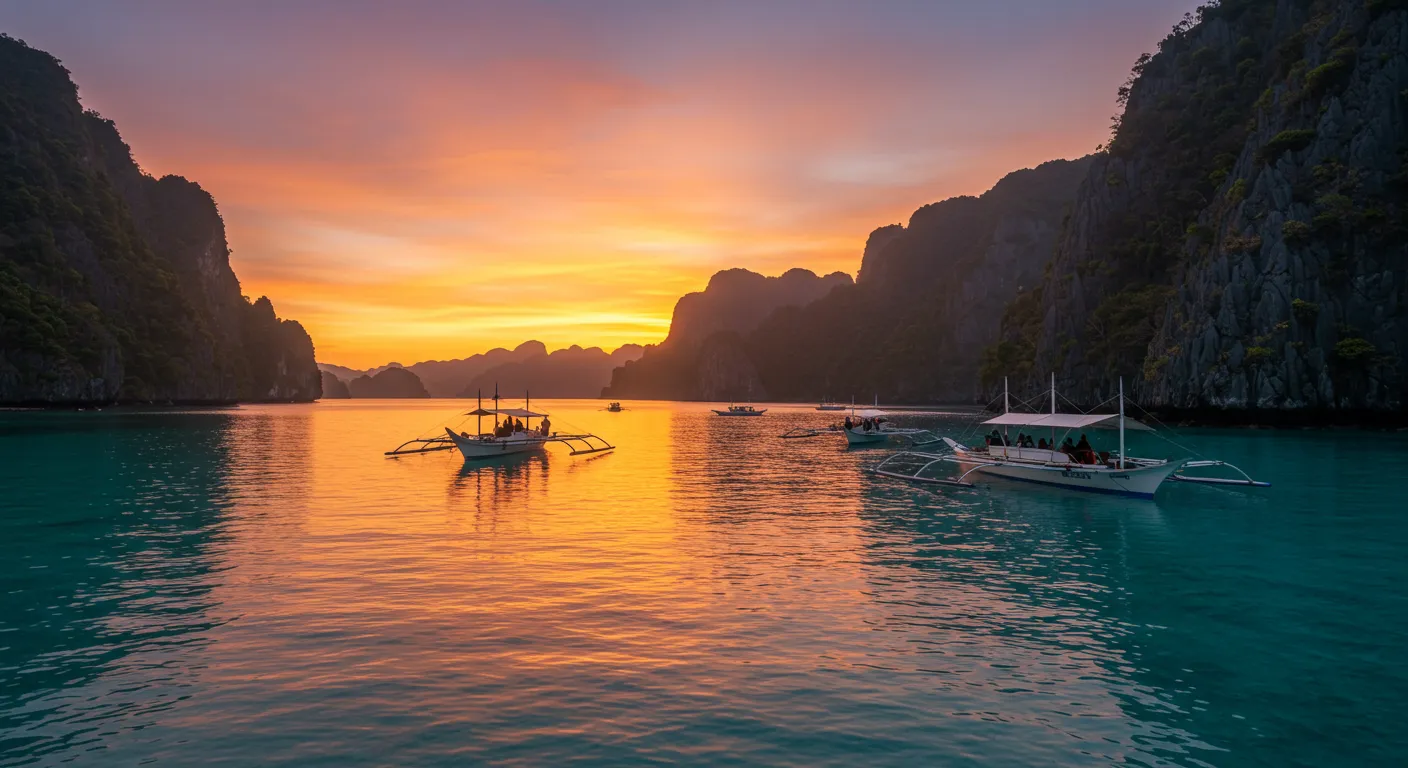
The best light is on island-hopping boats — shoot El Nido's Big and Small Lagoon at the FIRST tour slot (07:00) before crowds and harsh midday sun. Banca outrigger boats make iconic silhouette foregrounds at sunset. Coron's Kayangan Lake viewpoint is a short steep climb best done at opening to beat tour groups. Bring lens cloths; sea spray and humidity fog everything.
GOLDEN HOUR · PHOTO · SUNRISE · CROWD WARNING
Insider unlock: shoulder-season timing
Dry season (Nov–May) is peak, but late November and early June bracket the crowds while staying mostly dry. Typhoon season (roughly Jun–Oct) hits Luzon and the east hardest — the southern islands (Palawan, parts of Mindanao) stay drier and cheaper. [ASSUMPTION] Verify current advisories before booking eastern-facing destinations in storm months.
SEASONAL · BUDGET
When to Go
Late January through March is the sweet spot: reliably dry skies, calm seas for boat and beach photography, and comfortable-enough heat for walking before May's furnace arrives. February in particular balances dry weather with slightly thinner crowds after the New Year peak. For food markets and street life without sweating through your shirt, target the cooler Amihan mornings.
Amihan
The northeast monsoon brings the coolest, driest, and most settled weather of the year. Skies are clear, seas are calm, and humidity drops to its most comfortable levels.
Best overall window for beaches, diving, and photography — but expect peak prices and crowds around the holidays.
Summer (Tag-init)
The hot dry season pushes temperatures and humidity to their highest while seas stay calm and skies clear. It coincides with the busy domestic travel period around Holy Week and local fiestas.
Excellent for water activities but plan shooting and walking for early morning and late afternoon to avoid the heat.
Habagat
The southwest monsoon delivers the heaviest rains and the core of typhoon season, with frequent downpours and possible flooding. Landscapes are at their greenest and travel costs at their lowest.
Cheapest and quietest, but build buffer days for typhoon-related flight and ferry cancellations.
Transition
A shoulder period as the monsoon withdraws and dry conditions return, with weather varying sharply between regions. The Visayas often clears earlier than Luzon.
Strong value with improving weather, though late-season typhoons remain a possibility into November.
Where to Stay
The Philippines offers extraordinary value across every budget tier, from world-class island resorts rivaling the Maldives at a fraction of the cost to beachfront hostels for under $10 a night. The archipelago's 7,641 islands mean accommodation character shifts dramatically by region — Manila is urban hotel territory, Palawan and Siargao are boutique and eco-resort havens, and Cebu bridges both worlds. Peak season (December–May) can double prices in top destinations like El Nido and Boracay, and many island properties have limited rooms, so booking ahead is essential for anything above hostel level.
Amanpulo
Pamalican Island, Cuyo Archipelago
Resort
ICONIC · BOOK AHEAD
Shangri-La Boracay Resort and Spa
Barangay Yapak, Boracay
Resort
BOOK AHEAD · FAMILY · PHOTO
The Henry Hotel Manila
Pasay City, Metro Manila
Boutique Hotel
HIDDEN GEM · TRANSIT-FRIENDLY
Frangipani El Nido
Corong-Corong, El Nido, Palawan
Boutique Hotel
PHOTO · GOLDEN HOUR · BOOK AHEAD
Mad Monkey Hostel Nacpan Beach
Nacpan Beach, El Nido, Palawan
Hostel
BUDGET · NEXTPIC · PHOTO
Big Hotel
Mandaue City, Cebu
Hotel
BUDGET · TRANSIT-FRIENDLY
Siargao Bleu Resort and Spa
Tourism Road, General Luna, Siargao
Resort
BOOK AHEAD · PHOTO · HIDDEN GEM
Tao Philippines Expedition
Between Coron and El Nido, Palawan
Guesthouse
ICONIC · HIDDEN GEM · NEXTPIC · BOOK AHEAD · PHOTO
Top Attractions
№ 1 · Essential
Banaue Rice Terraces
★ ICONIC · PHOTO · GOLDEN HOUR · HARD HIKE · SUNRISE
These 2,000-year-old terraces carved into the Ifugao mountains are genuinely jaw-dropping and live up to the hype. The classic Banaue viewpoint is fine, but Batad's amphitheater terraces are the real showstopper if you make the effort.
Tip: Skip the roadside Banaue lookout crowds and hike down to Batad village. Hire a local guide at the saddle point — non-negotiable for the trail and worth every peso.
Best: Arrive by 7am for soft light and mist clearing off the terraces; harsh midday sun flattens the contours.
Fees: Around PHP 50 environmental fee at Batad; guide approx PHP 1,500 [ASSUMPTION]
Chocolate Hills, Bohol
Over 1,200 symmetrical mounds that turn brown in dry season, hence the name. Visually unique and worth the stop, but the main viewing deck can feel like a quick tour-bus tick-box — the surrounding landscape is the real draw.
ICONICKawasan Falls, Cebu
Turquoise multi-tiered waterfalls famous for canyoneering. Stunning in photos, but it has become heavily commercialized and crowded — the canyoneering experience upstream is more rewarding than the packed base pool.
PHOTOIntramuros, Manila
The walled Spanish colonial core of Manila, home to Fort Santiago and San Agustin Church. A genuinely atmospheric history lesson and the best photo walk in the capital, though some restored sections feel a little theme-park.
ICONICDay Trips
Taal Volcano and Tagaytay (Batangas)
Travel: 65 km / 1.5–2 hr by car from Manila
Pagsanjan Falls (Laguna)
Travel: 100 km / 2.5–3 hr by car from Manila
Corregidor Island (Manila Bay)
Travel: 48 km / ~1 hr by ferry from Manila
Intramuros and Manila Old Town
Travel: In-city / 30–60 min by taxi or jeepney
Banaue and Batad Rice Terraces (Ifugao)
Travel: 330 km / 8–9 hr by night bus from Manila
Villa Escudero Plantation (Quezon/Laguna)
Travel: 90 km / 2–2.5 hr by car from Manila
Hidden Valley Springs (Laguna)
Travel: 85 km / 2–2.5 hr by car from Manila
Scenic Routes
Halsema Highway (Baguio to Sagada)
Driving
Route: Baguio to Sagada
PHOTO · GOLDEN HOUR · SEASONAL
Batanes North Loop (Basco to Mahatao)
Cycling
Route: Basco to Mahatao and back
PHOTO · HIDDEN GEM · SEASONAL
Chocolate Hills to Loboc River (Bohol)
Driving
Route: Carmen to Loboc
ICONIC · PHOTO · CROWD WARNING · SUNRISE
Intramuros Heritage Walk (Manila)
Walking
Route: Fort Santiago to San Agustin Church
EASY WALK · PHOTO · BLUE HOUR · TRANSIT-FRIENDLY
Osmena Peak Ridge Trail (Cebu)
Hiking
Route: Mantalongon to Osmena Peak summit
HARD HIKE · PHOTO · SUNRISE · HIDDEN GEM
Kawasan Falls Trail (Cebu)
Walking
Route: Matutinao to upper falls
EASY WALK · PHOTO · CROWD WARNING
Street Art
The Philippines has a vibrant and growing street art scene, anchored heavily in Metro Manila but spreading through cities like Cebu, Bacolod, and Angeles. Manila's scene blends political commentary, indigenous motifs, and pop culture, with collectives and solo artists turning bare concrete walls and underpasses into open-air galleries. Filipino street art tends to be colorful and narrative-driven, often reflecting social issues, faith, and everyday Pinoy life.
BGC Art Walk / Bonifacio High Street area
The most accessible and well-maintained outdoor mural collection in Metro Manila. Curated large-scale works by local and international artists across building walls and parking structures. Clean, safe, and walkable, making it a great low-stress intro to the scene.
Around 9th Ave & Bonifacio High Street, Taguig
PHOTO · EASY WALK · ICONIC · GOLDEN HOUR · FAMILY
Escolta Street, Old Manila
Historic district undergoing creative revival, with murals and art installations tucked among heritage buildings like the First United Building. Gritty, atmospheric, and rich in texture; pairs street art with old architecture for layered shots.
Escolta St, Binondo, Manila
PHOTO · HIDDEN GEM · TRANSIT-FRIENDLY · RAINY DAY
Cubao Expo / Cubao area, Quezon City
A creative pocket with murals, indie shops, and a bohemian feel. The walls here lean more experimental and underground than BGC's polished commissions. Good for character and authenticity.
General Romulo Ave, Cubao, Quezon City
PHOTO · HIDDEN GEM · BUDGET
Bacolod murals, Negros Occidental
Outside Manila, Bacolod has a notable mural culture tied to its MassKara festival creativity. Colorful, festive walls scattered around the city center reward a wander if you're already in the Visayas.
Central Bacolod, around Lacson St [ASSUMPTION]
PHOTO · HIDDEN GEM · SEASONAL
Culture & History
The Philippines is an archipelago of over 7,000 islands where indigenous Austronesian roots, three centuries of Spanish Catholicism, and decades of American influence blend into something wholly its own. The result is a culture defined by bayanihan (communal cooperation), deep family ties, an irrepressible musicality, and a hospitality that visitors consistently remember more than any single monument. Its identity is plural — Tagalog, Cebuano, Ilocano, Maranao, Igorot and dozens more — held together by shared resilience and humour.
Eat & Drink
Filipino food is the great underrated cuisine of Southeast Asia: a layered, sour-salty-sweet conversation between indigenous cooking, Malay and Chinese trade, and three centuries of Spanish then American influence. Expect vinegar and citrus in everything (adobo, kinilaw, sinigang), rice at every meal, and a national sweet tooth that produces halo-halo, leche flan, and ube in dozens of forms. Manila and Cebu lead the dining scene, but the best meals are often roadside carinderias, seaside seafood dampa, and provincial specialties like Pampanga's sisig and La Union's longganisa.
Toyo Eatery ★★★★★
modern Filipino tasting menu, garden vegetables, heritage techniques
Karrivin Plaza, Chino Roces Ave Ext, Makati
Restaurant
Sarsa Kitchen + Bar ★★★★★
Negros-style chicken inasal, kansi, batchoy
BGC, Taguig
Restaurant
Corazon ★★★★
vegetable-forward Filipino, kinilaw, grilled produce
Tagaytay [ASSUMPTION], also Makati branch
Restaurant · vegetarian_restaurant
Aristocrat Restaurant ★★★★
chicken barbecue with java rice, classic Filipino comfort food
Roxas Blvd, Malate, Manila
Restaurant
Greenery Kitchen ★★★
plant-based Filipino classics, vegan sisig and kare-kare
Quezon City [ASSUMPTION]
Restaurant · vegan_restaurant
Yardstick Coffee
specialty single-origin, local Philippine beans, clean roasting
Legazpi Village, Makati
Coffee · cafe
Kalsada Coffee
traceable Philippine-grown coffee, Sagada and Benguet beans
Manila metro [ASSUMPTION]
Coffee · cafe
EDSA Beverage Design Studio
experimental brews, ferments, design-driven cafe
Mandaluyong
Coffee · cafe
Habitual Coffee
minimalist pour-overs, espresso, quiet workspace
Escolta, Manila
Coffee · cafe
Panaderia Dimas-Alang
pan de sal, classic Filipino breads, ensaymada
Manila metro [ASSUMPTION]
Bakery · bakery
Wildflour Cafe + Bakery
pastries, brunch, kouign-amann and pandesal hybrids
BGC and Salcedo, Makati
Bakery · bakery · breakfast_restaurant
Kuya J / local ube bakeries
ube-based pastries, hopia, otap
Cebu and nationwide [ASSUMPTION]
Bakery · bakery
Pipino Vegetarian Food
vegetarian Filipino, sisig, sinigang, kare-kare
Malingap St, Quezon City
Vegetarian · vegetarian_restaurant
Cosmic
plant-based comfort food, bowls, vegan desserts
Poblacion, Makati
Vegetarian · vegan_restaurant
Greens Vegetarian Restaurant
Asian-fusion vegetarian, mock-meat stir-fries
Quezon City
Vegetarian · vegetarian_restaurant · vegan_restaurant
Shopping
Shopping in the Philippines swings between sprawling air-conditioned megamalls and gloriously chaotic public markets, with the real treasures being handwoven textiles, pearls, and woodcraft from specific regions. Bargain-hunters and craft lovers will thrive here, especially anyone willing to skip the mall and dig into a tiangge (bazaar).
Greenhills Shopping Center
Mixed
South Sea and freshwater pearls, native handicrafts, and well-priced fashion. The pearl section is the main draw — strands, loose pearls, and custom settings.
Market · ICONIC · BARGAIN · TRANSIT-FRIENDLY
Baguio City Market & Maharlika Livelihood Center
Mixed
Cordillera weavings, woodcarvings, silver, knitted goods, and brooms. Maharlika is the dedicated handicraft floor above the wet market.
Market · LOCAL · BUDGET · BARGAIN
Legazpi Sunday Market
Mixed
Artisanal non-food goods — handmade soaps, woven bags, local crafts, and design pieces from small Filipino makers. [ASSUMPTION] Vendor mix varies week to week.
Market · LOCAL · EASY WALK
Makati CBD (Greenbelt & Glorietta)
Upscale and mid-range mall shopping, the polished heart of Metro Manila retail with international and homegrown brands.
Filipino designer labels, Rustan's department store for local luxury goods, and Kultura for curated regional handicrafts under one roof.
District · LUXURY · LOCAL · TRANSIT-FRIENDLY
Divisoria, Manila
Wholesale and bargain district — frenetic, crowded, and the cheapest place in the country for fabric, party goods, and general merchandise.
168 Mall and Tutuban Center for cheap textiles, beads, craft supplies, and bulk buys. Best for sewers, resellers, and DIY shoppers, not delicate souvenir hunting.
District · BUDGET · BARGAIN · LOCAL · CROWD WARNING
Cebu (Mactan & Mango Avenue area)
Guitar-making heartland and home to Cebu's well-known costume and fashion jewellery industry.
Alegre and Susing's guitar workshops on Mactan Island for handmade guitars and ukuleles; local jewellery exporters for affordable fashion pieces.
District · LOCAL
Photo Spots
Seasonal light in the Philippines splits sharply between the dry season (roughly Nov–May) and the wet/monsoon season (Jun–Oct). Near 10–17°N latitude, day length stays fairly consistent year-round: sunrise ranges from about 5:25am in June to 6:20am in December, with sunset between 5:25pm (Dec) and 6:30pm (Jun). Golden hour is short and punchy this close to the equator — roughly 45 minutes — so plan to be in position before the light arrives, not chasing it. Dry season delivers the cleanest skies and best landscape conditions (Chocolate Hills turn brown, crater treks open, terraces in transition). Wet season brings lush green terraces, dramatic cloudscapes, and moody waterfall light, but tropical haze and afternoon storms are common — shoot early, before 9am, when air is clearest and humidity haze is lowest.
Banaue and Batad Rice Terraces
Amphitheater-shaped rice terraces carved into mountainsides — shoot from the Batad viewpoint above the village looking down. Best when terraces are flooded (reflections) or vivid green. Wide layered compositions with morning mist filling the valley.
Chocolate Hills
Hundreds of symmetrical conical hills turning brown in dry season. Shoot from the official complex viewing deck — wide and telephoto compression both work. Best with low side-light raking across the hills for texture and depth.
El Nido Big Lagoon
Towering karst cliffs framing turquoise shallows with kayaks for scale. Shoot from a kayak or paddleboard low to the waterline. Reflections of cliffs on calm morning water — the signature El Nido frame.
Kawasan Falls
Multi-tiered turquoise waterfalls in jungle. Shoot long exposures for silky water against the vivid blue pools. Best upper tiers are quieter than the crowded lower pool.
Mount Pinatubo Crater Lake
Surreal turquoise crater lake ringed by jagged volcanic walls and lahar canyons en route. Shoot the canyon switchbacks and the crater rim from the viewpoint. Otherworldly, sparse landscape.
Vigan Calle Crisologo
Cobblestone Spanish-colonial street lined with heritage mansions, kalesa horse carriages, and warm lamplight at dusk. Shoot down the street with a carriage in frame; blue hour brings out the lamp glow.
Masungi Georeserve
Dramatic limestone karst formations with sculptural rope walkways and 'spider web' nets suspended over jungle. Shoot the geometric trail elements against the karst backdrop — strong human-design-meets-nature compositions.
Siargao Cloud 9 Boardwalk
Weathered wooden boardwalk and viewing tower extending over the reef toward the legendary surf break. Shoot surfers backlit at dawn, or the empty boardwalk leading lines toward the horizon.
Suggested Itinerary
Nightlife
Philippine nightlife is anchored in Metro Manila and Cebu but spills out into beach towns like Boracay, El Nido, and Siargao, where the vibe shifts from urban clubs to barefoot beach bars. Filipinos love live music above almost everything — cover bands here are world-class — and the scene rarely peaks before 11pm, with clubs filling closer to 1am. Manila's Poblacion district is the current epicentre: locally driven, dense, and walkable, while tourist beach towns lean more international and sunset-driven.
The Curator
A dim, serious craft cocktail bar hidden behind an unassuming coffee shop, where bartenders treat each drink like a thesis and conversation stays low.
Enter through Curator Coffee during the day; the bar opens evenings. No strict dress code but neat attire fits the room. Small space — arrive early or expect a wait on weekends. House specialty is bespoke cocktails built around your preferences.
Z Hostel Rooftop
A breezy open-air rooftop full of backpackers, expats, and young locals where the Poblacion crawl tends to begin or end.
No cover. Casual dress. Best for sunset and early evening before the streets below get rowdy. Good launch point — Poblacion's bar density means you can walk to a dozen spots after. [ASSUMPTION] Drink prices have crept up as the area gentrifies.
Handlebar
A long-running biker-themed expat pub with pool tables, sports on screens, and a beer garden out back that's been a Poblacion fixture since before it was cool.
No cover. Very casual. Reliable for cheap San Miguel, pub grub, and live sports. Gets busy on fight nights (boxing, UFC). Open very late, food served late too.
19 East
A proper live-music institution where top Filipino bands and acoustic acts play to a seated, attentive crowd who came specifically for the music.
Cover or minimum consumption depends on the act — check the schedule. Reservations strongly recommended for headline nights. It's out in the south, so factor a longer Grab ride from the city centre. Smart casual.
XX XX (Twenty Twenty)
A speakeasy-style cocktail-bar-meets-club hidden behind a facade, with quality DJs and a crowd that knows it's there — moody, intimate, and dance-forward late.
Look for the unmarked-ish entrance; ask locally. Dress up a notch. Cocktails are strong and pricey. Fills after midnight. [ASSUMPTION] Reservations help on weekends given the limited space.
Tisa's Bar
A polished, see-and-be-seen spot in the cleanest, safest district in Metro Manila, drawing a professional after-work crowd.
BGC is the place to be if you want order, walkability, and no street grit. Smart casual to smart. Pricier than Poblacion. Good for a relaxed evening rather than a wild one.
Sky Bar / Lindbergh's
Beachfront bars where the white-sand strip turns into one long party at night, with fire dancers, buckets of mixed drinks, and barefoot dancing in the sand.
The beachfront has multiple stacked venues — wander and pick by the music. Sunset is the headline event here. Negotiate bucket prices. Watch belongings on a crowded dark beach. [ASSUMPTION] Specific venue names shift with renovations and rebranding.
Jungle Bar / Viento del Mar area
Laid-back surf-town hangouts with reggae, communal tables, and a salty crowd who surfed all day and drink slowly into the night.
Siargao nightlife is low-key and clusters around General Luna. Things wind down earlier than in cities. Bring cash; ATMs are unreliable on the island. Casual to the extreme — flip-flops welcome. Sunday Funday parties are a known scene.
Holy Smokes
A rare nightlife option in heritage Vigan — a casual bar-restaurant near the cobblestoned colonial streets, modest but a welcome drink after the museum circuit.
Vigan is conservative and family-oriented; nightlife is minimal and ends early. Most of the evening action is the lit-up Calle Crisologo for photos rather than drinking. Manage expectations — this is a heritage town, not a party destination.
Build your own Itinerary from this guide
Pick the places you care about — attractions, photo spots, map markers — and we'll lay out a day-by-day starting point. Yours to edit; guide updates never touch it.
Premium section
Special Interest
This part of the guide is included with a NextTripLabs account. Sign in to read it here — full guide unlocks and itineraries are available in the NextTripLabs app.
Premium section
Walkability Scores
This part of the guide is included with a NextTripLabs account. Sign in to read it here — full guide unlocks and itineraries are available in the NextTripLabs app.
Premium section
unesco world heritage sites
This part of the guide is included with a NextTripLabs account. Sign in to read it here — full guide unlocks and itineraries are available in the NextTripLabs app.
Premium section
Hidden Gems and Off the Beaten Path
This part of the guide is included with a NextTripLabs account. Sign in to read it here — full guide unlocks and itineraries are available in the NextTripLabs app.
Premium section
Sustainability Guide
This part of the guide is included with a NextTripLabs account. Sign in to read it here — full guide unlocks and itineraries are available in the NextTripLabs app.